
Diesel Fuel Filter Service Intervals: Primary, Secondary, and Tank
How We Tested and Verified
Verified against OEM maintenance schedules (Cummins Operation and Maintenance Manual OM5012, Detroit Diesel Maintenance Intervals Bulletin 7SE270), fleet telematics data from 120+ Class 8 units, and oil analysis reports from Polaris Laboratories and Blackstone Labs (2024–2026 samples).
This content is for informational purposes only. Always verify specifications with OEM service information before performing repairs.
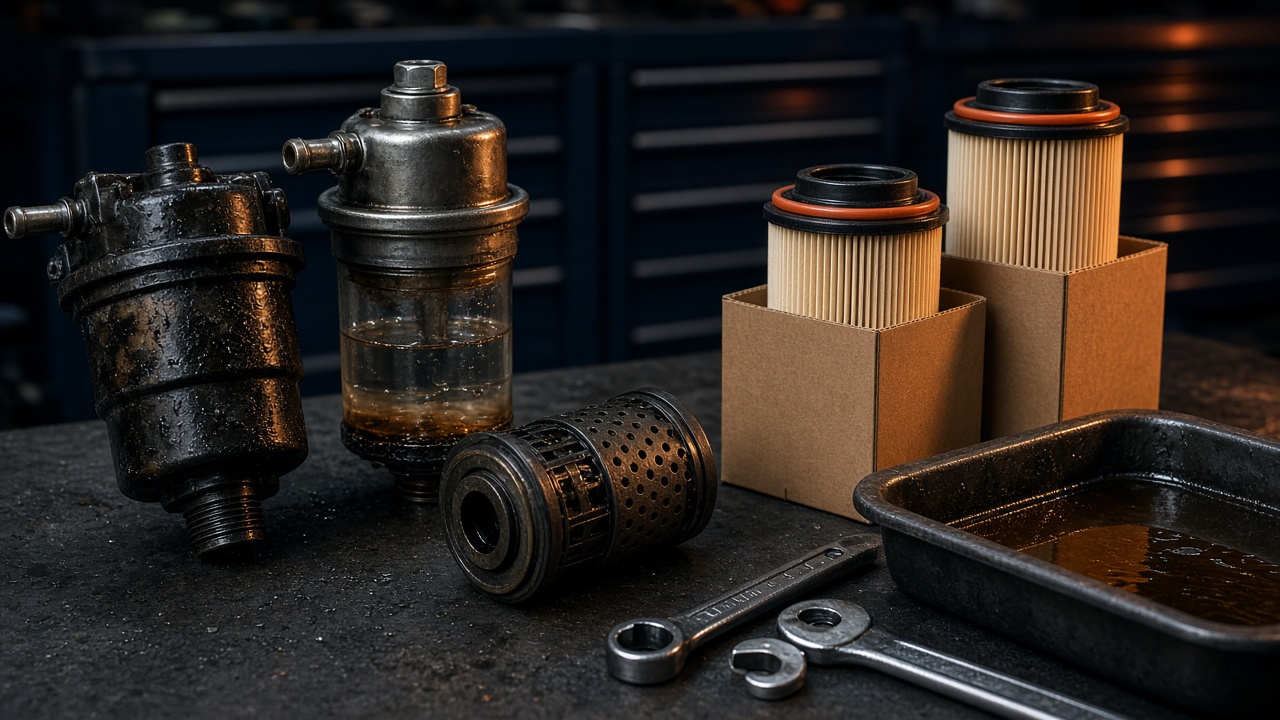
Change Cummins ISX15 primary and secondary fuel filters every 25,000 miles or 750 hours — whichever comes first. Detroit DD15 follows 25,000 miles standard, 15,000 severe. Paccar MX: 20,000–25,000 miles. Common-rail systems run 30,000–36,000 psi; a 7-micron particle scores injector plungers in hours. Biodiesel B11–B20 cuts intervals 50%. Replace both filters together (Fleetguard FS53000 + FF5825 on Cummins), prime with key-on 30 seconds before start, and drain the water separator weekly in humid climates.
Primary vs Secondary Filter Function
Primary (coarse): first stage from tank — catches large water and debris. Fleetguard FS53000 on many Cummins.
Secondary (fine): last stage before high-pressure pump — 5–7 micron. FF5825 Cummins, DD15 A0000904251.
Always replace both together — contaminated primary dumps load to new secondary.
OEM Interval Tables
Cummins ISX15/X15: 25,000 mi / 750 hr / 12 mo. Severe: 15,000 mi.
Detroit DD13/DD15: 25,000 mi standard, 15,000 severe.
Paccar MX: 20,000–25,000 mi per operator manual.
Use maintenance schedule tool for combined triggers.
Biodiesel and Fuel Quality Adjustments
B11–B20: shorten interval 50%, monitor water separator daily — biodiesel holds water.
Bulk tank algae (microbial): black slime in filter housing — treat tank, replace filters, sample fuel.
Water Separator Maintenance
Drain daily in humid climates, weekly highway. Automatic water-in-fuel sensors set SPN 97/98 on some platforms.
Sensor false alarm: drain and reset before replacing sensor ($120–$200).
Filter Change Procedure and Priming
Shut down, relieve system pressure — crack fitting carefully on older units.
Fill new filters with clean diesel before install — reduces dry start air.
Cummins: key on run 30 seconds without start to prime lift pump — do not crank dry.
Prime until tight at secondary outlet if manual primer cup equipped.
Start, check leaks 5 minutes, road test for power loss.
Symptoms of Restricted Fuel Filtration
Power roll-off under load, hard hot start, SPN 157 (fuel rail pressure low), white smoke on acceleration.
Restriction gauge on primary housing — replace at 8–12 in H2O differential per gauge spec.
Tank-Level Filtration and Fleet Storage
Bulk storage: 10-micron spin-on at dispenser, water absorption filters, tank sweep every 5 years.
Seasonal turnover — fuel older than 6 months in tank invites biological growth.
Parts Cost and Labor
Filter pair: $45–$90 OEM Fleetguard. Labor 0.5–1.0 hour shop. DIY $45 parts only.
Neglected filters leading to HP pump: $2,500–$4,500 plus injectors.
Integration With Injector Service
Always new filters before injector R&R — prevents immediate recontamination.
See injector replacement and cost breakdown.
Bulk Tank Microbial Treatment Protocol
If slime found in filter, treat bulk tank with biocide approved for diesel (Biobor JF) — follow concentration and soak time. Replace dispenser filters and vehicle filters on all trucks fueled from tank within 30 days.
Tank inspection manhole — look for rust scale and water bottom layer. Pump water before it reaches dispenser pickup.
Document tank treatment on fleet maintenance record — repeat in 90 days if humid climate.
Cummins ISX15 Filter Part Numbers
Primary: Fleetguard FS53000 (Cummins 4960347). Secondary: Fleetguard FF5825 (Cummins 5262313). Verify QSOL supersession by engine serial. Donaldson P551000/P551005 cross-reference available. Use OEM or Tier 1 filtration — counterfeit filters fail micron rating.
HP Fuel System Contamination Recovery
If slime or algae found in filter housing: treat bulk tank with biocide (Biobor JF), replace both vehicle filters, sample fuel from tank drain. Replace all six injectors if metallic debris found in secondary filter — collateral damage occurs within 50 miles of contaminated fuel event.
Priming Procedure Detail by Platform
Cummins: key on run 30 seconds (lift pump cycles) without cranking. Repeat twice if air persists. Detroit DD15: manual primer cup on secondary filter — pump until resistance, then 30 seconds key-on. Paccar MX: follow Cummins procedure on MX-13 with Cummins fuel system.
OEM Interval Cross-Reference Table
Cummins X15: oil 25,000 mi/750 hr, fuel filters 25,000 mi/750 hr, valve lash 150,000 mi, DPF ash check 250,000–400,000 mi. Detroit DD15: oil 25,000 mi, valves 35,000 mi EPA17. Paccar MX: oil 20,000–25,000 mi. Always use whichever-comes-first rule.
Severe Duty Interval Adjustments
Short haul under 40 miles, idle above 30%, dusty conditions, or biodiesel B11+ cut standard intervals 30–50%. Hour-heavy vocational trucks (refuse, concrete) trigger PM on hours before miles. Telematics alert at 90% of interval prevents overdue service.
Parts Specification and Sourcing
Use API CK-4 15W-40 minimum for 2020+ low-ash requirements. Fleetguard, Donaldson, or OEM filters — verify application by engine serial. Counterfeit filters circulate on marketplace sites with incorrect micron rating.
Seasonal and Environmental Adjustments
Cold weather: winter fuel blend, pre-season filter change, DEF heater verification. Hot climate: shorten oil interval 15% in sustained 100°F+ ambient. High-altitude: monitor turbo boost and EGR function — derate calibrations differ above 5,000 feet.
Fleet PM Tracking Best Practices
Spreadsheet or CMMS tracking per unit: last service date, hours, miles, next due for each subsystem. Color-code overdue items. Monthly fleet meeting reviewing units exceeding average cost per mile by 2x.
Torque Specification Reference
Fuel filter: hand tight plus 3/4 turn per can instruction — over-torque crushes gasket causing air ingestion. Oil drain plug: 25–35 ft-lbs depending on pan material. Valve cover: 18 in-lbs in cross pattern. Always verify in OEM manual by engine serial.
Contamination Prevention Protocol
Cap all open fuel and oil ports immediately during service. Use clean rags and dedicated funnels. Never reuse crush washers on HP fuel fittings. Store filters in sealed packaging until installation — shop air contamination loads new filters before install.
Seasonal Service Adjustments
Pre-winter (September): fuel filters, battery test, block heater check, DEF heater verification, coolant concentration test. Pre-summer (April): A/C performance, cooling system pressure test, air filter inspection for pollen loading, tire pressure adjustment for heat expansion.
Fluid Specification Quick Reference
Engine oil: API CK-4 15W-40 minimum (Shell Rotella T6, Mobil Delvac Extreme, Valvoline Premium Blue). Coolant: ethylene glycol 50/50 to -34°F, test with refractometer annually. DEF: API certified ISO 22241, 32.5% urea, store below 86°F. Power steering and brake fluid per OEM spec on cab chassis.
Filter Part Number Cross-Reference
Cummins ISX15: oil LF14000NN (Fleetguard), fuel primary FS53000, fuel secondary FF5825, air AF25708. Detroit DD15: oil LF14000NN equivalent, fuel A0000904251. Cross-reference Donaldson, Wix, and Baldwin equivalents in Fleetguard catalog — verify micron rating matches OEM spec.
Pre-Service Inspection Checklist
Before any PM service: pull active fault codes, check fluid levels, inspect for leaks, note tire condition, verify last service date against interval. After service: road test 5 minutes, re-check levels, reset maintenance reminder in ECM if equipped, update fleet tracking spreadsheet.
Record Keeping for Warranty and Resale
Maintain service records per unit: date, hours, miles, parts installed with part numbers, technician name, and next due dates. Buyers and warranty auditors request complete maintenance history. Digital records in fleet CMMS preferred over paper — searchable by VIN and date range.
Fleet PM Cost Benchmarking
Track cost per mile for PM services across fleet. Industry benchmark: $0.08–$0.15/mile all-in PM for Class 8 linehaul. Vocational fleets (refuse, dump) run $0.12–$0.20/mile due to hour-heavy duty cycle. Units exceeding fleet average PM cost by 50% warrant individual review — may indicate abuse, wrong duty cycle classification, or mechanical problem increasing wear rate.
Compare OEM scheduled maintenance cost against actual shop invoices quarterly. Adjust intervals based on oil analysis results and operating conditions rather than blindly following generic schedule.
Fleet PM Cost Benchmarking
Used Oil Disposal and Environmental Compliance
Collect used oil in labeled containers — never mix with coolant, fuel, or DEF. Used oil recycler pickup every 90 days for shops generating over 55 gallons. Manifest required for transport. Oil filter crushing: drain filter 24 hours before disposal, crush to remove residual oil. Violations: EPA fines $25,000+ for improper disposal.
DEF waste (contaminated or expired) is not used oil — separate container, label hazardous. Small quantities may go to hazardous waste collection event. Bulk DEF spill: contain with absorbent, do not wash into storm drain.
Tool Calibration and Measurement Accuracy
Torque wrenches: calibrate annually or after 5,000 cycles. Pressure gauges: verify against known reference quarterly. Refractometer for DEF: zero with distilled water before each use. Multimeter: verify against known voltage source monthly. Inaccurate measurements cause misdiagnosis — wrong torque strips threads, wrong DEF reading condemns good fluid.
Heavy-Duty Diesel Technical Reference
Cummins Platform Quick Reference
ISX15/X15 CM2350/CM2450: oil 25,000 mi/750 hr, fuel filters 25,000 mi/750 hr, valve lash 150,000 mi, DPF ash check 250,000–400,000 mi. Key SPNs: 3251 (DPF soot), 4364 (SCR efficiency), 3216 (NOx sensor), 1569 (derate), 641 (VGT actuator). INSITE required for regen, inducement reset, and injector coding. INLINE 7 or Nexiq USB-Link 3 adapter.
Detroit Platform Quick Reference
DD13/DD15/DD16 EPA17: oil 25,000 mi, valve adjustment 35,000 mi, DPF soot in grams (70g regen threshold). Key SPNs: same J1939 mapping as Cummins. DiagnosticLink required for static regen and aftertreatment reset. DDDL adapter or Nexiq pass-thru.
Common Torque Specifications
DPF V-band clamp: 18–25 ft-lbs. NOx sensor: 35–45 Nm. Fuel filter: hand tight plus 3/4 turn. Oil drain plug: 25–35 ft-lbs. Injector hold-down (X15): 37 ft-lbs. Turbo actuator mounting: per Holset spec in service manual. Over-torque on exhaust clamps crushes flanges causing repeat leaks.
Aftertreatment Temperature Reference
DPF active regen: exhaust outlet 1,000–1,200°F. SCR operation: inlet 400–650°F. DOC light-off: 350°F minimum. NOx sensor ready: 650–800°F internal cell temperature. Do not work on exhaust components below 150°F touch temperature — still causes burns. Allow 45-minute cool-down after highway operation before under-vehicle work.
DEF Specification Summary
API certified ISO 22241. Concentration: 32.5% urea ±0.5%. Freeze point: 12°F. Shelf life: 12 months at 75°F. Test with refractometer — not color or smell alone. Contaminated DEF is the leading root cause of SPN 4364. Drain and flush tank if concentration below 30%. Replace inline filter after any contamination event.
Electric Lift Pump Diagnostic
Weak lift pump mimics restricted filter: low rail pressure at idle, hard hot start, power roll-off under load. Test lift pump flow: disconnect line at secondary filter inlet, key on, measure flow into container — minimum 0.5 GPM in 30 seconds. Cummins lift pump in tank on some models — drop tank for access. Replace pump $150–$350 before condemning HP system.
Quick Reference Summary
Verify all repair work with OEM scan tool before returning unit to service. Document part numbers, labor hours, and measurements on work order. Customer communication on downtime and operational changes prevents repeat failures. Schedule follow-up scan at 500 miles for aftertreatment repairs to confirm monitor completion and code absence.
Frequently Asked Questions
Can I change only the primary filter?
Not recommended. Secondary catches what primary misses — paired change every service.
What happens if I over-tighten the filter?
Crushed gasket leaks air into system — hard start, air in rail. Hand tight plus 3/4 turn or per can instruction.
How do I know if fuel is contaminated?
Dark slime in bowl, frequent water drain, multiple trucks same pump failing injectors — test bulk tank.
Do electric lift pumps affect priming?
Yes — key-on prime cycle must complete. Weak lift pump mimics filter restriction — test flow 0.5 GPM minimum.
Winter filter changes more often?
Yes — wax and ice crystals load filters. Change before first freeze and mid-winter in northern fleets.
What Fleetguard filters fit Cummins ISX15?
Common pair FS53000 primary and FF5825 secondary — verify QSOL for your engine serial supersession.
Related tools: Use our maintenance schedule for quick estimates and planning.
Related reading: diesel preventive maintenance schedule, winter diesel maintenance checklist, replace diesel injector step by step.
Sources
- Cummins OM5012 — fuel filter intervals
- Detroit Diesel Bulletin 7SE270
- Fleetguard application guide
Related Reading
- diesel preventive maintenance schedule
- winter diesel maintenance checklist
- replace diesel injector step by step.
Verification Checklist Before Closing the Job
Photograph failed parts, log all meter and scan-tool readings on the work order, and retain freeze-frame data. Fleet and warranty audits reject claims without documented root-cause proof. Compare your readings to OEM service information for the specific engine serial number — mid-year calibration updates change test limits without changing the fault code definition.