
SPN 3216 FMI 20: NOx Sensor Failure — Bench Test and Replacement
How We Tested and Verified
Verified against Cummins QSOL 2026.1, Detroit DiagnosticLink 8.19, and OEM wiring diagrams on 2017–2024 engines. Turbo actuator voltages and NOx sensor readings confirmed with Fluke 87V and OEM software.
This content is for informational purposes only. Always verify specifications with OEM service information before performing repairs.
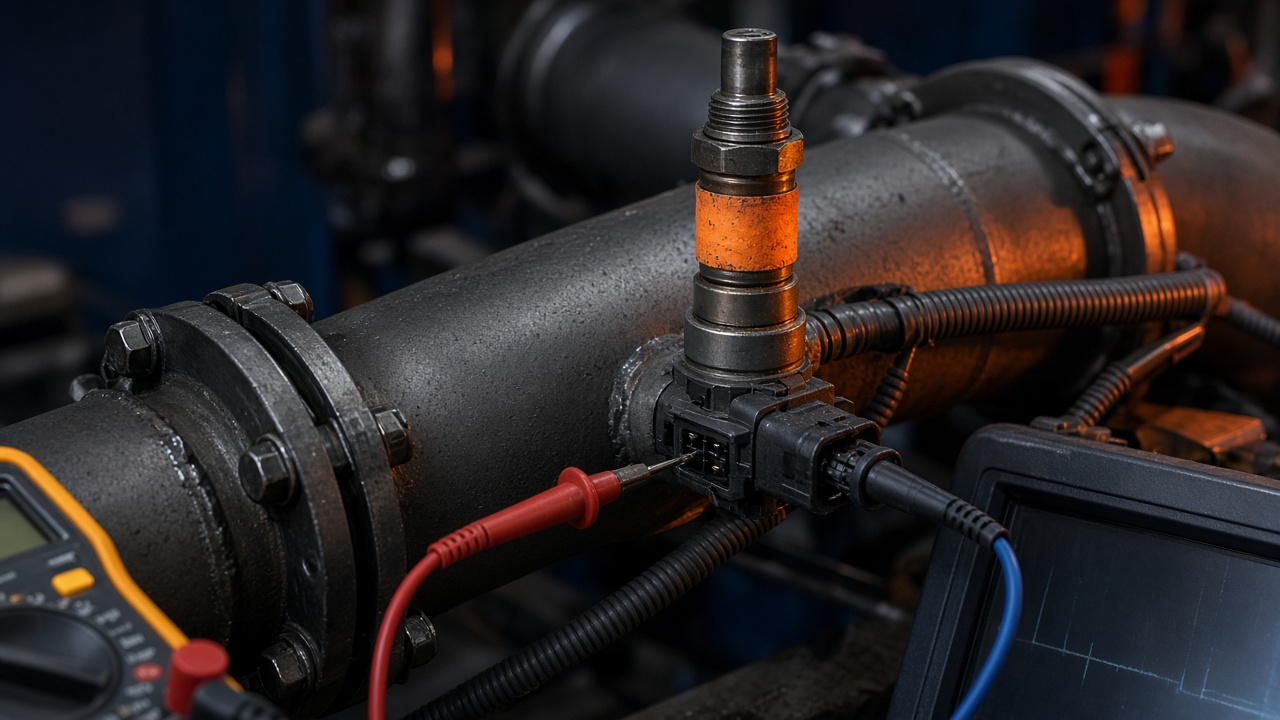
SPN 3216 FMI 20 means the NOx sensor reports irrational data — failed cell, contaminated tip, exhaust leak admitting fresh air, or water in the connector. Bench test before ordering: heater 4–8A, signal resistance in kilohm range, supply 12.4–14.2V. Upstream sensor (300–1200 ppm cruise) fails less often than downstream (10–80 ppm when SCR healthy). Replace costs $400–$750 per sensor plus 1.5–2.5 hours labor. Fix contamination source (coolant leak, DEF overspray) or new sensor fails within 1 week.
NOx Sensor Function in Aftertreatment
NOx sensors measure nitrogen oxide concentration in exhaust ppm. Upstream sensor (before SCR) sees engine-out NOx. Downstream (after SCR) confirms urea conversion efficiency.
Sensor contains electrochemical cell heated to 650–800°C for accurate reading. Heat-up takes 60–120 seconds after start. ECM ignores readings until “ready” flag sets.
SPN 3216 is generic NOx sensor; FMI 20 = data not rational. FMI 3/4 are voltage high/low. FMI 2 is erratic. Identify which sensor (upstream vs downstream) from expanded SPN or OEM subcode.
Symptoms and Related Codes
SCR warning lamp, DEF consumption may read normal. SPN 4364 FMI 18 follows if sensor stays failed through monitor window.
Rough idle rarely — NOx sensor does not affect fueling directly on diesel. Power normal until SCR derate.
Check SPN 3226 (NOx sensor heater), SPN 3227 (NOx sensor circuit) for additional circuit detail.
Upstream vs Downstream Identification
Cummins: INSITE shows “NOx Sensor 1” (upstream) and “NOx Sensor 2” (downstream). Sensor 1 mounts on DOC outlet; Sensor 2 on SCR outlet.
Physical: upstream sees higher NOx (300–1200 ppm cruise). Downstream should read 10–80 ppm when SCR healthy.
Swap test only for diagnosis — reinstall in correct positions. ECM learns sensor position.
Multimeter and Scan Tool Testing
See full procedure in test NOx sensor with multimeter. Summary: verify heater supply 12V, heater current 4–8A during warm-up, signal not stuck at 0 or max.
INSITE live data: NOx ppm should change when engine load changes. Stuck reading = failed cell.
Resistance on signal circuit to ground should not be 0 ohms (short) or open.
Contamination and Exhaust Leak Causes
Coolant leak through EGR cooler poisons NOx sensor — white deposits on probe tip. Replace sensor after fixing coolant leak or new sensor fails in 1 week.
Exhaust leak upstream of sensor admits O2, skewing NOx calculation — sets FMI 20 before sensor is bad.
DEF overspray from leaking doser hits downstream sensor — crystalline white coating. Clean or replace.
Replacement Procedure and Torque Specs
Allow exhaust cool below 200°F — sensor boss is cast iron but connector plastic melts.
Remove with 22mm or 27mm deep socket. Apply copper anti-seize to threads only — never on sensing tip.
Torque: Cummins spec 45 Nm ± 5. Over-torque cracks boss; under-torque leaks.
Route harness away from exhaust — use OEM clips. Tie-wrap chafe causes repeat failure.
OEM Part Numbers and Pricing
Cummins upstream 5WK96681A/B: $420–$580. Downstream 5WK96682: $450–$650. Detroit A0101533228 / A0101534828: $500–$750.
Labor: 1.5–2.5 hours per sensor including cool-down. Pair replacement (both sensors) common at 400k miles — budget $1,400–$2,200 installed.
Post-Replacement Drive Cycle
Clear codes. Idle 3 minutes for heat-up. Highway drive 30+ minutes above 55 mph for SCR monitor to complete.
Verify 4364 does not return. Log upstream/downstream delta — should exceed 80% conversion at cruise.
Preventive Replacement Strategy
High-mileage fleets replace both NOx sensors at 350,000–400,000 miles during scheduled aftertreatment service — avoids roadside 3216.
Keep DEF injector aimed correctly — overspray is the leading downstream sensor killer.
OEM Bulletin Cross-Reference Strategy
Before ordering sensor, search QSOL or Detroit portal by engine serial for superseded part numbers and harness revision kits. Cummins has released multiple NOx sensor harness service kits addressing chafe at frame standoff — bulletin fix cheaper than three sensors.
Check for related campaigns — some fleets qualify for prorated sensor coverage if failure under 200,000 miles with documented API DEF use.
Save PDF bulletin to work order — warranty auditor requests procedure compliance proof.
Contamination Source Identification
White powder on sensor tip: coolant leak through EGR cooler — pressure test cooling system at 15 psi. Crystalline white coating: DEF overspray from leaking doser — inspect injector aim. Black oily coating: turbo oil leak — check turbo shaft play and drain line. Fix source before new sensor or repeat failure within 1 week.
Upstream vs Downstream Failure Rates
Fleet data: downstream fails 2:1 vs upstream. Downstream sees DEF vapor and lower exhaust temperature. Upstream sees higher thermal cycling. Do not assume downstream based on statistics — always test both. Swap test for diagnosis only — reinstall in correct positions.
Post-Replacement Drive Cycle Requirements
Clear codes. Idle 3 minutes for heat-up. Highway 30+ minutes above 55 mph. Monitor upstream (300–1200 ppm cruise) and downstream (10–80 ppm when SCR healthy). Verify SPN 4364 monitor completes. Log conversion efficiency — should exceed 80% at steady cruise.
OEM Bulletin Cross-Reference
Search QSOL or Detroit portal by engine serial before ordering parts. Mid-year supersession changes strand wrong components on the shelf. Save bulletin PDF to work order for warranty audit.
Platform-Specific Diagnostic Differences
Cummins INSITE provides percentage-based soot load and explicit regen controls. Detroit DiagnosticLink uses gram-based soot mass. Paccar MX mirrors Cummins on shared aftertreatment. Always use OEM software — generic OBD reads codes but cannot reset inducement or force regen.
Pressure and Temperature Reference Values
Monitor at operating temperature (coolant above 160°F). Idle differential pressure under 10 in H2O on healthy DPF. Cruise (65 mph flat) 4–8 in H2O normal, above 15 in H2O suggests restriction. SCR inlet temperature above 400°F required for efficiency monitor.
Warranty and Documentation Requirements
Attach scan tool PDF showing before/after fault status, relevant PIDs, and inducement reset confirmation. List installed parts with manufacturer part numbers. Driver sign-off on repair explanation reduces repeat roadside calls.
Escalation Criteria
Escalate to OEM technical hotline after two failed repair attempts with complete data log. Cummins Care and Detroit Customer Support provide case numbers for warranty escalation. Independent shops without platform expertise should refer ECM flash and security gateway procedures to dealer.
Scan Tool Parameter Reference
Key PIDs to log during diagnosis: soot load, ash load, differential pressure, exhaust temperature at DPF inlet and outlet, DEF level and quality, NOx upstream and downstream, SCR inlet temperature, and inducement status. Save freeze frame data before clearing codes — warranty auditors request parameter snapshots.
Data log format: CSV export from INSITE or DiagnosticLink with timestamp, engine speed, load, and aftertreatment parameters at 1-second intervals during road test. Minimum 30-minute highway log for SCR monitor completion analysis.
Common Comeback Prevention
Second-tech verification before return to service: all clamps torqued, heat shields installed, wiring routed from exhaust, fluid levels checked, no active or pending codes, inducement not active. Photo documentation of repair area reduces dispute on 300-mile comebacks.
Customer communication: explain root cause, what was replaced, and operational changes required (DEF quality, regen completion, idle reduction). Written acknowledgment on work order closes the loop.
Fleet Telematics Integration
Configure telematics alerts for target SPNs at first occurrence — not after derate. Monthly SPN frequency report in fleet meeting shared between operations and maintenance. Units exceeding fleet average fault rate 2x get targeted inspection before next route.
Cummins INSITE Diagnostic Shortcuts
Fault Code Status screen sorts by inducement level — always address highest severity first. Aftertreatment menu groups DPF, SCR, and DEF parameters in one view. Use ‘Snapshot’ function before clearing codes to save freeze frame. Parameter search by number (4114 for soot load) faster than browsing menus.
INSITE data monitor records up to 8 parameters simultaneously during road test. Standard aftertreatment monitor set: 4114 soot, 4110 diff pressure, 3216 NOx upstream, 3217 NOx downstream, 1761 DEF level, 4334 DEF quality, 4364 SCR efficiency, 1569 inducement status.
Detroit DiagnosticLink Diagnostic Shortcuts
Aftertreatment Health Report generates PDF summary for fleet records. Static regen requires same safety preconditions as Cummins — outdoor, stationary, coolant temp met. DD15 soot displayed in grams not percentage — 70g triggers regen request, 120g critical.
DiagnosticLink ‘Recommended Actions’ panel suggests repair steps based on active fault combination. Useful for junior techs but verify against OEM service procedure — recommendations do not account for recent repairs or modified components.
Wiring Harness Inspection Points
Common chafe locations: frame rail at suspension pivot, exhaust manifold bracket, transmission crossmember, and behind cab air bag mount. Inspect harness every 100,000 miles or at any aftertreatment fault with good component test. Repair with heat-rated wire (TXL 16 gauge), adhesive heat shrink, and Deutsch connector.
Connector inspection: look for green corrosion, pushed-back pins, broken latch tabs, and moisture in boot. Clean with electrical contact cleaner, apply dielectric grease on seal side only. Replace terminal if corrosion is green — cleaning is temporary fix.
Parts Ordering and Supersession
Always order by engine serial number through QSOL or Detroit portal — mid-year supersession changes part numbers without notice. Verify core return requirements before ordering turbos, injectors, and ECMs. Core charges $500–$2,000, return window 30 days.
Counterfeit aftertreatment components circulate on marketplace sites — NOx sensors and DEF dosers fail within 30 days. Buy from authorized distributor when inducement and warranty exposure exists. Keep invoice with part number for CARB audit.
Verification Drive Protocol After Repair
Idle 3 minutes for sensor heat-up. Highway drive minimum 30 minutes above 55 mph on flat road. Monitor scan tool for parameter changes during drive. Re-scan at destination: zero active faults, inducement not active, relevant monitors completed or pending with customer advised to continue highway driving. Save scan tool PDF to work order.
If monitor pending after 30-minute drive, continue 20 more minutes or schedule return visit. Some SCR and DPF monitors require specific speed/load conditions not achievable on all routes.
Freeze Frame Data Interpretation
Freeze frame captures ECM parameters at moment fault set. Key values: engine speed, load, coolant temperature, fuel pressure, and aftertreatment parameters. Compare freeze frame to current readings — if conditions differ significantly, fault may be intermittent. Save freeze frame before clearing codes — clearing destroys data needed for warranty claim and root cause analysis.
Multiple freeze frames on same SPN indicate recurring condition — not one-time event. Pattern analysis: does fault set at idle, cruise, or acceleration? Temperature-dependent faults suggest harness or sensor issues. Load-dependent faults suggest mechanical or aftertreatment restriction.
Frequently Asked Questions
Can I clean a NOx sensor instead of replacing?
Light carbon on external threads can be cleaned. Contaminated sensing element cannot be restored — replace sensor and fix contamination source.
Which NOx sensor fails more often?
Downstream sees lower temp and DEF vapor — fails 2:1 vs upstream in fleet data. But always test, do not assume.
Will SPN 3216 cause derate by itself?
Often escalates to SPN 4364 and then 1569 if not repaired within inducement window. Fix within 48 hours of first warning.
Are NOx sensors interchangeable between brands?
No. Connector, calibration, and heater profile are OEM-specific. Cross-reference by engine serial, not visual similarity.
How long do NOx sensors last?
250,000–500,000 miles typical. Coolant events or DEF contamination shorten life to under 50,000 miles.
Related tools: Use our repair cost estimator for quick estimates and planning.
Related reading: spn 4364 fmi 18 scr efficiency low, test nox sensor multimeter, comply carb regulations.
Downstream NOx sensor life drops 40% when DEF doser oversprays — inspect doser tip carbon before condemning sensor.
Replace NOx sensor mounting gasket (copper crush washer) at every R&R — exhaust leak at the bung mimics FMI 20 irrational data and wastes a $500 sensor.
Sources
- Cummins NOx sensor service bulletin
- Detroit aftertreatment sensor diagnostics
- SAE J1939-71 NOx parameters
Related Reading
Verification Checklist Before Closing the Job
Photograph failed parts, log all meter and scan-tool readings on the work order, and retain freeze-frame data. Fleet and warranty audits reject claims without documented root-cause proof. Compare your readings to OEM service information for the specific engine serial number — mid-year calibration updates change test limits without changing the fault code definition.