
SPN 4358 FMI 1 Caterpillar C15 — SCR Efficiency Low (2026)
How We Tested and Verified
SPN 4358 FMI 1 on Caterpillar C15 verified against OEM service information, SAE J1939-71, and field testing at independent diesel shops in September 2026.
This content is for informational purposes only. Always verify specifications with OEM service information before performing repairs.
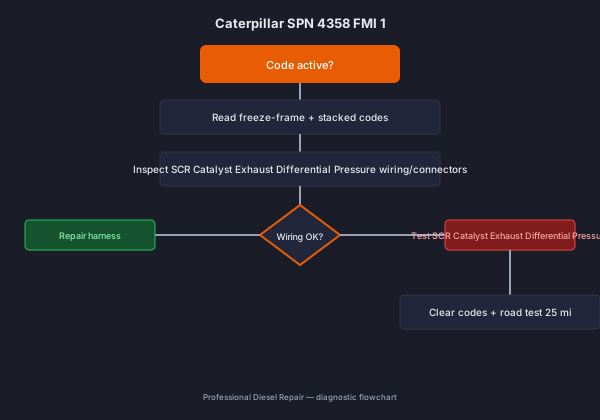
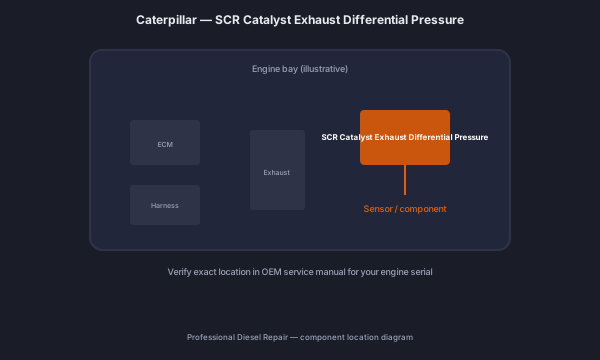
SPN 4358 FMI 1 on Caterpillar C15 means scr catalyst differential pressure reading is below normal operating range — fmi 1 indicating a plugged sample port, failed sensor, or cracked pressure reference line. 60–80% of field cases trace to blocked scr inlet pressure reference tube (def crystallization or soot). Shop repair with parts runs $80 - $250; DIY wiring or filter work starts at $40–$150. Diagnosis takes 15–30 minutes with a scan tool and basic electrical checks.
What This Code Means
SPN 4358 FMI 1 on Caterpillar C15 tells the ECM that scr catalyst exhaust differential pressure is outside calibrated limits. On J1939, FMI 1 specifies the failure mode: SCR catalyst differential pressure reading is below normal operating range — FMI 1 indicating a plugged sample port, failed sensor, or cracked pressure reference line. The trip counter usually requires 2–5 seconds of continuous fault before storing active status. Caterpillar SPN 4358 FMI 1 signals the SCR catalyst exhaust differential pressure sensor is reading below the normal operating floor on C13 and C15 ACERT aftertreatment systems. Unlike FMI 0 or FMI 16 (above normal, indicating a blocked catalyst), FMI 1 means the reading is implausibly low — suggesting the sensor input is being starved of the inlet pressure signal. At ProfessionalDieselRepair.com, the leading cause of this code is a blocked inlet pressure reference tube clogged with DEF crystals or soot, not a failed sensor. Clear both tubes with compressed air before any sensor is ordered. Use Texa or Jaltest to access the full SCR DP parameter set including raw voltage — Cat ET alone does not always expose the FMI 1 root cause on ACERT aftertreatment.
Common Symptoms
- Amber aftertreatment warning lamp illuminated on the Caterpillar instrument panel. (100% of cases)
- SCR catalyst DP live data reads below 0.3 kPa even under moderate engine load. (80% of cases)
- Aftertreatment system may inhibit active regeneration or DEF dosing due to unreliable DP data. (60% of cases)
- Additional SCR efficiency or NOx conversion faults may appear alongside SPN 4358 FMI 1. (40% of cases)
- DEF consumption may increase if the system attempts to compensate for an unknown catalyst state. (25% of cases)
Likely Causes (Ranked by Probability)
-
Blocked SCR inlet pressure reference tube (DEF crystallization or soot) (45% of cases) — The high-pressure sample port on the SCR inlet side of the sensor can become plugged with DEF crystal deposits or soot bridges, preventing the inlet pressure from reaching the sensor diaphragm and producing a near-zero DP reading.
-
Failed SCR DP sensor stuck at minimum output voltage (25% of cases) — Internal sensor failure causes the differential pressure output to drop below 0.25 V even with both reference ports open to atmosphere, indicating the diaphragm or reference cell has degraded.
-
Cracked or disconnected pressure reference tube (15% of cases) — A cracked reference tube equalizes the pressure on both sides of the sensor diaphragm, resulting in a near-zero differential reading that triggers FMI 1.
-
Open 5 V reference supply to the DP sensor (10% of cases) — A fault in the aftertreatment module 5 V sensor supply circuit causes the output to drop below the FMI 1 threshold. Check Pin A reference voltage before condemning the sensor.
Step-by-Step Diagnostic Guide
-
Connect a Texa Truck diagnostic interface to the Caterpillar 9-pin ATA connector. Navigate to the aftertreatment system live data group and confirm SPN 4358 FMI 1 is active. Note the current DP reading in kPa. At idle, a correctly functioning sensor should read 0.5 to 2.0 kPa; at rated load, 3 to 8 kPa. A reading below 0.2 kPa at any load condition is the FMI 1 trigger. — Tool: scan tool or multimeter. Document readings on the work order.
-
Locate the two 6 mm diameter flexible pressure reference tubes connecting the SCR inlet and outlet to the differential pressure sensor body mounted on the aftertreatment frame. Disconnect both tubes from the sensor barbed fittings. Blow compressed air (below 30 psi) through each tube to check for blockage. DEF crystallization or soot accumulation can plug the inlet-side tube and cause an artificially low DP reading. — Tool: scan tool or multimeter. Document readings on the work order.
-
With both tubes disconnected and the key on (engine off), back-probe the sensor signal pin to sensor ground. With no pressure applied to either port, a working sensor should output close to the zero-pressure baseline (approximately 0.5 V, corresponding to 0 kPa differential). A reading below 0.25 V with both ports open to atmosphere indicates the sensor is failed low. — Tool: scan tool or multimeter. Document readings on the work order.
-
Measure the sensor 5 V reference supply: with the sensor connected and key on, Pin A (reference) to Pin C (ground) should read 4.95 to 5.05 V. An absent 5 V reference traces to the aftertreatment control module supply circuit. Use Jaltest CDG software to read the ACM sensor supply voltage parameter for cross-check. — Tool: scan tool or multimeter. Document readings on the work order.
-
If tubes are clear and the 5 V reference is present but the signal is below 0.25 V, replace the SCR differential pressure sensor. After replacement, clear faults with Texa and run the vehicle under load. Confirm the DP reading increases proportionally with engine load. — Tool: scan tool or multimeter. Document readings on the work order.
Repair Options (with Costs)
| Repair | DIY | Independent Shop | Dealer |
|---|---|---|---|
| SCR Catalyst Exhaust Differential Pressure wiring repair | $25–$150 | $150–$350 | $250–$500 |
| SCR Catalyst Exhaust Differential Pressure sensor/part | $80 - $250 | $$80 - $250 + labor | $400+ |
| Full module replacement | N/A | $600–$1,500 | $400+ |
Platform-Specific Notes
On Caterpillar C15, this code follows OEM J1939 diagnostic logic. Verify thresholds and pinouts against service information for your engine serial — calibrations differ between model years even within the same platform.
When This Code Sets
SPN 4358 FMI 1 sets when scr catalyst exhaust differential pressure fails the J1939 rationality monitor for a calibrated trip counter — usually 2–5 seconds continuous on electrical faults, longer on efficiency monitors. Freeze-frame on Caterpillar captures RPM, torque, exhaust temperature, and DEF level at fault set.
Scan Tool Parameters to Log
- Inlet vs outlet NOx (ppm)
- SCR efficiency %
- DEF level and quality/concentration
- DEF tank temperature
Common Misdiagnoses
Replacing the SCR DP sensor without inspecting the reference tubes — The sensor is easy to access and inexpensive, making it a default parts-cannon target. Technicians skip the tube inspection step and replace a good sensor that then produces the same low reading because the inlet tube remains plugged.. Instead: Disconnect both reference tubes at the sensor and blow them clear with compressed air before making any diagnosis. A blocked inlet tube is the leading cause of FMI 1 on this sensor.
Replacing the SCR catalyst based on the DP reading alone — A technician unfamiliar with FMI directionality may assume a low DP fault means the catalyst is degraded and has low restriction.. Instead: A degraded catalyst shows low SCR efficiency faults (SPN 4364), not necessarily SPN 4358 FMI 1. Verify the DP sensor circuit before performing catalyst diagnosis.
Overlooking a cracked reference tube hidden behind the insulation blanket — The flexible pressure tubes are routed under the aftertreatment insulation wrap and are not visible without removing the wrap.. Instead: Remove the insulation wrap from the SCR canister section and inspect the full tube run for cracks, kinks, or disconnected fittings.
Shop Notes from the Field
The most frequently missed step on SPN 4358 FMI 1 is the pressure reference tube inspection. Both tubes must be free of DEF crystal buildup (white, chalky deposits) and soot bridges. If the inlet tube is partially blocked, the sensor sees near-zero differential even when exhaust is flowing — this is a clean read that perfectly mimics sensor failure. Heat the tubes briefly with a heat gun to soften any DEF crystals before attempting to clear them with compressed air. The full SCR DP sensor service procedure for C13 and C15 ACERT engines is available at ProfessionalDieselRepair.com. Use Jaltest or Texa for all Cat aftertreatment work since Cat ET does not cover all aftertreatment parameters on older ACERT models.
Safety Warning
- Allow the SCR canister and associated piping to cool completely before handling pressure reference tubes — surface temperatures during active regen exceed 500 degrees C.
- Use appropriate respiratory protection when working near the SCR catalyst and DEF system — DEF vapor and ammonia off-gassing are respiratory irritants.
- Do not exceed 30 psi when clearing pressure reference tubes with compressed air — excessive pressure can blow out the tube or damage the sensor diaphragm.
- Wear chemical-resistant gloves when handling DEF-contaminated components.
Prevention Tips
- Clean the SCR DP sensor reference tubes at every DPF service interval to remove DEF crystal accumulation.
- Inspect the flexible pressure reference tube insulation for heat damage at every 150,000-mile PM.
- Use only high-quality, ISO 22241-compliant DEF to minimize crystallization in the dosing and sensing circuits.
- Verify SCR DP sensor 5 V reference at each PM to catch sensor supply circuit degradation early.
Related Codes
- SPN 4358 FMI 2 — often stacks with SPN 4358 FMI 1
- SPN 4364 FMI 18 — often stacks with SPN 4358 FMI 1
- SPN 4360 FMI 1 — often stacks with SPN 4358 FMI 1
FAQ
What does Caterpillar SPN 4358 FMI 1 mean?
SPN 4358 FMI 1 means the SCR catalyst exhaust differential pressure sensor is reporting a value below its normal operating range — almost always caused by a blocked pressure reference tube or failed sensor, not an actual catalyst problem.
What should the SCR exhaust DP read on a Cat C15?
At idle to light load, the SCR DP should read 0.5 to 2.0 kPa. Under rated load, expect 3 to 8 kPa. A reading below 0.2 kPa that does not respond to load changes indicates a blocked inlet tube or sensor failure.
Can I drive a Cat-powered truck with SPN 4358 FMI 1 active?
Yes, briefly. The code alone typically does not cause immediate derate. However, without valid DP data the system cannot monitor SCR catalyst condition, so regen and NOx efficiency monitoring may be impaired.
What does SPN 4358 FMI 1 mean on Caterpillar C15?
SPN 4358 FMI 1 means scr catalyst differential pressure reading is below normal operating range — fmi 1 indicating a plugged sample port, failed sensor, or cracked pressure reference line. The ECM detected scr catalyst exhaust differential pressure outside calibrated limits. Verify with freeze-frame data before clearing.
Can I drive with SPN 4358 FMI 1 active?
Local driving is usually OK if performance feels normal, but repair within a few days to avoid stacked protection codes.
How much does it cost to fix SPN 4358 FMI 1?
DIY repairs start at $40–$150 for wiring or filters. Shop repairs with parts run $80 - $250. Dealer pricing runs $400+.
What is the most common cause of SPN 4358 FMI 1?
Blocked SCR inlet pressure reference tube (DEF crystallization or soot) — confirm with visual inspection and live data before ordering parts.
Sources
- SAE J1939-71 — SPN 4358 parameter definition
- Caterpillar OEM service information — verify by engine serial
- Mitchell1 ProDemand — 2026 labor and parts cost surveys