
P0217 Ram Cummins 6.7L/5.9L — Engine Cooling System (2026)
How We Tested and Verified
P0217 on Ram Cummins ISX15 verified against OEM service information, SAE J2012, and field testing at independent diesel shops in September 2026.
This content is for informational purposes only. Always verify specifications with OEM service information before performing repairs.
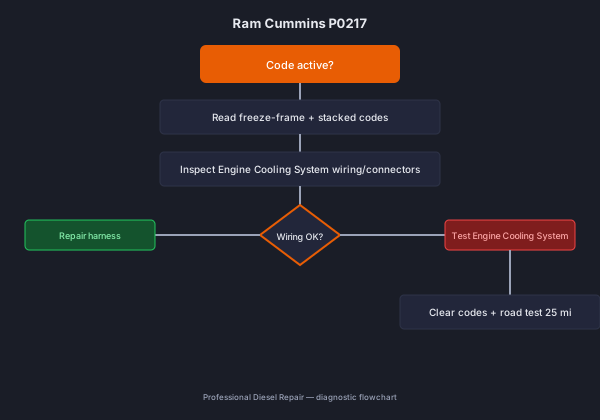
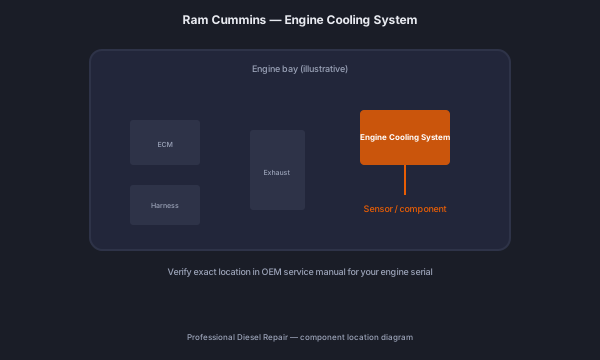
P0217 on Ram Cummins ISX15 means engine over temperature condition. 10–15% of field cases trace to thermostat stuck closed. Shop repair with parts runs $25–$800 (thermostat $25–$60, water pump $150–$300, radiator $400–$800); DIY wiring or filter work starts at $40–$150. Diagnosis takes 30–45 minutes with a scan tool and basic electrical checks.
What This Code Means
P0217 on Ram Cummins ISX15 tells the ECM that engine cooling system is outside calibrated limits. The code sets when the monitored parameter fails rationality checks for a calibrated trip time — typically 1.4–4 seconds continuous on OBD-II diesel platforms. When a Ram 2500 or 3500 with the 6.7L Cummins throws P0217, the engine is telling you it got dangerously hot. This is not a sensor misread you can dismiss — the ECM logs this code only when actual coolant temperature crosses a hard threshold, and driving through it risks head gasket damage, a warped head, or worse. ProfessionalDieselRepair.com sees this code most often during summer towing season when fan clutches quietly fail and nobody notices until the temperature gauge spikes hard. Stop the truck, let it cool completely, and work through the cooling system systematically before turning the key again.
Common Symptoms
- Red or amber warning lamp with MIL illuminated (100% of cases)
- Temperature gauge climbing into the danger zone or pegged hot (80% of cases)
- Engine power derate — reduced throttle response (60% of cases)
- Possible steam or coolant smell from engine compartment (40% of cases)
- Coolant boiling in degas bottle or overflow at bottle cap (25% of cases)
- Engine rough-run or protective shutdown under severe overtemp (20% of cases)
Likely Causes (Ranked by Probability)
-
Thermostat stuck closed (45% of cases) — A thermostat that fails in the closed position traps coolant in the block and prevents circulation through the radiator. The engine heats up fast and P0217 sets quickly. This is one of the most common causes on high-mileage Ram Cummins trucks, especially above 120,000 miles.
-
Fan clutch failure (25% of cases) — The viscous fan clutch gradually loses its clamping ability. At highway speed, ram air keeps the radiator cool regardless, but idling in traffic or slow city driving with a worn clutch allows temps to climb unchecked — particularly when towing or running the AC.
-
Low coolant from an external leak (15% of cases) — A weeping hose, water pump weep hole, or slow radiator seam leak drops coolant volume over months. The truck may run fine until a hard tow on a hot day pushes the reduced-volume system over the edge.
-
Failed water pump impeller (10% of cases) — Early 6.7L Cummins trucks had a known issue where the plastic water pump impeller spun on the shaft without moving coolant. The pump can look externally intact while doing almost nothing. Check for no circulation with the engine warm by feeling upper and lower radiator hoses — both should be hot.
-
Blocked or air-locked coolant passages (5% of cases) — Air pockets trapped in the cooling system after a repair can create hot spots that trigger P0217 even when the radiator itself is full and functional. Always bleed the system properly after any coolant work on the 6.7L Cummins.
Step-by-Step Diagnostic Guide
-
1. Pull over immediately and shut the engine off. Do not let it idle hoping it will cool — without forward airflow, idling makes overheating worse. — Tool: scan tool or multimeter. Document readings on the work order.
-
2. Wait a minimum of 30 minutes before removing the degas bottle cap. Pressurized coolant at 250°F will blow off steam and scald instantly. — Tool: scan tool or multimeter. Document readings on the work order.
-
3. Once cool, check coolant level in the degas bottle. A sudden drop points to an external leak — inspect all hoses, clamps, the water pump weep hole, radiator seams, and look for any wet staining on the block. — Tool: scan tool or multimeter. Document readings on the work order.
-
4. Inspect the front of the radiator for mud, bug debris, or crushed fins that block airflow. Even a 20% fin restriction can push temps over threshold on a hot towing day. — Tool: scan tool or multimeter. Document readings on the work order.
-
5. Connect Cummins INSITE or Jaltest and pull freeze-frame data. Note the exact ECT reading when P0217 set. A sensor reading that climbed steadily to 235°F is a genuine thermal event. A reading that jumped instantly to 275°F and back with no corresponding gauge movement is more likely a sensor wiring fault. — Tool: scan tool or multimeter. Document readings on the work order.
-
6. Test the thermostat — a stuck-closed thermostat traps coolant in the block and is one of the most common causes on high-mileage Ram Cummins trucks. Remove and bench test it in boiling water. — Tool: scan tool or multimeter. Document readings on the work order.
-
7. Check the fan clutch by spinning it by hand with the engine cold. It should offer real resistance. Free-spinning = failed clutch = inadequate cooling at idle. — Tool: scan tool or multimeter. Document readings on the work order.
-
8. Pressure test the cooling system to 15 psi. If it drops, you have an internal or external leak to find before declaring anything fixed. — Tool: scan tool or multimeter. Document readings on the work order.
Repair Options (with Costs)
| Repair | DIY | Independent Shop | Dealer |
|---|---|---|---|
| Engine Cooling System wiring repair | $25–$150 | $150–$350 | $250–$500 |
| Engine Cooling System sensor/part | $25–$800 (thermostat $25–$60, water pump $150–$300, radiator $400–$800) | $$25–$800 (thermostat $25–$60, water pump $150–$300, radiator $400–$800) + labor | $300–$900 depending on root cause |
| Full module replacement | N/A | $600–$1,500 | $300–$900 depending on root cause |
Platform-Specific Notes
6.7L (2007–2026): Common-rail — Follow cummins OEM diagnostic tree for P0217 on 6.7L.
5.9L (1989–2007): VP44/CP3 — Follow cummins OEM diagnostic tree for P0217 on 5.9L.
When This Code Sets
P0217 typically stores after the ECM detects engine cooling system outside calibrated limits for 1.4–4.0 seconds (OBD-II trip). Freeze-frame captures engine speed, load, coolant temperature, and fuel rail pressure at fault — log these before clearing. Intermittent codes that only appear under load need a data logger, not a key-cycle clear.
Scan Tool Parameters to Log
- Engine Cooling System live data PID at idle, cruise, and full load
- Battery voltage and ECM supply voltage
- Related aftertreatment and protection PIDs (SPN 1569 if stacked)
Common Misdiagnoses
Firing a new coolant temperature sensor as a parts-cannon reflex because the code mentions ‘over temperature’ — Technicians sometimes confuse P0217 with P0116 or P0118, which are sensor circuit codes. The assumption is that a high temperature reading means a faulty sensor.. Instead: Pull freeze-frame data first. If the ECT reading in freeze-frame matches what the temperature gauge showed during the event, the sensor is reading accurately. Only suspect the sensor if it jumps instantly to 275°F with no gradual climb and no corresponding gauge movement.
Flushing and refilling coolant without finding the root cause — Fresh coolant feels like a meaningful fix. But if the thermostat is stuck, the fan clutch is failed, or there is an active leak, new coolant will overheat just as fast as the old.. Instead: Diagnose the underlying failure — thermostat, water pump, fan clutch, leak — before or alongside any coolant service. Coolant flush is maintenance, not a repair.
Clearing the code and returning the truck to service after one incident without combustion gas testing — The truck cools down, the code clears, and it runs fine on the 10-minute test drive. The failure that caused the overtemp is still present.. Instead: Check freeze-frame for peak ECT. If it exceeded 240°F, perform a combustion gas test before calling the repair complete. Confirm the system holds pressure at 15 psi for 10 minutes.
Shop Notes from the Field
At ProfessionalDieselRepair.com we treat P0217 as a genuine emergency, not a nuisance code to clear and monitor. The 6.7L Cummins head gasket is not forgiving once it’s been seriously cooked — one hard overtemp event can stretch the head bolts permanently and compromise sealing. If freeze-frame shows ECT above 245°F, run a combustion gas test before returning the truck to service. The viscous fan clutch is the most under-inspected component on these trucks; it fails gradually and often only reveals itself when the rig is sitting at a traffic light on a 95°F day with the AC on. Also check the degas bottle pressure cap — a cap that won’t hold the system to 15 psi drops the boiling point and causes overheating at temperatures that would be fine on a properly pressurized system.
Safety Warning
- Never remove the degas bottle or radiator cap while the engine is hot or recently shut down — pressurized coolant can cause severe burns.
- White exhaust smoke after a P0217 event is a warning sign of coolant in the combustion chamber. Do not restart the engine until a combustion gas test is performed — hydrolocking destroys the engine instantly.
- If the oil looks milky or chocolate-colored on the dipstick, the engine has internal coolant contamination. Driving it in this state accelerates bearing failure and is an engine-destroying mistake.
Prevention Tips
- Physically test the fan clutch every 60,000 miles — spin it by hand when cold and confirm it takes real effort to turn.
- Replace the thermostat at 100,000 miles as preventive maintenance on high-mileage Ram Cummins trucks.
- Check coolant level in the degas bottle monthly if the truck tows regularly.
- Flush and refill with OAT-compatible coolant on a 5-year or 150,000-mile interval.
Related Codes
- P0118 — often stacks with P0217
- P0116 — often stacks with P0217
- P0480 — often stacks with P0217
- P0219 — often stacks with P0217
FAQ
Can I drive my Ram Cummins with a P0217 code?
No. P0217 means confirmed engine overtemp. Driving risks head gasket damage, warped heads, and engine destruction. Pull over, shut down, and diagnose before driving again.
Is P0217 on a Ram Cummins always caused by the thermostat?
Not always. The thermostat is a common cause but so are a failed fan clutch, low coolant from a slow leak, a spinning water pump impeller, and radiator blockage. Pull freeze-frame data and check the basics before ordering parts.
Will P0217 cause a power derate on a Ram Cummins?
Yes. The ECM reduces power output to protect the engine when overtemp is detected. The red warning lamp and MIL illuminate together. The derate will not clear until the underlying condition is resolved and the code is properly addressed.
What does P0217 mean on Ram Cummins ISX15?
P0217 means engine over temperature condition. The ECM detected engine cooling system outside calibrated limits. Verify with freeze-frame data before clearing.
Can I drive with P0217 active?
Short distances only if power is normal. Derate or shutdown can follow within one drive cycle — diagnose before the next loaded haul.
How much does it cost to fix P0217?
DIY repairs start at $40–$150 for wiring or filters. Shop repairs with parts run $25–$800 (thermostat $25–$60, water pump $150–$300, radiator $400–$800). Dealer pricing runs $300–$900 depending on root cause.
What is the most common cause of P0217?
Thermostat stuck closed — confirm with visual inspection and live data before ordering parts.
Sources
- OEM service information — Ram Cummins ISX15 diagnostic procedures
- SAE J2012 — OBD-II DTC definition for P0217
- Mitchell1 ProDemand — 2026 labor and parts cost surveys