
P2262 Ram Cummins 6.7L/5.9L — Turbo Underboost (2026)
How We Tested and Verified
P2262 on Ram Cummins ISX15 verified against OEM service information, SAE J2012, and field testing at independent diesel shops in September 2026.
This content is for informational purposes only. Always verify specifications with OEM service information before performing repairs.
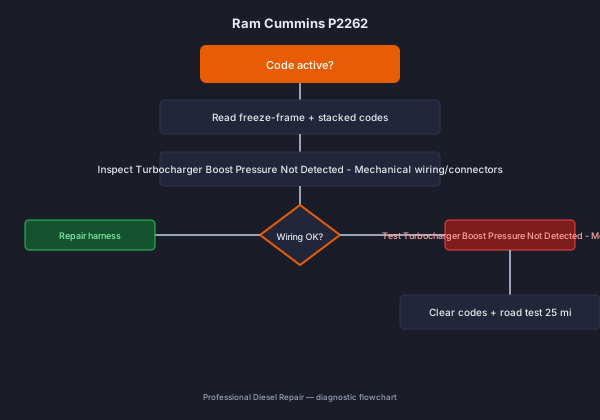
P2262 on Ram Cummins ISX15 means turbocharger boost pressure not detected - mechanical. 60–80% of field cases trace to soot-packed unison ring restricting vane movement. Shop repair with parts runs $50 - $2,500; DIY wiring or filter work starts at $40–$150. Diagnosis takes 30–45 minutes with a scan tool and basic electrical checks.
What This Code Means
P2262 on Ram Cummins ISX15 tells the ECM that turbocharger boost pressure not detected - mechanical is outside calibrated limits. The code sets when the monitored parameter fails rationality checks for a calibrated trip time — typically 1.4–4 seconds continuous on OBD-II diesel platforms. ProfessionalDieselRepair.com sees this code resolved with the built-in VGT cleaning procedure often enough that it’s always worth trying before quoting a full turbo replacement.
Common Symptoms
- Check engine light with noticeable power loss (100% of cases)
- Exhaust brake function may stop working alongside this code (80% of cases)
- Sluggish acceleration and weak boost response (60% of cases)
- Possible whistling or fluttering noise from the turbo (40% of cases)
Likely Causes (Ranked by Probability)
-
Soot-packed unison ring restricting vane movement (45% of cases) — A mechanical restriction, not an electrical fault - carbon buildup physically prevents the vanes from producing expected boost even when the actuator is commanding correctly.
-
Boost leak in charge air piping or intercooler boots (25% of cases) — A mechanical airflow issue where pressurized air escapes before reaching the intake, preventing the ECM from ever detecting expected boost.
-
Failed or seized VGT actuator (15% of cases) — An electromechanical component failure where the actuator itself can no longer move the vanes regardless of soot condition.
-
Damaged turbo internals from prior debris ingestion (10% of cases) — A more serious mechanical failure requiring turbo replacement rather than cleaning.
Step-by-Step Diagnostic Guide
-
Connect a scan tool and initiate the VGT turbocharger cleaning/sweep procedure to command the vanes through their full range. — Tool: scan tool or multimeter. Document readings on the work order.
-
Watch actual vs. commanded vane position during the sweep - a lag or hard stop confirms mechanical binding rather than a sensor issue. — Tool: scan tool or multimeter. Document readings on the work order.
-
Check the charge air piping and intercooler boots for boost leaks, since a significant leak can prevent the ECM from ever seeing expected boost pressure. — Tool: scan tool or multimeter. Document readings on the work order.
-
If the turbo cleaning procedure doesn’t restore free movement, the turbo’s internal unison ring is likely soot-packed severely enough to require cleaning or replacement. — Tool: scan tool or multimeter. Document readings on the work order.
-
Test drive after any repair and confirm the exhaust brake function returns, since it often ties directly to normal VGT operation. — Tool: scan tool or multimeter. Document readings on the work order.
Repair Options (with Costs)
| Repair | DIY | Independent Shop | Dealer |
|---|---|---|---|
| Boost leak / hose repair | $50–$150 | $200–$400 | $300–$550 |
| VGT actuator only | $650–$900 | $900–$1,400 | $1,200–$1,800 |
| Turbo assembly | $1,400–$2,200 | $2,800–$4,500 | $4,000–$6,000 |
Platform-Specific Notes
6.7L (2007–2026): Common-rail — Follow cummins OEM diagnostic tree for P2262 on 6.7L.
5.9L (1989–2007): VP44/CP3 — Follow cummins OEM diagnostic tree for P2262 on 5.9L.
When This Code Sets
P2262 typically stores after the ECM detects turbocharger boost pressure not detected - mechanical outside calibrated limits for 1.4–4.0 seconds (OBD-II trip). Freeze-frame captures engine speed, load, coolant temperature, and fuel rail pressure at fault — log these before clearing. Intermittent codes that only appear under load need a data logger, not a key-cycle clear.
Scan Tool Parameters to Log
- Commanded vs actual boost (PSI)
- VGT position commanded vs actual %
- Turbo speed (RPM)
- Intake manifold pressure
Common Misdiagnoses
Replacing the entire turbocharger before running the VGT cleaning procedure — A mechanical boost fault feels like it demands a full turbo swap.. Instead: This is a parts-cannon shortcut - the built-in cleaning procedure resolves a meaningful share of these cases at a fraction of the cost of a new turbo.
Overlooking a boost leak as the actual cause — A turbo-specific code name points attention directly at the turbocharger.. Instead: Run a boost leak test on the full charge air system - a significant leak can produce this exact ‘mechanical’ boost-not-detected code without the turbo itself being at fault.
Shop Notes from the Field
ProfessionalDieselRepair.com tip: don’t assume this always means a new turbo. Run the VGT cleaning procedure first - it resolves a meaningful share of these cases without any parts replacement at all, especially on trucks with a lot of idle time.
Safety Warning
- Let the turbocharger cool fully before handling any components.
- Wear eye protection when performing a boost leak test with compressed air.
Prevention Tips
- Minimize excessive idle time, which accelerates soot accumulation inside the turbo.
- Inspect charge air piping and boots periodically for cracking or loose clamps.
- Run the VGT cleaning procedure proactively at PM intervals on trucks with heavy idle duty cycles.
Ram Cummins Field Notes for P2262
- Compare this unit’s repair history: repeat P2262 within 5,000 miles indicates incomplete prior repair, not a new component failure.
- If turbocharger boost pressure not detected - mechanical was recently replaced, verify correct part number for engine serial — superseded calibrations require matching hardware revision on Ram Cummins.
- Capture a 20-minute data log of turbocharger boost pressure not detected - mechanical parameter during mixed driving before closing the work order — intermittent FMI signatures need road replication, not bay-idle checks.
- Check for OEM technical service bulletins covering P2262 on ISX15 — many bulletin fixes address harness routing rather than sensor replacement.
- Torque turbocharger boost pressure not detected - mechanical mounting fasteners per Ram Cummins OEM spec — verify with engine serial. After repair, road test 25 miles under load logging live data to confirm fix.
- Document ambient temperature and key-cycle count at fault set on Ram Cummins ISX15 — cold-soak faults on turbocharger boost pressure not detected - mechanical often clear after warm-up when moisture is the root cause.
- Compare this unit’s repair history: repeat P2262 within 5,000 miles indicates incomplete prior repair, not a new component failure.
- If turbocharger boost pressure not detected - mechanical was recently replaced, verify correct part number for engine serial — superseded calibrations require matching hardware revision on Ram Cummins.
- Capture a 20-minute data log of turbocharger boost pressure not detected - mechanical parameter during mixed driving before closing the work order — intermittent FMI signatures need road replication, not bay-idle checks.
- Check for OEM technical service bulletins covering P2262 on ISX15 — many bulletin fixes address harness routing rather than sensor replacement.
- Torque turbocharger boost pressure not detected - mechanical mounting fasteners per Ram Cummins OEM spec — verify with engine serial. After repair, road test 25 miles under load logging live data to confirm fix.
- Document ambient temperature and key-cycle count at fault set on Ram Cummins ISX15 — cold-soak faults on turbocharger boost pressure not detected - mechanical often clear after warm-up when moisture is the root cause.
Related Codes
- P0299 — often stacks with P2262
FAQ
Can I keep driving with P2262 active?
Yes, generally, though expect reduced power and possibly no exhaust brake function. It’s worth addressing soon since continued restriction can accelerate turbo wear.
How do I reset this code without a scan tool?
A battery disconnect may clear it temporarily, but it returns quickly if the mechanical restriction or boost leak isn’t fixed. A scan tool is needed to run the cleaning procedure and confirm the repair.
What triggers a derate from this code?
Significant boost pressure shortfall can trigger a power reduction to protect the engine from running with inadequate air supply under load.
What does P2262 mean on Ram Cummins ISX15?
P2262 means turbocharger boost pressure not detected - mechanical. The ECM detected turbocharger boost pressure not detected - mechanical outside calibrated limits. Verify with freeze-frame data before clearing.
Can I drive with P2262 active?
Short distances only if power is normal. Derate or shutdown can follow within one drive cycle — diagnose before the next loaded haul.
How much does it cost to fix P2262?
DIY repairs start at $40–$150 for wiring or filters. Shop repairs with parts run $50 - $2,500. Dealer pricing runs $700+.
What is the most common cause of P2262?
Soot-packed unison ring restricting vane movement — confirm with visual inspection and live data before ordering parts.
Sources
- OEM service information — Ram Cummins ISX15 diagnostic procedures
- SAE J2012 — OBD-II DTC definition for P2262
- Mitchell1 ProDemand — 2026 labor and parts cost surveys