
SPN 100 FMI 18 Cummins ISX15 — Low Oil Pressure (2026)
How We Tested and Verified
SPN 100 FMI 18 on Cummins ISX15 verified against OEM service information, SAE J1939-71, and field testing at independent diesel shops in September 2026.
This content is for informational purposes only. Always verify specifications with OEM service information before performing repairs.
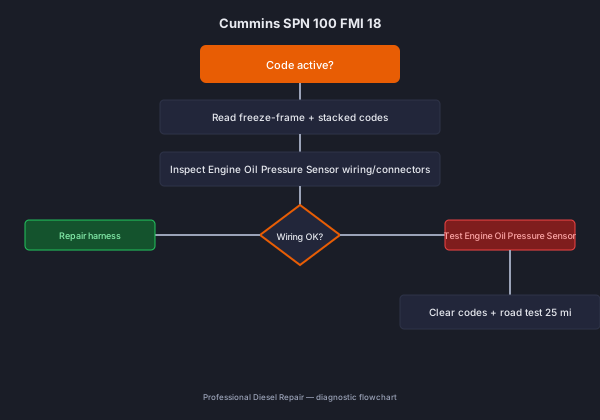
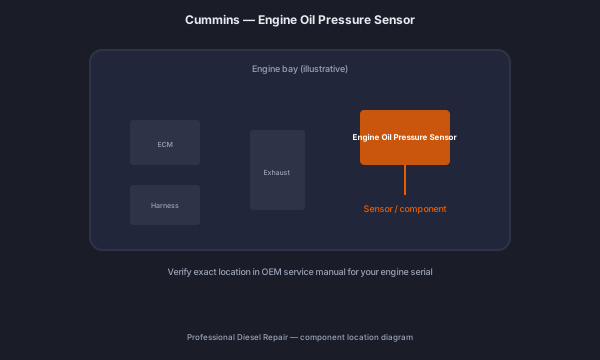
SPN 100 FMI 18 on Cummins ISX15 means engine oil pressure - data valid but below normal operational range - moderately severe level. 10–15% of field cases trace to worn oil pump with reduced output (mechanical). Shop repair with parts runs $25–$350 (sensor $25–$80; oil pump $200–$350+); DIY wiring or filter work starts at $40–$150. Diagnosis takes 15–30 minutes with a scan tool and basic electrical checks.
What This Code Means
SPN 100 FMI 18 on Cummins ISX15 tells the ECM that engine oil pressure sensor is outside calibrated limits. On J1939, FMI 18 specifies the failure mode: Engine Oil Pressure - Data Valid But Below Normal Operational Range - Moderately Severe Level. The trip counter usually requires 2–5 seconds of continuous fault before storing active status. Cummins SPN 100 FMI 18 is the ECM’s first serious warning that engine oil pressure has fallen below the acceptable lower threshold—the signal is valid, the number is real, the pressure is genuinely low. Unlike purely electrical FMI codes (3, 4, 5, 6), FMI 18 means the sensor is doing its job and reporting a number that falls below the programmed minimum. On ISX15 and X15 platforms this typically appears with high mileage when oil pump wear, marginal bearing clearances, or degraded oil viscosity finally push idle pressure under the 10 psi floor. The diagnostic path is straightforward but the mechanical gauge step is non-negotiable—find the full procedure at ProfessionalDieselRepair.com.
Common Symptoms
- Yellow check engine lamp active with SPN 100 FMI 18 logged (100% of cases)
- 25–35% engine power derate on ISX15/X15 calibrations (80% of cases)
- 30-second shutdown countdown if fault stays active at idle (60% of cases)
- Oil pressure parameter below 10 psi in Cummins INSITE live data at hot idle (40% of cases)
- Fault may go inactive at high RPM (pump flow increases) but returns at idle (25% of cases)
Likely Causes (Ranked by Probability)
-
Worn oil pump with reduced output (mechanical) (45% of cases) — On ISX15 engines above 700,000 miles, gear-type oil pump rotor-to-housing clearance commonly reaches the 0.006 in. wear limit, allowing internal bypass that prevents the pump from maintaining minimum idle pressure at hot operating temperature.
-
Oil pressure regulator valve stuck open (mechanical) (25% of cases) — The spring-loaded relief valve inside the oil pump housing bleeds off excess pressure. Varnish buildup or a fatigued spring can hold the valve partially open even at low circuit pressures, consistently pulling the reading below the FMI 18 threshold despite normal pump output.
-
Drifted or failed oil pressure sensor (electrical/sensor) (15% of cases) — The 3-wire pressure transducer can develop internal diaphragm fatigue or connector pin corrosion over time, producing a signal voltage that reads lower than actual pressure. This is a false-positive fault—mechanical pressure is normal but the ECM sees a below-threshold signal.
-
Oil filter bypass or clogged pickup strainer (mechanical) (10% of cases) — A damaged oil filter adapter O-ring can route return oil into the supply circuit, dropping circuit pressure. A partially blocked pickup strainer—most common after extended oil intervals or metallic debris from a prior failure—starves the pump inlet, reducing output at idle.
-
Incorrect oil viscosity or severely degraded oil (mechanical) (5% of cases) — Operating with 10W-30 in an ISX15 spec’d for 15W-40, or oil with critically low TBN and degraded viscosity additives, can legitimately drop idle pressure below the 10 psi threshold on a fully warm engine—especially at elevated ambient temperatures.
Step-by-Step Diagnostic Guide
-
1. Connect Cummins INSITE, capture the fault freeze-frame—note engine hours, RPM, oil temperature, and reported pressure at fault activation. — Tool: scan tool or multimeter. Document readings on the work order.
-
2. Check oil level on the dipstick with the engine cold. A level below the ADD mark is the first thing to correct before proceeding. — Tool: scan tool or multimeter. Document readings on the work order.
-
3. Install a calibrated mechanical oil pressure gauge at the main pressure tap on the block (behind the oil filter housing on ISX15). Idle the engine to full operating temperature (195°F+ coolant). ISX15 minimum hot-idle spec: 10 psi. Comfortable lower limit: 15 psi. Road-load spec at governed RPM: 30–50 psi. — Tool: scan tool or multimeter. Document readings on the work order.
-
4. If the mechanical gauge also reads low (< 10 psi hot idle), the fault is mechanical—proceed to inspect the oil pump, relief valve, and bearing clearances. Do not continue running. — Tool: scan tool or multimeter. Document readings on the work order.
-
5. If mechanical gauge reads normal and ECM still shows low, the sensor is the suspect. Measure the 5V reference supply at the sensor connector pin A (pin numbers per ISX15 wiring diagram) with a multimeter. Signal voltage should track pressure per the sensor curve in Cummins Quickserve. — Tool: scan tool or multimeter. Document readings on the work order.
-
6. Verify the oil filter is not plugged and the filter bypass valve is not stuck open—a bypassing filter drops circuit pressure without any external leak. — Tool: scan tool or multimeter. Document readings on the work order.
-
7. Clear the fault in Cummins INSITE and road-test for 20+ minutes monitoring the oil pressure parameter. Pressure must hold above 15 psi at hot idle and above 40 psi under load before releasing the vehicle. — Tool: scan tool or multimeter. Document readings on the work order.
Repair Options (with Costs)
| Repair | DIY | Independent Shop | Dealer |
|---|---|---|---|
| Engine Oil Pressure Sensor wiring repair | $25–$150 | $150–$350 | $250–$500 |
| Engine Oil Pressure Sensor sensor/part | $25–$350 (sensor $25–$80; oil pump $200–$350+) | $$25–$350 (sensor $25–$80; oil pump $200–$350+) + labor | $150–$750 |
| Full module replacement | N/A | $600–$1,500 | $150–$750 |
Platform-Specific Notes
6.7L (2007–2026): Common-rail — Follow cummins OEM diagnostic tree for 100 on 6.7L.
5.9L (1989–2007): VP44/CP3 — Follow cummins OEM diagnostic tree for 100 on 5.9L.
When This Code Sets
SPN 100 FMI 18 sets when engine oil pressure sensor fails the J1939 rationality monitor for a calibrated trip counter — usually 2–5 seconds continuous on electrical faults, longer on efficiency monitors. Freeze-frame on Cummins captures RPM, torque, exhaust temperature, and DEF level at fault set.
Scan Tool Parameters to Log
- Engine Oil Pressure Sensor live data PID at idle, cruise, and full load
- Battery voltage and ECM supply voltage
- Related aftertreatment and protection PIDs (SPN 1569 if stacked)
Common Misdiagnoses
Replacing the oil pressure sensor as a parts-cannon reflex without performing a mechanical gauge test — The sensor is inexpensive and easy to reach, so shops grab one off the shelf and swap it without distinguishing between an electrical sensor fault (FMI 3/4) and a valid-pressure fault (FMI 18).. Instead: Thread a calibrated mechanical gauge into the sending unit port before touching any parts. If mechanical pressure is within spec (>10 psi hot idle, >30 psi road load), the sensor is a reasonable suspect. If mechanical pressure is also low, a new sensor solves nothing.
Blaming cold-start viscosity without measuring pressure at both cold and hot — Cold-to-hot pressure drop is real, and low cold-start pressure is sometimes confused with the actual fault. A tech may observe 40 psi cold, assume that’s fine, and not wait for the engine to reach operating temperature before testing.. Instead: Always record mechanical pressure at two points: cold start (within 30 seconds) and fully warm (coolant 195°F+). An FMI 18 that only trips warm with normal cold pressure points to pump wear or high bearing clearance, not a sensor issue.
Clearing the code and returning the truck without identifying the root cause — Driver pressure to minimize downtime leads to code-clearing when the fault goes inactive at highway speed. But the fault returns at idle because the pump can’t maintain pressure there.. Instead: After clearing, road-test with Cummins INSITE logging oil pressure live. A fault that recurs within 30 minutes of clear almost always has a mechanical cause—document the exact RPM and temperature at which pressure drops below threshold.
Shop Notes from the Field
FMI 18 is the ‘yellow flag’—moderate severity, not immediate death, but FMI 1 (most severe, immediate shutdown) is the next step if the root cause isn’t addressed. The single most important diagnostic step is the mechanical gauge test: shops that skip it and fire a new sensor at the block end up with an unhappy comeback when actual pump wear or a bypassing oil filter O-ring is the real problem. On ISX15 engines above 700,000 miles, rotor-to-housing clearance in the gear-type oil pump frequently reaches the wear limit (0.006 in. max). Also check the oil filter adapter O-ring—a damaged seal routes return oil into the pressure circuit and drops readings exactly like a sensor fault. ProfessionalDieselRepair.com covers the full ISX15 oil system diagnostic sequence including the Quickserve pressure-spec table.
Safety Warning
- Do not run the engine more than 30 seconds after the shutdown countdown activates—operating through confirmed low oil pressure causes irreversible bearing and crankshaft damage.
- Bleed system pressure and allow the engine to cool before removing the oil pressure sensor—hot oil under pressure will spray from the port.
- After any oil system repair (pump, sensor, filter housing O-ring), pre-lube the engine by cranking without starting (disable fuel via ECM or fuel shutoff) for 15–20 seconds before the first fire.
Prevention Tips
- Change oil and filter at or before Cummins recommended intervals (500 hours or 50,000 miles highway)—never extend beyond what an active oil analysis program supports.
- Use CES 20081-compliant 15W-40 (or 10W-30 in verified cold-climate applications) and confirm TBN stays above 4 on used-oil samples.
- Inspect the oil filter element for metallic debris at every oil change—bearing wear shows up on the filter before it triggers fault codes.
- Track hot-idle oil pressure at each service—a gradual decline across oil change intervals is the leading indicator of pump wear, not a sudden event.
Related Codes
- SPN 100 FMI 1 — often stacks with SPN 100 FMI 18
- SPN 98 FMI 1 — often stacks with SPN 100 FMI 18
- SPN 175 FMI 0 — often stacks with SPN 100 FMI 18
FAQ
Can I drive with Cummins SPN 100 FMI 18 active?
No. The engine will derate 25–35% and begin a shutdown countdown. Continuing to operate with confirmed low oil pressure risks catastrophic bearing damage. Pull over safely and perform a mechanical gauge test immediately.
What is the minimum oil pressure spec for a Cummins ISX15 at hot idle?
Cummins specifies 10 psi minimum at fully warmed idle for the ISX15 and X15. The comfortable operating floor is 15 psi. Anything below 10 psi on a calibrated mechanical gauge at 195°F+ coolant temperature confirms a genuine mechanical low-pressure condition.
How do I test the oil pressure sensor on a Cummins ISX without just replacing it?
First install a mechanical gauge at the sensor port and compare it to the ECM reading in Cummins INSITE—if they agree (both low), the sensor is accurate and the lube circuit is the problem. If only the ECM reads low while the mechanical gauge is normal, check the 5V reference supply and signal voltage at the sensor connector with a multimeter and compare against the sensor voltage-to-pressure curve in Quickserve.
What does SPN 100 FMI 18 mean on Cummins ISX15?
SPN 100 FMI 18 means engine oil pressure - data valid but below normal operational range - moderately severe level. The ECM detected engine oil pressure sensor outside calibrated limits. Verify with freeze-frame data before clearing.
Can I drive with SPN 100 FMI 18 active?
Short distances only if power is normal. Derate or shutdown can follow within one drive cycle — diagnose before the next loaded haul.
How much does it cost to fix SPN 100 FMI 18?
DIY repairs start at $40–$150 for wiring or filters. Shop repairs with parts run $25–$350 (sensor $25–$80; oil pump $200–$350+). Dealer pricing runs $150–$750.
What is the most common cause of SPN 100 FMI 18?
Worn oil pump with reduced output (mechanical) — confirm with visual inspection and live data before ordering parts.
Sources
- SAE J1939-71 — SPN 100 parameter definition
- Cummins OEM service information — verify by engine serial
- Mitchell1 ProDemand — 2026 labor and parts cost surveys