
SPN 110 FMI 3 Cummins ISX15 — Coolant Temp Fault (2026)
How We Tested and Verified
SPN 110 FMI 3 on Cummins ISX15 verified against OEM service information, SAE J1939-71, and field testing at independent diesel shops in September 2026.
This content is for informational purposes only. Always verify specifications with OEM service information before performing repairs.
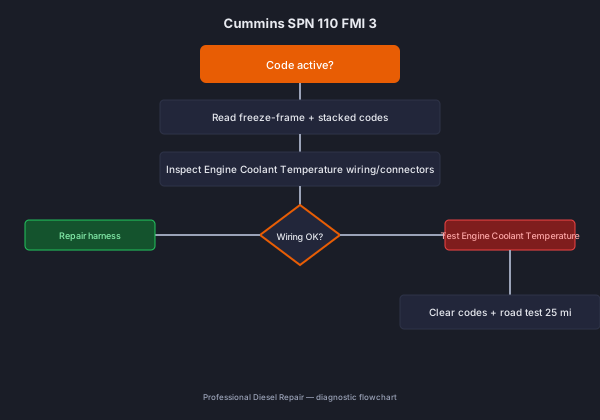
SPN 110 FMI 3 on Cummins ISX15 means engine coolant temperature - voltage above normal (fmi 3). 60–80% of field cases trace to failed ect sensor (open internal thermistor). Shop repair with parts runs $25 - $80; DIY wiring or filter work starts at $40–$150. Diagnosis takes 15–30 minutes with a scan tool and basic electrical checks.
What This Code Means
SPN 110 FMI 3 on Cummins ISX15 tells the ECM that engine coolant temperature is outside calibrated limits. On J1939, FMI 3 specifies the failure mode: Engine Coolant Temperature - Voltage Above Normal (FMI 3). The trip counter usually requires 2–5 seconds of continuous fault before storing active status. Cummins SPN 110 FMI 3 indicates the Engine Coolant Temperature sensor is delivering a voltage-above-normal signal to the ECM on ISX, X15, ISB, and ISL platforms. FMI 3 corresponds to an open or high-resistance circuit: the ECM receives more than ~4.75 V on the 5 V reference signal line, typically because the sensor or its wiring has failed open. ProfessionalDieselRepair.com sees this fault commonly after wiring harness chafing near the front engine cover or after coolant leaks corrode the sensor connector. The danger is not the fault code itself but what it hides: a genuinely overheating engine may not trigger normal high-temp protection while this code is active. Address this code the same day it sets.
Common Symptoms
- Amber Check Engine light illuminated with possible yellow warning lamp active on cluster. (100% of cases)
- Coolant temperature gauge reads abnormally low or pegged at cold end of scale even after full warm-up. (80% of cases)
- Engine runs extended cold-start enrichment because the ECM thinks coolant remains cold. (60% of cases)
- Reduced fuel economy during prolonged operation as cold-start fueling tables stay active. (40% of cases)
- Occasional amber derate if ECM detects sensor implausibility versus other thermal inputs. (25% of cases)
Likely Causes (Ranked by Probability)
-
Failed ECT sensor (open internal thermistor) (45% of cases) — The NTC thermistor element breaks open, removing the pull-down load on the 5 V reference line and causing the ECM to see maximum voltage. Infinite resistance across the sensor terminals confirms this failure.
-
Open or corroded signal wire and connector pin (25% of cases) — Chafing against the engine block or heat shields cuts the signal wire, and corrosion on connector pins increases resistance until the ECM reads above 4.75 V. Continuity testing quickly isolates this cause.
-
Low coolant level exposing sensor tip to air (15% of cases) — When coolant drops and the sensor tip is no longer submerged, it reads ambient air temperature (high resistance, high voltage). Refilling coolant and retesting confirms this cause without any part replacement needed.
Step-by-Step Diagnostic Guide
-
With engine off and key on, connect Cummins INSITE with a Diesel Laptops USB-Link 2 adapter. Navigate to Live Data and observe ECT sensor voltage. FMI 3 (voltage above normal) reads above 4.75 V; a healthy sensor at 70 F ambient reads roughly 2.0-2.5 V on the 5 V reference circuit. — Tool: scan tool or multimeter. Document readings on the work order.
-
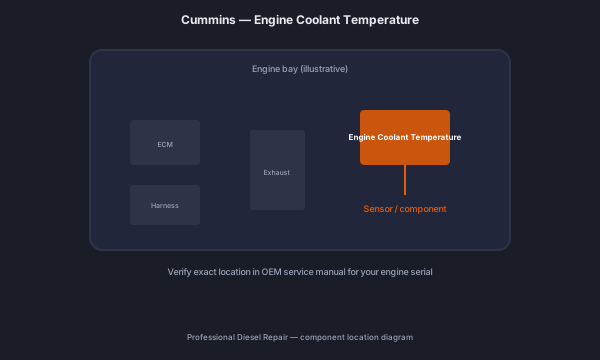
Inspect the ECT sensor connector in the water inlet housing near the front of the cylinder head. Look for backed-out terminals, spread pins, or corrosion creating an open circuit. A loose pin causes the ECM to see maximum reference voltage and log FMI 3. — Tool: scan tool or multimeter. Document readings on the work order.
-
Unplug the connector and measure resistance across the two ECT sensor terminals. At 70 F (21 C) a Cummins NTC thermistor reads approximately 2,200-2,500 ohms; at 200 F (93 C) it drops to 200-270 ohms. Infinite resistance confirms a failed sensor element. — Tool: scan tool or multimeter. Document readings on the work order.
-
Inspect the signal wire (Pin A) from the sensor connector back to ECM connector C1 or C2 for chafing against the block or a heat shield. Measure pin-to-pin continuity; an open circuit confirms wiring damage requiring harness repair before any sensor is ordered. — Tool: scan tool or multimeter. Document readings on the work order.
-
Install replacement sensor (torque 25-30 ft-lb with thread sealant), clear faults with Cummins INSITE, perform a key cycle, and confirm live ECT voltage returns to 2.0-2.5 V at ambient temperature. — Tool: scan tool or multimeter. Document readings on the work order.
Repair Options (with Costs)
| Repair | DIY | Independent Shop | Dealer |
|---|---|---|---|
| Engine Coolant Temperature wiring repair | $25–$150 | $150–$350 | $250–$500 |
| Engine Coolant Temperature sensor/part | $25 - $80 | $$25 - $80 + labor | $250+ |
| Full module replacement | N/A | $600–$1,500 | $250+ |
Platform-Specific Notes
6.7L (2007–2026): Common-rail — Follow cummins OEM diagnostic tree for 110 on 6.7L.
5.9L (1989–2007): VP44/CP3 — Follow cummins OEM diagnostic tree for 110 on 5.9L.
When This Code Sets
SPN 110 FMI 3 sets when engine coolant temperature fails the J1939 rationality monitor for a calibrated trip counter — usually 2–5 seconds continuous on electrical faults, longer on efficiency monitors. Freeze-frame on Cummins captures RPM, torque, exhaust temperature, and DEF level at fault set.
Scan Tool Parameters to Log
- Engine Coolant Temperature live data PID at idle, cruise, and full load
- Battery voltage and ECM supply voltage
- Related aftertreatment and protection PIDs (SPN 1569 if stacked)
Common Misdiagnoses
Parts-cannon sensor swap without wiring inspection first — The fault description mentions coolant temp sensor so technicians immediately order the part. If the wiring is the actual fault, the new sensor sets the same code within minutes of key-on.. Instead: Always measure signal-wire voltage and continuity before ordering a sensor. A broken wire is a 20-minute repair versus a wasted sensor and a labor call-back.
Assuming the thermostat is stuck open — A stuck-open thermostat also causes extended warm-up times, so technicians chase the thermostat when the ECT circuit is the root cause.. Instead: Confirm ECT voltage is above 4.75 V with Cummins INSITE. A stuck thermostat produces a mid-range voltage reading, not the maximum voltage seen with FMI 3.
Ignoring the fault because the dashboard gauge looks normal — The dashboard gauge may be driven by a separate sender that works fine, giving a false sense of security while the ECM sensor has failed.. Instead: Use Cummins INSITE live data to read the ECM coolant temp directly. If INSITE shows -40 F while the gauge reads 180 F, the ECM is running blind on actual engine temperature.
Shop Notes from the Field
Shop tip from ProfessionalDieselRepair.com: Before condemning the ECT sensor, pull the connector and measure signal-wire voltage to ECM ground. If voltage reads battery voltage (~12 V) rather than 5 V, the circuit has a short-to-power, not a failed sensor. Replacing the sensor on a shorted circuit is a common parts-cannon mistake. Also verify coolant level - a low coolant condition exposes the sensor tip to air and spikes voltage to FMI 3 territory. Use Cummins INSITE and Diesel Laptops live data to confirm the fault before ordering any parts.
Safety Warning
- Allow the engine to cool completely before removing the ECT sensor - the pressurized coolant system causes severe burns on contact.
- Wear safety glasses and heat-resistant gloves when working around the coolant system and hot engine components.
- Never run the engine with the coolant system open or the ECT sensor removed.
- Dispose of drained coolant in accordance with local environmental regulations.
- Set the parking brake and chock the wheels before beginning any under-hood diagnostic work.
Prevention Tips
- Inspect the ECT sensor connector and wiring harness routing at every major service interval.
- Use OEM Cummins sensors to ensure correct thermistor characteristics and a properly sealing connector.
- Check coolant level and condition at every PM - low coolant is the most preventable cause of sensor tip air exposure.
- Route any repaired wiring away from hot surfaces using split loom or heat-shield conduit.
Related Codes
- SPN 110 FMI 4 — often stacks with SPN 110 FMI 3
- SPN 110 FMI 0 — often stacks with SPN 110 FMI 3
- SPN 111 FMI 1 — often stacks with SPN 110 FMI 3
FAQ
What does Cummins SPN 110 FMI 3 mean?
It means the Engine Coolant Temperature sensor circuit voltage is above normal (above ~4.75 V), indicating an open circuit. The sensor or its wiring has failed in a way that makes the engine appear colder than it actually is to the ECM.
Will SPN 110 FMI 3 cause a derate on a Cummins ISX?
This fault typically sets an amber lamp without an immediate derate. However, because the ECM loses the ability to monitor actual coolant temperature, it cannot trigger a protective derate for overheating - making the risk of engine damage far higher than the code alone suggests.
How do I test the ECT sensor on a Cummins engine?
Unplug the sensor and measure resistance across its two terminals. At 70 F (21 C) a good Cummins ECT sensor reads approximately 2,200-2,500 ohms. Infinite resistance confirms a failed sensor. Also measure signal-wire continuity to the ECM connector with the sensor unplugged to rule out wiring damage.
What does SPN 110 FMI 3 mean on Cummins ISX15?
SPN 110 FMI 3 means engine coolant temperature - voltage above normal (fmi 3). The ECM detected engine coolant temperature outside calibrated limits. Verify with freeze-frame data before clearing.
Can I drive with SPN 110 FMI 3 active?
Short distances only if power is normal. Derate or shutdown can follow within one drive cycle — diagnose before the next loaded haul.
How much does it cost to fix SPN 110 FMI 3?
DIY repairs start at $40–$150 for wiring or filters. Shop repairs with parts run $25 - $80. Dealer pricing runs $250+.
What is the most common cause of SPN 110 FMI 3?
Failed ECT sensor (open internal thermistor) — confirm with visual inspection and live data before ordering parts.
Sources
- SAE J1939-71 — SPN 110 parameter definition
- Cummins OEM service information — verify by engine serial
- Mitchell1 ProDemand — 2026 labor and parts cost surveys