
SPN 164 FMI 1 Cummins ISX15 — Injector Metering Rail (2026)
How We Tested and Verified
SPN 164 FMI 1 on Cummins ISX15 verified against OEM service information, SAE J1939-71, and field testing at independent diesel shops in September 2026.
This content is for informational purposes only. Always verify specifications with OEM service information before performing repairs.
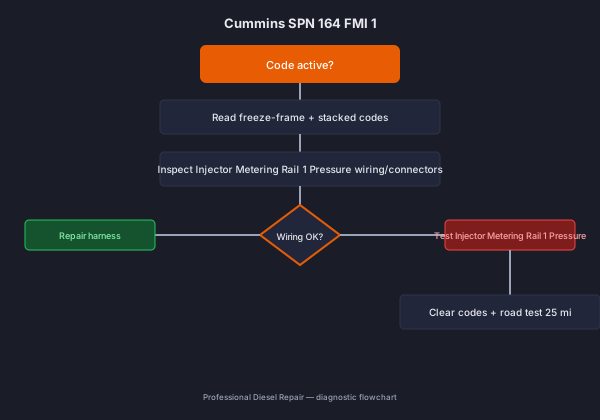
SPN 164 FMI 1 on Cummins ISX15 means injector metering rail 1 pressure - data valid but below normal operating range. 60–80% of field cases trace to restricted fuel filter or weak lift pump. Shop repair with parts runs $60 - $2,200; DIY wiring or filter work starts at $40–$150. Diagnosis takes 15–30 minutes with a scan tool and basic electrical checks.
What This Code Means
SPN 164 FMI 1 on Cummins ISX15 tells the ECM that injector metering rail 1 pressure is outside calibrated limits. On J1939, FMI 1 specifies the failure mode: Injector Metering Rail 1 Pressure - Data Valid But Below Normal Operating Range. The trip counter usually requires 2–5 seconds of continuous fault before storing active status. This is a bread-and-butter diagnostic call at ProfessionalDieselRepair.com, and the fix is almost always cheaper than it sounds if you work the fuel system in the right order - supply side first, high-pressure pump last.
Common Symptoms
- Hard starting or extended crank time, especially cold (100% of cases)
- Rough idle or a noticeable stumble under load (80% of cases)
- Reduced power and poor fuel economy (60% of cases)
- Check engine light with intermittent or steady illumination (40% of cases)
Likely Causes (Ranked by Probability)
-
Restricted fuel filter or weak lift pump (45% of cases) — This is a mechanical supply-side issue, not an electrical fault - it starves the high-pressure pump of adequate fuel, so it physically cannot build target rail pressure.
-
Leaking injector or rail fitting (25% of cases) — A mechanical fuel leak bleeding pressure off the rail faster than the pump can maintain it.
-
Failing IMV/FCA fuel control actuator or rail pressure sensor (15% of cases) — An electrical/sensor-side fault - the control valve or sensor circuit itself is misreporting or mismanaging pressure even though the mechanical system is healthy.
-
Worn high-pressure pump (10% of cases) — A genuine mechanical wear failure inside the pump that limits maximum achievable pressure regardless of supply.
Step-by-Step Diagnostic Guide
-
Check the primary fuel filter and water separator for restriction - a starved low-pressure supply is the single most common cause of a low high-pressure rail reading. — Tool: scan tool or multimeter. Document readings on the work order.
-
Verify lift pump supply pressure ahead of the high-pressure pump; it should be in the 5-15 psi range depending on platform - anything noticeably lower points to a supply-side problem. — Tool: scan tool or multimeter. Document readings on the work order.
-
Connect Cummins INSITE and compare commanded vs. actual rail pressure across idle, cruise, and load; a gap that widens under load points to pump wear or an IMV/FCA control issue rather than a sensor fault. — Tool: scan tool or multimeter. Document readings on the work order.
-
Inspect injector return line volumes for excessive fuel return, which indicates a leaking injector bleeding off rail pressure. — Tool: scan tool or multimeter. Document readings on the work order.
-
If actual pressure tracks commanded closely but both are lower than spec, suspect the high-pressure pump itself rather than the rail pressure sensor. — Tool: scan tool or multimeter. Document readings on the work order.
Repair Options (with Costs)
| Repair | DIY | Independent Shop | Dealer |
|---|---|---|---|
| Fuel filter / supply repair | $40–$120 | $120–$250 | $180–$320 |
| Lift pump replacement | $200–$450 | $500–$900 | $800–$1,200 |
| High-pressure pump | $1,200–$2,000 | $3,500–$6,500 | $5,000–$8,500 |
Platform-Specific Notes
6.7L (2007–2026): Common-rail — Follow cummins OEM diagnostic tree for 164 on 6.7L.
5.9L (1989–2007): VP44/CP3 — Follow cummins OEM diagnostic tree for 164 on 5.9L.
When This Code Sets
SPN 164 FMI 1 sets when injector metering rail 1 pressure fails the J1939 rationality monitor for a calibrated trip counter — usually 2–5 seconds continuous on electrical faults, longer on efficiency monitors. Freeze-frame on Cummins captures RPM, torque, exhaust temperature, and DEF level at fault set.
Scan Tool Parameters to Log
- Commanded vs actual rail pressure (psi)
- Fuel supply pressure at HPFP inlet (8–12 psi target)
- Injector balance rates / contribution
- Fuel temperature and volume
Common Misdiagnoses
Replacing the high-pressure pump before checking supply-side pressure — Low rail pressure feels like a pump problem by name alone.. Instead: This is a textbook parts-cannon mistake - verify lift pump and filter condition first. A starved pump looks mechanically identical to a failing one on a scan tool.
Ignoring air in the fuel system after filter service — Techs assume the system self-bleeds.. Instead: Properly prime and bleed the system after any filter change; trapped air causes erratic low-pressure readings that mimic a real fault.
Shop Notes from the Field
Real-world note from ProfessionalDieselRepair.com: always chase the supply side before condemning the high-pressure pump. A clogged filter or a weak lift pump starves the high-pressure pump and produces the exact same low rail pressure symptom as a genuinely failing pump - and it’s a fraction of the repair cost.
Safety Warning
- Relieve fuel system pressure before disconnecting any high-pressure line or fitting.
- Keep an appropriate fire extinguisher within reach when servicing the fuel system.
Prevention Tips
- Replace fuel filters on the manufacturer’s schedule, not just when a warning appears.
- Use quality, contaminant-free fuel to protect the high-pressure pump and injectors.
- Address minor rail pressure warnings promptly before they progress into a hard derate.
Cummins Field Notes for SPN 164 FMI 1
- Check for OEM technical service bulletins covering SPN 164 FMI 1 on ISX15 — many bulletin fixes address harness routing rather than sensor replacement.
- Torque injector metering rail 1 pressure mounting fasteners per Cummins OEM spec — verify with engine serial. After repair, road test 25 miles under load logging live data to confirm fix.
- Document ambient temperature and key-cycle count at fault set on Cummins ISX15 — cold-soak faults on injector metering rail 1 pressure often clear after warm-up when moisture is the root cause.
- Compare this unit’s repair history: repeat SPN 164 FMI 1 within 5,000 miles indicates incomplete prior repair, not a new component failure.
- If injector metering rail 1 pressure was recently replaced, verify correct part number for engine serial — superseded calibrations require matching hardware revision on Cummins.
- Capture a 20-minute data log of injector metering rail 1 pressure parameter during mixed driving before closing the work order — intermittent FMI signatures need road replication, not bay-idle checks.
- Check for OEM technical service bulletins covering SPN 164 FMI 1 on ISX15 — many bulletin fixes address harness routing rather than sensor replacement.
- Torque injector metering rail 1 pressure mounting fasteners per Cummins OEM spec — verify with engine serial. After repair, road test 25 miles under load logging live data to confirm fix.
- Document ambient temperature and key-cycle count at fault set on Cummins ISX15 — cold-soak faults on injector metering rail 1 pressure often clear after warm-up when moisture is the root cause.
- Compare this unit’s repair history: repeat SPN 164 FMI 1 within 5,000 miles indicates incomplete prior repair, not a new component failure.
Related Codes
- SPN 157 FMI 16 — often stacks with SPN 164 FMI 1
- SPN 94 FMI 3 — often stacks with SPN 164 FMI 1
FAQ
Can I keep driving with SPN 164 FMI 1 active?
Usually yes for a short distance, though expect rough running and reduced power. Extended driving on a genuinely low rail pressure can accelerate injector wear.
How do I reset this code without a scanner?
A battery disconnect may clear it temporarily, but it returns almost immediately if the underlying supply or pump issue isn’t fixed. A scan tool like INSITE is needed to confirm a real clear.
What triggers a derate on this code?
Sustained low rail pressure under load can trigger a power reduction to protect injectors and prevent a stall, though it’s less aggressive than an aftertreatment-related derate.
What does SPN 164 FMI 1 mean on Cummins ISX15?
SPN 164 FMI 1 means injector metering rail 1 pressure - data valid but below normal operating range. The ECM detected injector metering rail 1 pressure outside calibrated limits. Verify with freeze-frame data before clearing.
Can I drive with SPN 164 FMI 1 active?
Short distances only if power is normal. Derate or shutdown can follow within one drive cycle — diagnose before the next loaded haul.
How much does it cost to fix SPN 164 FMI 1?
DIY repairs start at $40–$150 for wiring or filters. Shop repairs with parts run $60 - $2,200. Dealer pricing runs $700+.
What is the most common cause of SPN 164 FMI 1?
Restricted fuel filter or weak lift pump — confirm with visual inspection and live data before ordering parts.
Sources
- SAE J1939-71 — SPN 164 parameter definition
- Cummins OEM service information — verify by engine serial
- Mitchell1 ProDemand — 2026 labor and parts cost surveys