
SPN 512 FMI 2 Cummins ISX15 — Driver's Demand Engine (2026)
How We Tested and Verified
SPN 512 FMI 2 on Cummins ISX15 verified against OEM service information, SAE J1939-71, and field testing at independent diesel shops in September 2026.
This content is for informational purposes only. Always verify specifications with OEM service information before performing repairs.
SPN 512 FMI 2 on Cummins ISX15 means driver’s demand engine - percent torque - data erratic, intermittent, or incorrect. 60–80% of field cases trace to faulty or worn accelerator pedal position sensor. Shop repair with parts runs $50 - $300; DIY wiring or filter work starts at $40–$150. Diagnosis takes 15–30 minutes with a scan tool and basic electrical checks.
What This Code Means
SPN 512 FMI 2 on Cummins ISX15 tells the ECM that driver’s demand engine percent torque is outside calibrated limits. On J1939, FMI 2 specifies the failure mode: Driver’s Demand Engine - Percent Torque - Data Erratic, Intermittent, Or Incorrect. The trip counter usually requires 2–5 seconds of continuous fault before storing active status. Driver’s demand percent torque is the ECM’s translation of accelerator pedal input into a torque request, so when SPN 512 FMI 2 shows this value as erratic, the root cause is almost always upstream at the pedal assembly. ProfessionalDieselRepair.com sees this fault produce inconsistent throttle response that can be frustrating to pin down if you don’t start at the pedal sensor first, since the fault code itself doesn’t explicitly point there.
Common Symptoms
- Surging or hesitation under acceleration (100% of cases)
- Inconsistent throttle response, sometimes normal and sometimes sluggish (80% of cases)
- Amber Check Engine lamp (60% of cases)
- Occasional unexpected power reduction without a clear pattern (40% of cases)
Likely Causes (Ranked by Probability)
-
Faulty or worn accelerator pedal position sensor (45% of cases) — Wear inside the dual-track pedal sensor can cause one or both signal tracks to jump or drop out intermittently, producing erratic torque demand data.
-
Chafed or corroded pedal harness wiring (25% of cases) — The pedal harness flexes with every use, making it prone to wear and intermittent connection issues over time.
-
Loose or partially backed-out ECM connector pin (15% of cases) — A pin that isn’t fully seated can create an intermittent connection that produces erratic data without a clean fault pattern.
-
J1939 network communication interference (10% of cases) — Data corruption on the CAN bus between modules can occasionally produce erratic readings for shared parameters like torque demand.
Step-by-Step Diagnostic Guide
-
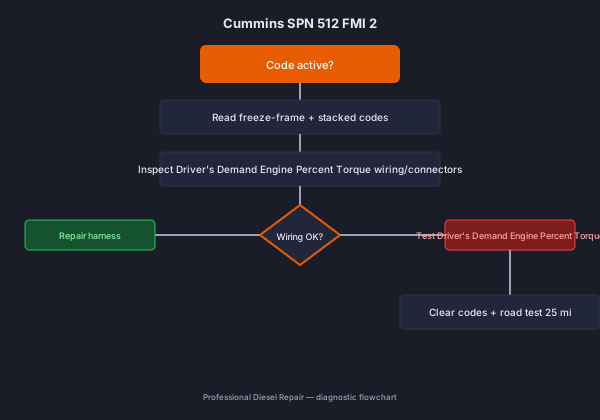
Pull the fault with Cummins INSITE and confirm SPN 512 FMI 2 is active; check whether it correlates with accelerator pedal position sensor faults (SPN 91) logged around the same time. — Tool: scan tool or multimeter. Document readings on the work order.
-
Inspect the accelerator pedal assembly and its wiring harness for looseness, water intrusion, or a chafed wire - the pedal sensor is the primary source feeding this calculated value. — Tool: scan tool or multimeter. Document readings on the work order.
-
Check the pedal sensor’s dual-track signal outputs with a multimeter while slowly depressing the pedal - both tracks should move smoothly and proportionally without jumps or dropouts. — Tool: scan tool or multimeter. Document readings on the work order.
-
Verify ECM connector pins for the pedal circuit are clean and fully seated - a partially backed-out pin can cause exactly this kind of erratic data pattern. — Tool: scan tool or multimeter. Document readings on the work order.
-
If the pedal assembly and wiring check out, use INSITE to check for any J1939 network communication errors between the ECM and other modules that share this torque-demand data. — Tool: scan tool or multimeter. Document readings on the work order.
-
Clear the code and road test through varying throttle inputs to confirm smooth, consistent torque demand tracking before returning the truck to service. — Tool: scan tool or multimeter. Document readings on the work order.
Repair Options (with Costs)
| Repair | DIY | Independent Shop | Dealer |
|---|---|---|---|
| Driver’s Demand Engine Percent Torque wiring repair | $25–$150 | $150–$350 | $250–$500 |
| Driver’s Demand Engine Percent Torque sensor/part | $50 - $300 | $$50 - $300 + labor | $350+ |
| Full module replacement | N/A | $600–$1,500 | $350+ |
Platform-Specific Notes
6.7L (2007–2026): Common-rail — Follow cummins OEM diagnostic tree for 512 on 6.7L.
5.9L (1989–2007): VP44/CP3 — Follow cummins OEM diagnostic tree for 512 on 5.9L.
When This Code Sets
SPN 512 FMI 2 sets when driver’s demand engine percent torque fails the J1939 rationality monitor for a calibrated trip counter — usually 2–5 seconds continuous on electrical faults, longer on efficiency monitors. Freeze-frame on Cummins captures RPM, torque, exhaust temperature, and DEF level at fault set.
Scan Tool Parameters to Log
- Driver’s Demand Engine Percent Torque live data PID at idle, cruise, and full load
- Battery voltage and ECM supply voltage
- Related aftertreatment and protection PIDs (SPN 1569 if stacked)
Common Misdiagnoses
Replacing the ECM for an erratic data fault — Erratic or ‘incorrect’ data faults sound like a control module problem, tempting some techs toward the most expensive parts-cannon swap available.. Instead: Check the accelerator pedal sensor and its harness thoroughly first - this is overwhelmingly the more common and far cheaper root cause.
Overlooking the pedal harness because the pedal ‘feels normal’ to the driver — Intermittent electrical faults don’t always produce a consistent physical symptom the driver notices.. Instead: Test the pedal sensor’s signal output through its full range of motion with a multimeter, watching for any jumps or dropouts rather than relying on driver feedback alone.
Shop Notes from the Field
Shop tip: this code almost always traces back to the accelerator pedal position sensor or its harness, even though the fault text doesn’t mention the pedal directly. ProfessionalDieselRepair.com always starts at the pedal assembly on this one rather than chasing it as a standalone ECM software issue.
Safety Warning
- Disconnect the battery before repairing any wiring near the pedal assembly to avoid unintended engine response during testing.
- Test the pedal circuit with the parking brake set and wheels blocked if any live engine testing is required.
Prevention Tips
- Inspect the accelerator pedal harness for wear at every major PM interval.
- Keep the pedal assembly connector clean and free of moisture intrusion.
- Avoid aftermarket pedal assemblies not designed to the OEM dual-track specification.
Cummins Field Notes for SPN 512 FMI 2
- Torque driver’s demand engine percent torque mounting fasteners per Cummins OEM spec — verify with engine serial. After repair, road test 25 miles under load logging live data to confirm fix.
- Document ambient temperature and key-cycle count at fault set on Cummins ISX15 — cold-soak faults on driver’s demand engine percent torque often clear after warm-up when moisture is the root cause.
- Compare this unit’s repair history: repeat SPN 512 FMI 2 within 5,000 miles indicates incomplete prior repair, not a new component failure.
- If driver’s demand engine percent torque was recently replaced, verify correct part number for engine serial — superseded calibrations require matching hardware revision on Cummins.
- Capture a 20-minute data log of driver’s demand engine percent torque parameter during mixed driving before closing the work order — intermittent FMI signatures need road replication, not bay-idle checks.
- Check for OEM technical service bulletins covering SPN 512 FMI 2 on ISX15 — many bulletin fixes address harness routing rather than sensor replacement.
Related Codes
- SPN 91 FMI 2 — often stacks with SPN 512 FMI 2
- SPN 513 FMI 2 — often stacks with SPN 512 FMI 2
- SPN 91 FMI 13 — often stacks with SPN 512 FMI 2
FAQ
Can I drive with SPN 512 FMI 2 active?
Yes, though expect inconsistent throttle response. It’s worth diagnosing soon since surging can be unpredictable and mildly unsafe in heavy traffic.
Does this code mean my accelerator pedal is bad?
Often yes, or at least the pedal’s wiring - this is the most common root cause even though the fault code itself references calculated torque demand rather than the pedal directly.
How do I reset SPN 512 FMI 2 without a scan tool?
You need Cummins INSITE or a comparable tool to clear the stored fault after the pedal sensor or wiring issue is resolved.
What does SPN 512 FMI 2 mean on Cummins ISX15?
SPN 512 FMI 2 means driver’s demand engine - percent torque - data erratic, intermittent, or incorrect. The ECM detected driver’s demand engine percent torque outside calibrated limits. Verify with freeze-frame data before clearing.
Can I drive with SPN 512 FMI 2 active?
Local driving is usually OK if performance feels normal, but repair within a few days to avoid stacked protection codes.
How much does it cost to fix SPN 512 FMI 2?
DIY repairs start at $40–$150 for wiring or filters. Shop repairs with parts run $50 - $300. Dealer pricing runs $350+.
What is the most common cause of SPN 512 FMI 2?
Faulty or worn accelerator pedal position sensor — confirm with visual inspection and live data before ordering parts.
Sources
- SAE J1939-71 — SPN 512 parameter definition
- Cummins OEM service information — verify by engine serial
- Mitchell1 ProDemand — 2026 labor and parts cost surveys