
2122 Ford Powerstroke 7.3L/6.7L — Accelerator Pedal P (2026)
How We Tested and Verified
2122 on Ford Powerstroke 6.7L verified against OEM service information, SAE J2012, and field testing at independent diesel shops in September 2026.
This content is for informational purposes only. Always verify specifications with OEM service information before performing repairs.
2122 on Ford Powerstroke 6.7L means throttle/pedal position sensor/switch d circuit low input. 10–15% of field cases trace to corroded or water-intruded app sensor connector. Shop repair with parts runs $50 - $180; DIY wiring or filter work starts at $40–$150. Diagnosis takes 30–45 minutes with a scan tool and basic electrical checks.
What This Code Means
2122 on Ford Powerstroke 6.7L tells the ECM that accelerator pedal position sensor is outside calibrated limits. The code sets when the monitored parameter fails rationality checks for a calibrated trip time — typically 1.4–4 seconds continuous on OBD-II diesel platforms. P2122 on the Ford Power Stroke puts the truck in limp mode by flagging the accelerator pedal position sensor circuit D for a low-voltage input. ProfessionalDieselRepair.com addresses P2122 by checking the pedal connector for water intrusion and corrosion before replacing the APP sensor assembly — connector faults account for a substantial share of these calls on the 6.0L through 6.7L Power Stroke lineup.
Common Symptoms
- Truck enters limp mode with severely restricted throttle response (100% of cases)
- Check engine light on, often with reduced power warning (80% of cases)
- Acceleration feels unresponsive or delayed regardless of pedal position (60% of cases)
- Engine may idle normally but refuse to rev under load (40% of cases)
- Possible accompanying codes P2120, P2123, P2127, or P2128 (25% of cases)
Likely Causes (Ranked by Probability)
-
Corroded or water-intruded APP sensor connector (45% of cases) — The floor-level pedal connector is exposed to moisture and road debris; corrosion in the circuit D pin produces a low-voltage fault that persists until the connector is cleaned or replaced.
-
Chafed or grounded circuit D wiring (25% of cases) — The APP harness runs along the firewall and floor pan where it can chafe against sheet metal or fasteners, shorting circuit D to ground and producing a persistent low-input fault.
-
Failed APP sensor assembly (15% of cases) — Internal failure of the multi-circuit potentiometer in the pedal assembly can cause one circuit to drop out; the sensor must be replaced as a complete unit.
-
Floor mat or pedal interference (10% of cases) — An aftermarket or improperly positioned floor mat preventing full pedal travel can keep circuit D below its minimum calibration threshold, setting P2122 without any electrical fault.
Step-by-Step Diagnostic Guide
-
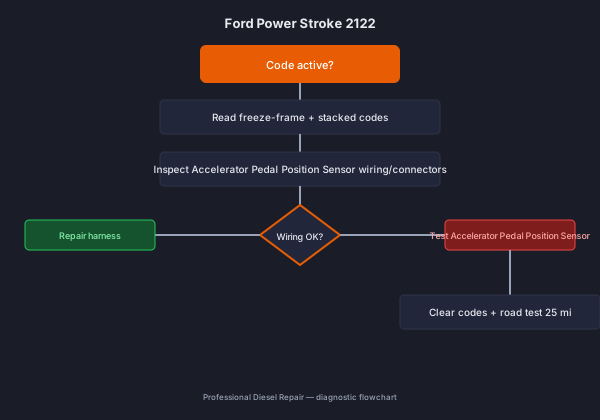
Connect Jaltest or Diesel Laptops and retrieve P2122 with freeze-frame. Check if any companion APP codes are stored — multiple APP circuit faults together point to a common wiring or connector problem rather than an individual circuit failure. — Tool: scan tool or multimeter. Document readings on the work order.
-
With the key on and engine off, use a multimeter to backprobe the APP sensor connector and measure the circuit D voltage. A healthy circuit D should read approximately 0.5–0.9V at rest and rise smoothly toward 4.5V at wide-open throttle. A reading at or near 0V confirms a circuit-low condition. — Tool: scan tool or multimeter. Document readings on the work order.
-
Inspect the APP sensor connector at the pedal assembly for pin spread, corrosion, or pushed-back terminals. Water intrusion at the floor-level connector is a common cause of low-circuit faults on Power Stroke trucks, especially on 6.0L engines. — Tool: scan tool or multimeter. Document readings on the work order.
-
Check the wiring harness from the pedal assembly to the PCM for chafing against the firewall or floor pan. A grounded circuit D wire will produce a persistent low-input fault regardless of pedal position. — Tool: scan tool or multimeter. Document readings on the work order.
-
If wiring and connector check out, the APP sensor assembly should be replaced as a unit — the individual circuits are not separately serviceable on Ford Power Stroke applications. — Tool: scan tool or multimeter. Document readings on the work order.
-
After repair, use Jaltest or Diesel Laptops to confirm all APP sensor PIDs sweep smoothly from idle to full throttle before clearing codes and returning the truck to service. — Tool: scan tool or multimeter. Document readings on the work order.
Repair Options (with Costs)
| Repair | DIY | Independent Shop | Dealer |
|---|---|---|---|
| Accelerator Pedal Position Sensor wiring repair | $25–$150 | $150–$350 | $250–$500 |
| Accelerator Pedal Position Sensor sensor/part | $50 - $180 | $$50 - $180 + labor | $200 - $450 |
| Full module replacement | N/A | $600–$1,500 | $200 - $450 |
Platform-Specific Notes
7.3L (1999–2003): HEUI — Follow ford-powerstroke OEM diagnostic tree for 2122 on 7.3L.
6.0L (2003–2007): HEUI/FICM — Follow ford-powerstroke OEM diagnostic tree for 2122 on 6.0L.
6.4L (2008–2010): Common-rail — Follow ford-powerstroke OEM diagnostic tree for 2122 on 6.4L.
6.7L (2011–2026): CP4.2 common-rail — Follow ford-powerstroke OEM diagnostic tree for 2122 on 6.7L.
When This Code Sets
2122 typically stores after the ECM detects accelerator pedal position sensor outside calibrated limits for 1.4–4.0 seconds (OBD-II trip). Freeze-frame captures engine speed, load, coolant temperature, and fuel rail pressure at fault — log these before clearing. Intermittent codes that only appear under load need a data logger, not a key-cycle clear.
Scan Tool Parameters to Log
- Accelerator Pedal Position Sensor live data PID at idle, cruise, and full load
- Battery voltage and ECM supply voltage
- Related aftertreatment and protection PIDs (SPN 1569 if stacked)
Common Misdiagnoses
Parts-cannon APP sensor replacement without first checking the connector and harness — P2122 names the sensor circuit, so the sensor assembly is the first item replaced. The connector inspection and wiring check that often resolve the fault are skipped.. Instead: Backprobe circuit D at the connector with a multimeter before ordering a sensor. A corroded pin or grounded wire is faster and cheaper to address than a sensor replacement.
Clearing codes and returning the truck to service without verifying all APP circuits sweep correctly — After a repair, the code clears and the truck drives normally on a short test — but the fault returns under specific pedal positions or temperatures.. Instead: Use Jaltest or Diesel Laptops to monitor all APP sensor PIDs through the complete pedal travel range before closing the job.
Shop Notes from the Field
Shop tip: ProfessionalDieselRepair.com inspects the APP sensor connector at the pedal assembly before ordering a new sensor on P2122 calls. Water intrusion and corroded terminals at the floor-level connector are responsible for a high percentage of circuit-low faults — cleaning and re-pinning the connector is often all that is needed. Use Jaltest to monitor all APP sensor PIDs simultaneously and confirm all circuits sweep smoothly after repair. On the 6.7L Power Stroke, also check for floor mat interference with the pedal travel that can prevent the sensor from reaching its calibration range.
Safety Warning
- Do not drive with P2122 active unless absolutely necessary — limp mode restricts acceleration in a way that can be hazardous in highway traffic.
- Disconnect the battery before probing the APP sensor connector on early 6.0L Power Strokes to avoid inadvertently activating the throttle control module.
Prevention Tips
- Inspect the APP sensor connector and harness routing during annual service for signs of corrosion or chafing.
- Avoid aftermarket floor mats that overlap the pedal area and restrict full pedal travel.
- Address any moisture intrusion into the cab floor pan promptly to prevent connector corrosion.
Related Codes
FAQ
What is APP sensor circuit D on the Ford Power Stroke?
The accelerator pedal position sensor on the Power Stroke uses multiple independent circuits that each send a voltage signal corresponding to pedal position. Circuit D is one of the redundant channels the PCM monitors to verify throttle demand. A low signal on circuit D triggers a protective limp mode.
Can I drive my Power Stroke with P2122 active?
The truck will operate in limp mode with severely restricted throttle response. Short low-speed drives to a shop are generally manageable, but highway driving with P2122 active is not safe.
How do I test the APP sensor circuit D with a multimeter?
Backprobe the circuit D pin at the APP sensor connector with the key on and engine off. The voltage should read approximately 0.5–0.9V at rest. Then slowly press the pedal to the floor — voltage should rise smoothly toward 4.5V. A reading stuck near 0V confirms a circuit-low condition.
What does 2122 mean on Ford Powerstroke 6.7L?
2122 means throttle/pedal position sensor/switch d circuit low input. The ECM detected accelerator pedal position sensor outside calibrated limits. Verify with freeze-frame data before clearing.
Can I drive with 2122 active?
Short distances only if power is normal. Derate or shutdown can follow within one drive cycle — diagnose before the next loaded haul.
How much does it cost to fix 2122?
DIY repairs start at $40–$150 for wiring or filters. Shop repairs with parts run $50 - $180. Dealer pricing runs $200 - $450.
What is the most common cause of 2122?
Corroded or water-intruded APP sensor connector — confirm with visual inspection and live data before ordering parts.
Sources
- OEM service information — Ford Powerstroke 6.7L diagnostic procedures
- SAE J2012 — OBD-II DTC definition for 2122
- Mitchell1 ProDemand — 2026 labor and parts cost surveys