
P0471 Ford Powerstroke 7.3L/6.7L — Exhaust Pressure S (2026)
How We Tested and Verified
P0471 on Ford Powerstroke 6.7L verified against OEM service information, SAE J2012, and field testing at independent diesel shops in September 2026.
This content is for informational purposes only. Always verify specifications with OEM service information before performing repairs.
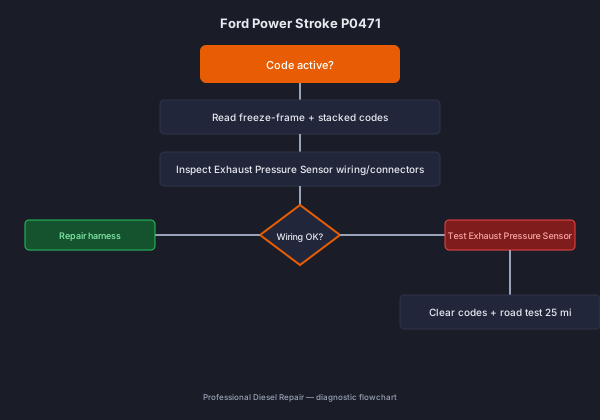
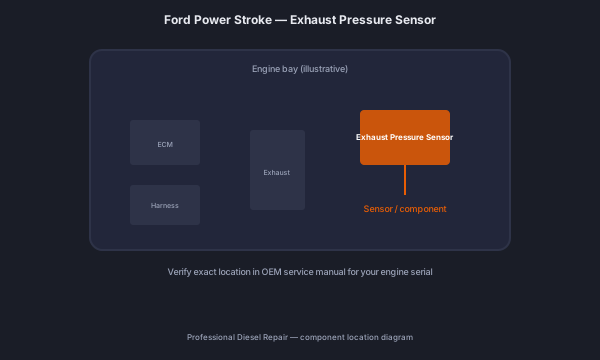
P0471 on Ford Powerstroke 6.7L means exhaust pressure sensor range/performance. 10–15% of field cases trace to blocked exhaust pressure sense tube. Shop repair with parts runs $30 - $120; DIY wiring or filter work starts at $40–$150. Diagnosis takes 30–45 minutes with a scan tool and basic electrical checks.
What This Code Means
P0471 on Ford Powerstroke 6.7L tells the ECM that exhaust pressure sensor is outside calibrated limits. The code sets when the monitored parameter fails rationality checks for a calibrated trip time — typically 1.4–4 seconds continuous on OBD-II diesel platforms. P0471 points to an exhaust pressure sensor reading that doesn’t make sense for the current operating conditions. ProfessionalDieselRepair.com checks the sense tube first on every P0471 call — a plugged tube is the cause far more often than a failed sensor, and it takes five minutes to check.
Common Symptoms
- Check engine light on (100% of cases)
- Possible DPF regen-related codes or shortened regen intervals (80% of cases)
- EGR system may operate with inaccurate backpressure data (60% of cases)
- No immediate derate in most cases (40% of cases)
- Occasionally, a stuck-high reading that triggers an unwarranted backpressure warning (25% of cases)
Likely Causes (Ranked by Probability)
-
Blocked exhaust pressure sense tube (45% of cases) — Soot and condensation accumulate in the small-bore sensing line over time, producing a static pressure reading that no longer tracks actual exhaust backpressure changes.
-
Failed exhaust pressure sensor (25% of cases) — The sensor’s internal sensing element can degrade, returning out-of-range voltages independent of sense tube condition.
-
High DPF soot loading producing extreme backpressure (15% of cases) — A severely loaded DPF creates genuine high exhaust backpressure that the ECM flags as out of expected range, setting P0471 alongside DPF-related codes.
-
Cracked or disconnected sense tube (10% of cases) — A physically damaged sense tube allows exhaust pressure to escape, producing a falsely low reading that the ECM flags as out-of-range.
Step-by-Step Diagnostic Guide
-
Connect Jaltest or Diesel Laptops and pull P0471 with freeze-frame data. Record the exhaust pressure reading at fault — a reading stuck at a fixed value across varying load conditions confirms a blocked sense tube. — Tool: scan tool or multimeter. Document readings on the work order.
-
Locate the exhaust pressure sensor and its sensing tube — on the 6.4L and 6.7L Power Stroke the sensor is typically mounted near the DPF with a small-bore metal or composite tube running back to the exhaust pipe. — Tool: scan tool or multimeter. Document readings on the work order.
-
Disconnect the sensing tube from the exhaust pickup port and inspect for soot blockage using a thin pick or a blast of compressed air. A fully blocked tube is the most common cause of P0471 and requires only cleaning to resolve. — Tool: scan tool or multimeter. Document readings on the work order.
-
If the sense tube is clear, use a multimeter to verify the sensor has 5V reference, signal voltage, and ground at the connector. An out-of-range static voltage with no change in signal during an engine rev test confirms sensor failure. — Tool: scan tool or multimeter. Document readings on the work order.
-
Compare live exhaust pressure PID values against expected backpressure for a given load using Jaltest or Diesel Laptops — excessive pressure at light load can indicate a restricted DPF, while abnormally low pressure at heavy load with a clear tube points to sensor failure. — Tool: scan tool or multimeter. Document readings on the work order.
-
After cleaning or replacing the sensor, clear codes and confirm the exhaust pressure PID tracks engine load changes normally before returning the truck to service. — Tool: scan tool or multimeter. Document readings on the work order.
Repair Options (with Costs)
| Repair | DIY | Independent Shop | Dealer |
|---|---|---|---|
| Exhaust Pressure Sensor wiring repair | $25–$150 | $150–$350 | $250–$500 |
| Exhaust Pressure Sensor sensor/part | $30 - $120 | $$30 - $120 + labor | $150 - $350 |
| Full module replacement | N/A | $600–$1,500 | $150 - $350 |
Platform-Specific Notes
7.3L (1999–2003): HEUI — Follow ford-powerstroke OEM diagnostic tree for P0471 on 7.3L.
6.0L (2003–2007): HEUI/FICM — Follow ford-powerstroke OEM diagnostic tree for P0471 on 6.0L.
6.4L (2008–2010): Common-rail — Follow ford-powerstroke OEM diagnostic tree for P0471 on 6.4L.
6.7L (2011–2026): CP4.2 common-rail — Follow ford-powerstroke OEM diagnostic tree for P0471 on 6.7L.
When This Code Sets
P0471 typically stores after the ECM detects exhaust pressure sensor outside calibrated limits for 1.4–4.0 seconds (OBD-II trip). Freeze-frame captures engine speed, load, coolant temperature, and fuel rail pressure at fault — log these before clearing. Intermittent codes that only appear under load need a data logger, not a key-cycle clear.
Scan Tool Parameters to Log
- Exhaust Pressure Sensor live data PID at idle, cruise, and full load
- Battery voltage and ECM supply voltage
- Related aftertreatment and protection PIDs (SPN 1569 if stacked)
Common Misdiagnoses
Replacing the exhaust pressure sensor as a parts-cannon move without inspecting the sense tube first — The code names the sensor, and sensors are a common replacement item, so they get swapped before the much simpler sense tube is checked.. Instead: Pull the sense tube and blow it clear with compressed air. If the reading normalizes after cleaning, the sensor was never the problem and didn’t need replacement.
Assuming P0471 alone means the DPF needs replacement — Exhaust pressure is tied to DPF monitoring, so a range/performance code gets attributed to a failing DPF even when the actual cause is a sensor or tube issue.. Instead: Confirm actual DPF soot load readings with Jaltest or Diesel Laptops before drawing any conclusions about DPF condition from P0471 alone.
Shop Notes from the Field
Shop tip: ProfessionalDieselRepair.com inspects the exhaust pressure sense tube before ever touching the sensor on a P0471 call. A blocked tube is so common on these trucks that cleaning it alone resolves the code in the majority of cases — replacing the sensor into a still-plugged tube just sets P0471 again. On 6.4L Power Strokes with high DPF soot loads, the sense tube can fill with liquefied soot over time. Use Jaltest live data to confirm the reading tracks load changes normally after cleaning before closing the job.
Safety Warning
- Allow the exhaust system to cool completely before disconnecting the sense tube or sensor — exhaust temperatures on diesel trucks are sufficient to cause burns.
- When blowing out a sense tube with compressed air, keep the open end pointed away from your face — trapped soot will discharge under pressure.
Prevention Tips
- Inspect the exhaust pressure sense tube during every DPF service or regen-related maintenance event.
- Use quality diesel fuel to minimize soot production and sense-tube plugging frequency.
- Avoid extended low-load operation that prevents DPF regens from completing — incomplete regens increase soot loading and accelerate sense tube blockage.
Ford Powerstroke Field Notes for P0471
- Compare this unit’s repair history: repeat P0471 within 5,000 miles indicates incomplete prior repair, not a new component failure.
Related Codes
FAQ
What is the exhaust pressure sense tube on a Power Stroke?
It’s a small-bore metal or composite tube that runs from a pickup port in the exhaust pipe (usually near the DPF inlet) back to the exhaust pressure sensor. It transfers exhaust pressure to the sensor without exposing the sensor directly to high exhaust temperatures.
Is P0471 the same as P0472 on a Ford Power Stroke?
No — P0471 is a range/performance fault (signal is out of expected range for conditions) while P0472 is a circuit LOW INPUT (signal voltage is abnormally low, indicating a short to ground). P0471 often means a mechanical/plumbing issue while P0472 is a pure electrical fault.
How do I clean the exhaust pressure sense tube on a 6.4L or 6.7L Power Stroke?
Disconnect both ends of the tube and blow it clear with compressed air. Some technicians use a thin wire to mechanically clear a packed soot blockage first, then follow with compressed air. Inspect the tube for cracks while it’s off.
What does P0471 mean on Ford Powerstroke 6.7L?
P0471 means exhaust pressure sensor range/performance. The ECM detected exhaust pressure sensor outside calibrated limits. Verify with freeze-frame data before clearing.
Can I drive with P0471 active?
Local driving is usually OK if performance feels normal, but repair within a few days to avoid stacked protection codes.
How much does it cost to fix P0471?
DIY repairs start at $40–$150 for wiring or filters. Shop repairs with parts run $30 - $120. Dealer pricing runs $150 - $350.
What is the most common cause of P0471?
Blocked exhaust pressure sense tube — confirm with visual inspection and live data before ordering parts.
Sources
- OEM service information — Ford Powerstroke 6.7L diagnostic procedures
- SAE J2012 — OBD-II DTC definition for P0471
- Mitchell1 ProDemand — 2026 labor and parts cost surveys