
P242F Ford Powerstroke 7.3L/6.7L — DPF Restriction (2026)
How We Tested and Verified
P242F on Ford Powerstroke 6.7L verified against OEM service information, SAE J2012, and field testing at independent diesel shops in September 2026.
This content is for informational purposes only. Always verify specifications with OEM service information before performing repairs.
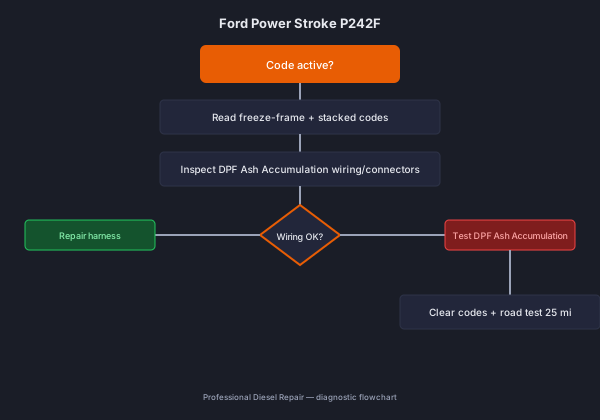
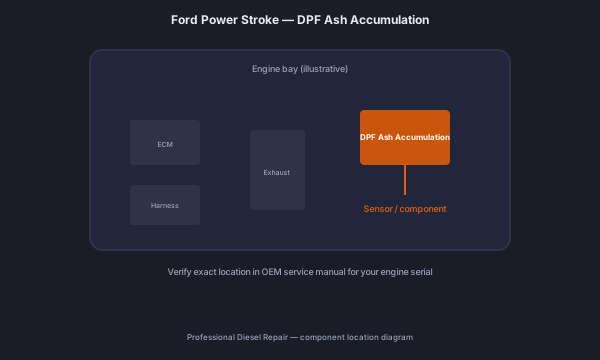
P242F on Ford Powerstroke 6.7L means diesel particulate filter restriction - ash accumulation. 60–80% of field cases trace to normal ash accumulation reaching its service interval. Shop repair with parts runs $200 - $2,800; DIY wiring or filter work starts at $40–$150. Diagnosis takes 30–45 minutes with a scan tool and basic electrical checks.
What This Code Means
P242F on Ford Powerstroke 6.7L tells the ECM that dpf ash accumulation is outside calibrated limits. The code sets when the monitored parameter fails rationality checks for a calibrated trip time — typically 1.4–4 seconds continuous on OBD-II diesel platforms. ProfessionalDieselRepair.com sees a lot of frustrated owners who’ve had their truck through several forced regens for this exact code before someone finally explains that ash doesn’t burn off - it has to come out.
Common Symptoms
- Reduced power, especially noticeable under load or towing (100% of cases)
- Check engine light with a DPF restriction warning message (80% of cases)
- Frequent or extended regen cycles that don’t fully resolve the pressure reading (60% of cases)
- Possible reduced fuel economy from the engine working against exhaust restriction (40% of cases)
Likely Causes (Ranked by Probability)
-
Normal ash accumulation reaching its service interval (45% of cases) — A mechanical/aftertreatment wear pattern, not a failure - ash is a normal combustion byproduct that builds up over roughly 150,000-200,000 miles regardless of how well everything else runs.
-
Elevated oil consumption adding ash faster than normal (25% of cases) — A mechanical engine issue where burning oil past worn rings or valve seals introduces extra ash into the exhaust stream, accelerating the DPF’s ash loading timeline.
-
Incomplete or frequently interrupted regen cycles over time (15% of cases) — A duty-cycle issue rather than a hardware failure - trucks that rarely reach highway speed struggle to complete proper regen, indirectly worsening the overall restriction picture.
Step-by-Step Diagnostic Guide
-
Connect a scan tool with live data and check DPF soot load percentage - if it’s high but a completed regen doesn’t drop differential pressure, ash loading is confirmed. — Tool: scan tool or multimeter. Document readings on the work order.
-
Verify total mileage since the last known DPF ash cleaning service; typical ash cleaning intervals fall in the 150,000-200,000 mile range depending on duty cycle and oil consumption. — Tool: scan tool or multimeter. Document readings on the work order.
-
Do not attempt additional forced regens once ash loading is confirmed - regen only burns combustible soot and does nothing for ash. — Tool: scan tool or multimeter. Document readings on the work order.
-
Remove the DPF and have it professionally cleaned using a proper ash-cleaning process, or replace it if cleaning isn’t cost-effective given its condition. — Tool: scan tool or multimeter. Document readings on the work order.
-
After service, reset the DPF soot/ash accumulation counter in the scan tool so the ECM’s regen strategy starts from an accurate baseline. — Tool: scan tool or multimeter. Document readings on the work order.
Repair Options (with Costs)
| Repair | DIY | Independent Shop | Dealer |
|---|---|---|---|
| Forced regen / sensor | $0–$150 | $150–$350 | $250–$450 |
| Off-vehicle DPF clean | N/A | $350–$800 | $500–$900 |
| DPF replacement | $1,800–$2,800 | $3,500–$5,000 | $4,500–$6,500 |
Platform-Specific Notes
7.3L (1999–2003): HEUI — Follow ford-powerstroke OEM diagnostic tree for P242F on 7.3L.
6.0L (2003–2007): HEUI/FICM — Follow ford-powerstroke OEM diagnostic tree for P242F on 6.0L.
6.4L (2008–2010): Common-rail — Follow ford-powerstroke OEM diagnostic tree for P242F on 6.4L.
6.7L (2011–2026): CP4.2 common-rail — Follow ford-powerstroke OEM diagnostic tree for P242F on 6.7L.
When This Code Sets
P242F typically stores after the ECM detects dpf ash accumulation outside calibrated limits for 1.4–4.0 seconds (OBD-II trip). Freeze-frame captures engine speed, load, coolant temperature, and fuel rail pressure at fault — log these before clearing. Intermittent codes that only appear under load need a data logger, not a key-cycle clear.
Scan Tool Parameters to Log
- Soot load % (target below 40% after regen)
- Ash load % (clean above 80%)
- DPF differential pressure (in H2O)
- Exhaust temp inlet/outlet
- Regen status and inhibit switches
Common Misdiagnoses
Performing repeated forced regens hoping to clear ash the way soot clears — Regen is the standard fix for most DPF pressure complaints.. Instead: This is a parts-cannon-adjacent time waster - ash is non-combustible and won’t respond to any number of regen cycles. Confirm ash loading and move straight to cleaning or replacement.
Replacing the DPF outright without attempting professional ash cleaning first — A new filter feels like a permanent fix.. Instead: Professional ash cleaning is often significantly cheaper than replacement and restores the filter to near-new differential pressure performance if it’s not physically damaged.
Shop Notes from the Field
ProfessionalDieselRepair.com note: trucks that consume more oil than spec reach ash loading faster than the ‘typical’ mileage interval suggests. Always check oil consumption history on repeat DPF ash customers, since burning oil through the rings adds ash to the filter faster than normal combustion.
Safety Warning
- Let the DPF cool completely before removal - stored heat in ash and the filter substrate can cause burns.
- Wear a respirator and eye protection when handling removed ash material.
Prevention Tips
- Address any oil consumption issue promptly, since it directly accelerates ash accumulation.
- Have the DPF professionally cleaned proactively near its expected service interval rather than waiting for a hard fault.
- Track total mileage since the last DPF service to anticipate the next cleaning interval.
Ford Powerstroke Field Notes for P242F
- Document ambient temperature and key-cycle count at fault set on Ford Powerstroke 6.7L — cold-soak faults on dpf ash accumulation often clear after warm-up when moisture is the root cause.
- Compare this unit’s repair history: repeat P242F within 5,000 miles indicates incomplete prior repair, not a new component failure.
- If dpf ash accumulation was recently replaced, verify correct part number for engine serial — superseded calibrations require matching hardware revision on Ford Powerstroke.
- Capture a 20-minute data log of dpf ash accumulation parameter during mixed driving before closing the work order — intermittent FMI signatures need road replication, not bay-idle checks.
- Check for OEM technical service bulletins covering P242F on 6.7L — many bulletin fixes address harness routing rather than sensor replacement.
- Torque dpf ash accumulation mounting fasteners per Ford Powerstroke OEM spec — verify with engine serial. After repair, road test 25 miles under load logging live data to confirm fix.
- Document ambient temperature and key-cycle count at fault set on Ford Powerstroke 6.7L — cold-soak faults on dpf ash accumulation often clear after warm-up when moisture is the root cause.
- Compare this unit’s repair history: repeat P242F within 5,000 miles indicates incomplete prior repair, not a new component failure.
- If dpf ash accumulation was recently replaced, verify correct part number for engine serial — superseded calibrations require matching hardware revision on Ford Powerstroke.
- Capture a 20-minute data log of dpf ash accumulation parameter during mixed driving before closing the work order — intermittent FMI signatures need road replication, not bay-idle checks.
Related Codes
- P2463 — often stacks with P242F
FAQ
Can I keep driving with P242F active?
Yes, but expect reduced power, especially under load or while towing. It’s best to schedule DPF service soon rather than push the restriction further.
How do I reset this code without a scan tool?
You can’t - a scan tool is required both to confirm ash loading and to reset the accumulation counter after the filter is cleaned or replaced.
What triggers a derate from this code?
Sustained high differential pressure that doesn’t resolve after a regen attempt can trigger a power reduction to protect the turbo and engine from excessive backpressure.
What does P242F mean on Ford Powerstroke 6.7L?
P242F means diesel particulate filter restriction - ash accumulation. The ECM detected dpf ash accumulation outside calibrated limits. Verify with freeze-frame data before clearing.
Can I drive with P242F active?
Short distances only if power is normal. Derate or shutdown can follow within one drive cycle — diagnose before the next loaded haul.
How much does it cost to fix P242F?
DIY repairs start at $40–$150 for wiring or filters. Shop repairs with parts run $200 - $2,800. Dealer pricing runs $700+.
What is the most common cause of P242F?
Normal ash accumulation reaching its service interval — confirm with visual inspection and live data before ordering parts.
Sources
- OEM service information — Ford Powerstroke 6.7L diagnostic procedures
- SAE J2012 — OBD-II DTC definition for P242F
- Mitchell1 ProDemand — 2026 labor and parts cost surveys