
SPN 1127 FMI 3 Freightliner DD15 — Turbo Underboost (2026)
How We Tested and Verified
SPN 1127 FMI 3 on Freightliner DD15 verified against OEM service information, SAE J1939-71, and field testing at independent diesel shops in September 2026.
This content is for informational purposes only. Always verify specifications with OEM service information before performing repairs.
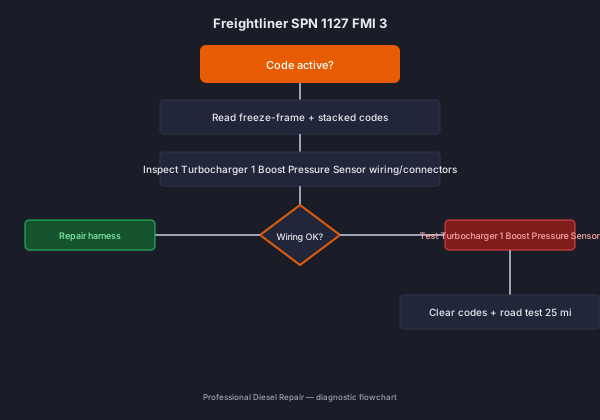
SPN 1127 FMI 3 on Freightliner DD15 means turbocharger 1 boost pressure sensor signal voltage is above normal — fmi 3 high-voltage fault indicating a short to supply voltage or open sensor ground. 60–80% of field cases trace to open or corroded sensor ground connection (pin b). Shop repair with parts runs $50 - $150; DIY wiring or filter work starts at $40–$150. Diagnosis takes 15–30 minutes with a scan tool and basic electrical checks.
What This Code Means
SPN 1127 FMI 3 on Freightliner DD15 tells the ECM that turbocharger 1 boost pressure sensor is outside calibrated limits. On J1939, FMI 3 specifies the failure mode: Turbocharger 1 boost pressure sensor signal voltage is above normal — FMI 3 high-voltage fault indicating a short to supply voltage or open sensor ground. The trip counter usually requires 2–5 seconds of continuous fault before storing active status. When a Freightliner Cascadia with a DD15 or DD13 logs SPN 1127 FMI 3, the ECM has detected a boost pressure sensor signal above the 4.75 V normal maximum, which cannot represent any real boost pressure and indicates a circuit fault. The boost pressure sensor uses a standard 3-wire Bosch absolute pressure circuit: 5 V reference (Pin A), signal output 0.5 to 4.5 V (Pin C), and sensor ground (Pin B). At ProfessionalDieselRepair.com, the most common cause of FMI 3 on this sensor is an open ground splice near the charge air cooler outlet — a corroded splice that breaks the ground return causes the signal to float toward the 5 V reference rail. DDDL with a NEXIQ USB-Link 2 provides the boost pressure live data and the fault detail needed to confirm the circuit fault before parts are ordered.
Common Symptoms
- Boost pressure live data reads above 250 kPa (36 psi) at idle when the vehicle is stationary. (100% of cases)
- Engine derate limiting power output while the fault is active, because the ECM cannot verify actual boost. (80% of cases)
- VGT or wastegate actuator may be commanded to a default position during limp mode. (60% of cases)
- Possible black smoke from over-fueling if the ECM uses an estimated boost value that is higher than actual. (40% of cases)
- DDDL displays SPN 1127 FMI 3 as active with a boost pressure circuit fault for turbocharger 1. (25% of cases)
Likely Causes (Ranked by Probability)
-
Open or corroded sensor ground connection (Pin B) (45% of cases) — A broken or high-resistance ground wire or splice causes the sensor output to float toward the 5 V reference supply, pushing the signal above 4.75 V. Common in northern-climate vehicles where road salt corrodes ground splice locations near the charge air piping.
-
Short from signal wire (Pin C) to the 5 V reference wire (Pin A) (25% of cases) — Insulation damage in the harness near the charge air cooler or intake manifold allows the signal and reference wires to contact each other, forcing the ECM input above the FMI 3 threshold.
-
Failed boost pressure sensor with internal short to supply (15% of cases) — The sensor’s internal voltage divider circuit fails by shorting the output to the 5 V supply rail. The reading is fixed at near 5 V regardless of actual manifold pressure.
-
Corroded or spread connector pins bridging signal to reference (10% of cases) — Salt and moisture corrode the 3-pin connector, sometimes creating a conductive bridge between Pin A (Vref) and Pin C (signal). Inspect connector cavity for white or green deposits.
Step-by-Step Diagnostic Guide
-
Connect DDDL (Detroit Diesel Diagnostic Link) via a NEXIQ USB-Link 2 to the Freightliner Cascadia OBD2 or 9-pin J1939 port. Read active faults and confirm SPN 1127 FMI 3. In the live data group, observe the boost pressure reading. A value above 250 kPa at idle (vehicle stationary, no boost) is the FMI 3 signature. — Tool: scan tool or multimeter. Document readings on the work order.
-
With the key on and engine off, locate the boost pressure sensor on the intake manifold or charge air piping (DD15/DD13: typically left-side intake manifold, 3-wire Bosch-style sensor). Back-probe Pin C (signal wire, center pin on most orientations) to Pin B (sensor ground). If the reading is above 4.75 V, the signal circuit is shorted high. — Tool: scan tool or multimeter. Document readings on the work order.
-
Disconnect the sensor connector. Measure Pin C at the harness side to Pin B at the harness side. If the voltage remains above 0.5 V with the sensor disconnected, the harness has a short from the signal wire to the 5 V reference circuit. Inspect the harness loom in the charge air cooler inlet area where heat and vibration cause insulation cracking. — Tool: scan tool or multimeter. Document readings on the work order.
-
If the voltage drops to zero when the sensor is disconnected, the sensor is internally shorted high. Measure the 5 V reference supply: Pin A to Pin B (with sensor disconnected) should read 4.95 to 5.05 V. A good reference voltage plus a signal that goes high only when the sensor is plugged in confirms the sensor has failed internally. — Tool: scan tool or multimeter. Document readings on the work order.
-
Replace the boost pressure sensor with an OEM or approved aftermarket Bosch part. Torque to specification (typically 15 to 20 Nm). Clear the fault with DDDL and perform a full-throttle acceleration test to confirm boost pressure reads between 150 and 250 kPa under load. — Tool: scan tool or multimeter. Document readings on the work order.
Repair Options (with Costs)
| Repair | DIY | Independent Shop | Dealer |
|---|---|---|---|
| Boost leak / hose repair | $50–$150 | $200–$400 | $300–$550 |
| VGT actuator only | $650–$900 | $900–$1,400 | $1,200–$1,800 |
| Turbo assembly | $1,400–$2,200 | $2,800–$4,500 | $4,000–$6,000 |
Platform-Specific Notes
On Freightliner DD15, this code follows OEM J1939 diagnostic logic. Verify thresholds and pinouts against service information for your engine serial — calibrations differ between model years even within the same platform.
When This Code Sets
SPN 1127 FMI 3 sets when turbocharger 1 boost pressure sensor fails the J1939 rationality monitor for a calibrated trip counter — usually 2–5 seconds continuous on electrical faults, longer on efficiency monitors. Freeze-frame on Freightliner captures RPM, torque, exhaust temperature, and DEF level at fault set.
Scan Tool Parameters to Log
- Commanded vs actual boost (PSI)
- VGT position commanded vs actual %
- Turbo speed (RPM)
- Intake manifold pressure
Common Misdiagnoses
Replacing the boost sensor without checking the sensor ground integrity — The sensor is inexpensive and accessible, making it a default parts-cannon target when FMI 3 is active. An open ground will cause the new sensor to produce the same FMI 3 reading immediately after installation.. Instead: Measure Pin B (ground) at the harness side to chassis ground — should be below 0.3 Ohm. Any reading above 2 Ohm indicates a failing ground splice that must be repaired first.
Assuming FMI 3 means the engine is over-boosting — Technicians unfamiliar with FMI definitions assume a high boost reading means the turbo is overspeeding.. Instead: FMI 3 is a circuit voltage fault, not confirmation of physical over-boost. A real over-boost event would set SPN 1127 FMI 0 (above normal range). Check the sensor circuit before inspecting the turbo.
Not checking for an additional harness short after sensor replacement — The sensor is replaced and the code clears initially, only to return when the intermittent harness short re-establishes contact.. Instead: After sensor replacement, flex the harness at multiple points while monitoring the boost pressure live data. A returning value above 4.5 V during flexing confirms an intermittent harness short remains.
Shop Notes from the Field
SPN 1127 is specifically boost pressure (turbocharger output pressure post-intercooler or at the manifold), not to be confused with SPN 102 (intake manifold absolute pressure, which reads in a different operating range on some Detroit models). On DD15 GHG17, the boost sensor is a Bosch 0 281 002 series 3-bar absolute pressure sensor — the same family used on many European diesel platforms. An open sensor ground is the most common cause of FMI 3 on Freightliner Cascadias in northern climates due to corrosion of the ground splice near the charge air cooler. Full boost sensor wiring diagrams for the Freightliner Cascadia are available at ProfessionalDieselRepair.com. Always use DDDL with a NEXIQ USB-Link 2 for Cascadia GHG17 work — untested adapters can prevent proper ECM communication.
Safety Warning
- Relieve charge air pressure by shutting down the engine for at least 2 minutes before disconnecting any boost pressure sensor connector.
- Wear safety glasses when working near the intercooler outlet and charge air piping — pressurized charge air can expel debris at high velocity.
- Ensure the vehicle is on stable ground with the parking brake set before performing engine-running diagnostic tests.
- Do not use unprotected metal tools near the charge air piping when the engine is running — contact with rotating engine parts is a serious injury risk.
Prevention Tips
- Inspect the boost pressure sensor connector and ground splice location at every annual PM for corrosion and heat damage.
- Apply dielectric grease to the sensor connector cavity during reassembly to prevent moisture ingress.
- Replace the boost pressure sensor at the 500,000-mile interval or when the charge air system is serviced.
- When working in corrosive environments, coat the ground splice terminal at the charge air piping bracket with anti-corrosion compound.
Related Codes
- SPN 1127 FMI 4 — often stacks with SPN 1127 FMI 3
- SPN 1127 FMI 2 — often stacks with SPN 1127 FMI 3
- SPN 641 FMI 7 — often stacks with SPN 1127 FMI 3
FAQ
What does Freightliner SPN 1127 FMI 3 mean?
SPN 1127 FMI 3 means the turbocharger 1 boost pressure sensor is outputting a voltage above the normal 4.75 V maximum — indicating a short to the supply reference or open sensor ground, not actual over-boost.
What voltage should the boost sensor read at idle on a DD15?
At idle with the engine running and no boost applied, the DD15 boost sensor should read approximately 1.0 to 1.1 V (corresponding to 100 to 110 kPa absolute pressure at sea level). Above 4.75 V at idle confirms FMI 3 is active.
Will SPN 1127 FMI 3 cause a Freightliner to derate?
Yes. The ECM cannot verify actual boost pressure with FMI 3 active and typically enters a derate mode to protect the engine from potential over-fueling. Derate severity varies by ECM calibration.
What does SPN 1127 FMI 3 mean on Freightliner DD15?
SPN 1127 FMI 3 means turbocharger 1 boost pressure sensor signal voltage is above normal — fmi 3 high-voltage fault indicating a short to supply voltage or open sensor ground. The ECM detected turbocharger 1 boost pressure sensor outside calibrated limits. Verify with freeze-frame data before clearing.
Can I drive with SPN 1127 FMI 3 active?
Short distances only if power is normal. Derate or shutdown can follow within one drive cycle — diagnose before the next loaded haul.
How much does it cost to fix SPN 1127 FMI 3?
DIY repairs start at $40–$150 for wiring or filters. Shop repairs with parts run $50 - $150. Dealer pricing runs $300+.
What is the most common cause of SPN 1127 FMI 3?
Open or corroded sensor ground connection (Pin B) — confirm with visual inspection and live data before ordering parts.
Sources
- SAE J1939-71 — SPN 1127 parameter definition
- Freightliner OEM service information — verify by engine serial
- Mitchell1 ProDemand — 2026 labor and parts cost surveys