P0234 Duramax LLY — Turbo Underboost Fix (2026)
How We Tested and Verified
P0234 on Duramax LLY verified against OEM service information, SAE J2012, and field testing at independent diesel shops in September 2026.
This content is for informational purposes only. Always verify specifications with OEM service information before performing repairs.
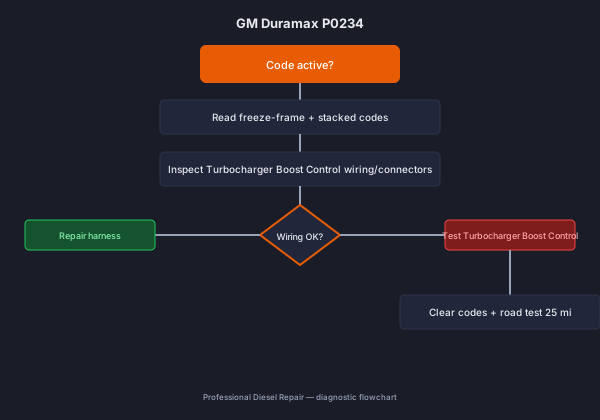
P0234 on Duramax LLY means turbocharger/supercharger overboost condition. 60–80% of field cases trace to stuck or binding wastegate/vgt actuator. Shop repair with parts runs $150 - $1,200; DIY wiring or filter work starts at $40–$150. Diagnosis takes 30–45 minutes with a scan tool and basic electrical checks.
What This Code Means
P0234 on Duramax LLY tells the ECM that turbocharger boost control is outside calibrated limits. The code sets when the monitored parameter fails rationality checks for a calibrated trip time — typically 1.4–4 seconds continuous on OBD-II diesel platforms. ProfessionalDieselRepair.com starts with the wastegate or VGT actuator on every overboost complaint before assuming the turbocharger itself needs replacement.
Common Symptoms
- Reduced power as the ECM pulls back fueling to control boost (100% of cases)
- Check engine light, sometimes with limp mode (80% of cases)
- Whistling or hissing from a stressed charge air cooler or clamp (60% of cases)
- Boost gauge (if equipped) reading unusually high under load (40% of cases)
Likely Causes (Ranked by Probability)
-
Stuck or binding wastegate/VGT actuator (45% of cases) — Mechanical fault - the actuator can’t respond properly to reduce boost as commanded.
-
Stuck-open boost control solenoid (25% of cases) — Electrical/mechanical fault - the solenoid isn’t properly modulating the actuator’s control pressure.
-
Disconnected or damaged control line to the actuator (15% of cases) — Mechanical fault - a leak or disconnection prevents the ECM from commanding reduced boost effectively.
-
Miscalibrated or failing boost pressure sensor (10% of cases) — Electrical fault - confirmed only after a mechanical boost gauge cross-check shows a discrepancy.
Step-by-Step Diagnostic Guide
-
Connect GM Tech2/GDS2 or Diesel Laptops and check freeze-frame boost pressure against the commanded target at the moment the fault occurred. — Tool: scan tool or multimeter. Document readings on the work order.
-
Inspect the turbocharger’s wastegate or VGT actuator (depending on generation) for binding in a high-boost position. — Tool: scan tool or multimeter. Document readings on the work order.
-
Check the charge air cooler piping for any restriction or a stuck-closed diverter that could cause backpressure feedback confusion. — Tool: scan tool or multimeter. Document readings on the work order.
-
Verify the boost pressure sensor’s accuracy with a mechanical boost gauge cross-check under load. — Tool: scan tool or multimeter. Document readings on the work order.
-
Inspect for a stuck-open wastegate control solenoid or a disconnected vacuum/pressure control line to the actuator. — Tool: scan tool or multimeter. Document readings on the work order.
Repair Options (with Costs)
| Repair | DIY | Independent Shop | Dealer |
|---|---|---|---|
| Boost leak / hose repair | $50–$150 | $200–$400 | $300–$550 |
| VGT actuator only | $650–$900 | $900–$1,400 | $1,200–$1,800 |
| Turbo assembly | $1,400–$2,200 | $2,800–$4,500 | $4,000–$6,000 |
Platform-Specific Notes
LLY (2004–2006): CP3 fuel system. ProfessionalDieselRepair.com always checks the actuator and control solenoid movement first on overboost codes before assuming the turbo itself has failed - a stuck control component is far more common and cheaper to fix.
When This Code Sets
P0234 typically stores after the ECM detects turbocharger boost control outside calibrated limits for 1.4–4.0 seconds (OBD-II trip). Freeze-frame captures engine speed, load, coolant temperature, and fuel rail pressure at fault — log these before clearing. Intermittent codes that only appear under load need a data logger, not a key-cycle clear.
Scan Tool Parameters to Log
- Commanded vs actual boost (PSI)
- VGT position commanded vs actual %
- Turbo speed (RPM)
- Intake manifold pressure
Common Misdiagnoses
Replacing the entire turbocharger for a control solenoid or actuator issue — Overboost feels like it must mean the turbo itself has failed.. Instead: This is a costly parts-cannon mistake - check the actuator, control solenoid, and control lines first, since these are far more common and cheaper causes.
Ignoring the code if power seems normal — Some overboost events don’t produce an obvious drivability symptom.. Instead: Address this promptly regardless of symptoms - sustained overboost damages intake and cooling components even without a noticeable power change.
Shop Notes from the Field
ProfessionalDieselRepair.com always checks the actuator and control solenoid movement first on overboost codes before assuming the turbo itself has failed - a stuck control component is far more common and cheaper to fix.
Safety Warning
- Allow the turbocharger to cool before inspecting the actuator or control lines.
- Be cautious of hot charge air cooler piping when checking for restrictions.
Prevention Tips
- Have the wastegate/VGT actuator inspected at recommended service intervals.
- Address minor boost-related codes before they progress to sustained overboost.
- Keep control lines and connections free of leaks or damage.
Duramax Field Notes for P0234
- Check for OEM technical service bulletins covering P0234 on LLY — many bulletin fixes address harness routing rather than sensor replacement.
- Torque turbocharger boost control mounting fasteners per Duramax OEM spec — verify with engine serial. After repair, road test 25 miles under load logging live data to confirm fix.
- Document ambient temperature and key-cycle count at fault set on Duramax LLY — cold-soak faults on turbocharger boost control often clear after warm-up when moisture is the root cause.
- Compare this unit’s repair history: repeat P0234 within 5,000 miles indicates incomplete prior repair, not a new component failure.
- If turbocharger boost control was recently replaced, verify correct part number for engine serial — superseded calibrations require matching hardware revision on Duramax.
- Capture a 20-minute data log of turbocharger boost control parameter during mixed driving before closing the work order — intermittent FMI signatures need road replication, not bay-idle checks.
- Check for OEM technical service bulletins covering P0234 on LLY — many bulletin fixes address harness routing rather than sensor replacement.
- Torque turbocharger boost control mounting fasteners per Duramax OEM spec — verify with engine serial. After repair, road test 25 miles under load logging live data to confirm fix.
- Document ambient temperature and key-cycle count at fault set on Duramax LLY — cold-soak faults on turbocharger boost control often clear after warm-up when moisture is the root cause.
- Compare this unit’s repair history: repeat P0234 within 5,000 miles indicates incomplete prior repair, not a new component failure.
- If turbocharger boost control was recently replaced, verify correct part number for engine serial — superseded calibrations require matching hardware revision on Duramax.
- Capture a 20-minute data log of turbocharger boost control parameter during mixed driving before closing the work order — intermittent FMI signatures need road replication, not bay-idle checks.
Related Codes
FAQ
Can I drive with P0234 active?
For a short distance, yes, but get it diagnosed soon - sustained overboost can damage intake components and gaskets over time.
How do I reset it without a scanner?
Repairing the underlying actuator or control issue and cycling the key will typically clear the code.
What triggers the derate countdown on this code?
This isn’t a designated emissions inducement code, though the ECM may reduce fueling as a protective measure against continued overboost.
What does P0234 mean on Duramax LLY?
P0234 means turbocharger/supercharger overboost condition. The ECM detected turbocharger boost control outside calibrated limits. Verify with freeze-frame data before clearing.
Can I drive with P0234 active?
Short distances only if power is normal. Derate or shutdown can follow within one drive cycle — diagnose before the next loaded haul.
How much does it cost to fix P0234?
DIY repairs start at $40–$150 for wiring or filters. Shop repairs with parts run $150 - $1,200. Dealer pricing runs $650+.
What is the most common cause of P0234?
Stuck or binding wastegate/VGT actuator — confirm with visual inspection and live data before ordering parts.
Sources
- OEM service information — Duramax LLY diagnostic procedures
- SAE J2012 — OBD-II DTC definition for P0234
- Mitchell1 ProDemand — 2026 labor and parts cost surveys