
P2033 Duramax LB7/L5P — Exhaust Gas Temperature Senso (2026)
How We Tested and Verified
P2033 on Duramax LML verified against OEM service information, SAE J2012, and field testing at independent diesel shops in September 2026.
This content is for informational purposes only. Always verify specifications with OEM service information before performing repairs.
P2033 on Duramax LML means exhaust gas temperature sensor circuit low bank 1 sensor 2. 60–80% of field cases trace to chafed or shorted egt sensor harness. Shop repair with parts runs $75 - $250; DIY wiring or filter work starts at $40–$150. Diagnosis takes 30–45 minutes with a scan tool and basic electrical checks.
What This Code Means
P2033 on Duramax LML tells the ECM that exhaust gas temperature sensor bank 1 sensor 2 is outside calibrated limits. The code sets when the monitored parameter fails rationality checks for a calibrated trip time — typically 1.4–4 seconds continuous on OBD-II diesel platforms. ProfessionalDieselRepair.com treats Duramax P2033 as an aftertreatment wiring problem until proven otherwise. When Bank 1 Sensor 2 drops out, the ECM loses confidence in exhaust temperature downstream of the turbo and may withhold DPF regeneration.
Common Symptoms
- Check engine light (100% of cases)
- Reduced or blocked DPF regen attempts (80% of cases)
- Companion SCR or DPF efficiency codes over time (60% of cases)
- Exhaust temperature gauge or data may read incorrectly (40% of cases)
- No immediate power loss in most cases (25% of cases)
Likely Causes (Ranked by Probability)
-
Chafed or shorted EGT sensor harness (45% of cases) — Rubbing against frame or heat shields shorts the signal wire to ground, producing a low circuit reading.
-
Failed downstream EGT sensor (25% of cases) — Internal element degradation sends a stuck-low voltage signal even when exhaust is hot.
-
Corroded connector at the sensor (15% of cases) — Moisture intrusion increases resistance and pulls voltage below the PCM threshold.
Step-by-Step Diagnostic Guide
-
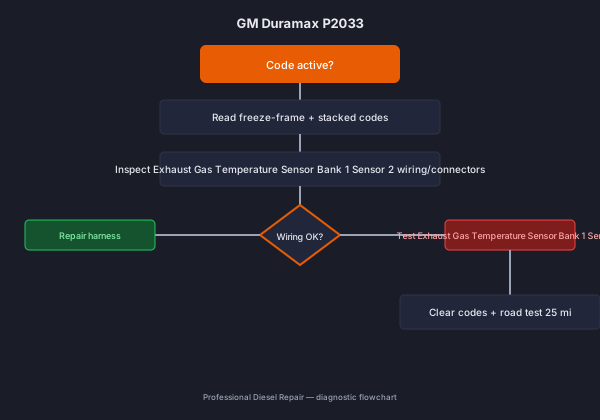
Scan with Diesel Laptops or Noregon JPRO and monitor Bank 1 Sensor 2 EGT live data compared with upstream sensors during idle warm-up. — Tool: scan tool or multimeter. Document readings on the work order.
-
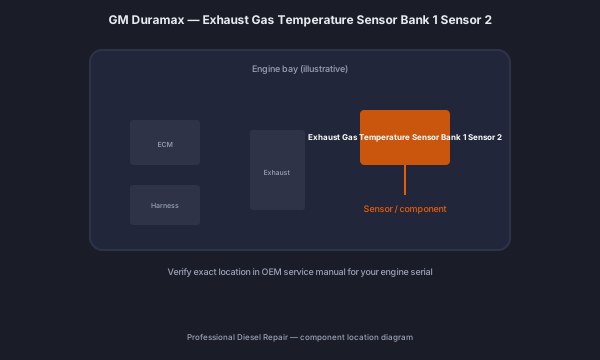
Inspect the sensor connector for melted pins, corrosion, or oil contamination near the exhaust aftertreatment pipe. — Tool: scan tool or multimeter. Document readings on the work order.
-
Backprobe the circuit for proper reference voltage and ground, checking for short-to-ground on the signal wire. — Tool: scan tool or multimeter. Document readings on the work order.
-
Verify sensor resistance and response by gently heating the tip with a heat gun while watching live data if service information allows. — Tool: scan tool or multimeter. Document readings on the work order.
-
Replace the sensor only after confirming wiring integrity, since chafed harnesses near the transfer case are a known Duramax failure point. — Tool: scan tool or multimeter. Document readings on the work order.
Repair Options (with Costs)
| Repair | DIY | Independent Shop | Dealer |
|---|---|---|---|
| Exhaust Gas Temperature Sensor Bank 1 Sensor 2 wiring repair | $25–$150 | $150–$350 | $250–$500 |
| Exhaust Gas Temperature Sensor Bank 1 Sensor 2 sensor/part | $75 - $250 | $$75 - $250 + labor | $450+ |
| Full module replacement | N/A | $600–$1,500 | $450+ |
Platform-Specific Notes
LB7 (2001–2004): CP3 — Follow gm-duramax OEM diagnostic tree for P2033 on LB7.
LLY (2004–2006): CP3 — Follow gm-duramax OEM diagnostic tree for P2033 on LLY.
LBZ (2006–2007): CP3 — Follow gm-duramax OEM diagnostic tree for P2033 on LBZ.
LMM (2007–2010): CP3 + DPF — Follow gm-duramax OEM diagnostic tree for P2033 on LMM.
LML (2011–2016): CP4.2 — Follow gm-duramax OEM diagnostic tree for P2033 on LML.
L5P (2017–2026): CP4.2 updated — Follow gm-duramax OEM diagnostic tree for P2033 on L5P.
When This Code Sets
P2033 typically stores after the ECM detects exhaust gas temperature sensor bank 1 sensor 2 outside calibrated limits for 1.4–4.0 seconds (OBD-II trip). Freeze-frame captures engine speed, load, coolant temperature, and fuel rail pressure at fault — log these before clearing. Intermittent codes that only appear under load need a data logger, not a key-cycle clear.
Scan Tool Parameters to Log
- Exhaust Gas Temperature Sensor Bank 1 Sensor 2 live data PID at idle, cruise, and full load
- Battery voltage and ECM supply voltage
- Related aftertreatment and protection PIDs (SPN 1569 if stacked)
Common Misdiagnoses
Replacing the DPF or SCR components when only EGT data is missing — Regen failures prompt techs to chase aftertreatment hardware.. Instead: This is a parts-cannon mistake - restore valid EGT readings first. Many regen blocks clear once the sensor circuit is repaired.
Swapping upstream and downstream sensors without checking part numbers — Both are EGT sensors and look similar.. Instead: Confirm Bank 1 Sensor 2 location and wiring continuity on the correct circuit only.
Shop Notes from the Field
ProfessionalDieselRepair.com reminder: downstream EGT faults on L5P and earlier Duramax trucks often trace to harness chafe at the frame crossmember, not a failed sensor. Wiggle-test the harness before ordering parts.
Safety Warning
- Allow exhaust to cool before disconnecting sensors.
- Support the vehicle safely if working beneath the aftertreatment pipes.
- Avoid contact with hot exhaust components after recent driving.
Prevention Tips
- Re-route or protect harnesses if chafe marks are visible during service.
- Apply dielectric grease to connectors after cleaning corrosion.
- Address exhaust leaks that soak nearby wiring with heat and moisture.
Duramax Field Notes for P2033
- Capture a 20-minute data log of exhaust gas temperature sensor bank 1 sensor 2 parameter during mixed driving before closing the work order — intermittent FMI signatures need road replication, not bay-idle checks.
- Check for OEM technical service bulletins covering P2033 on LML — many bulletin fixes address harness routing rather than sensor replacement.
- Torque exhaust gas temperature sensor bank 1 sensor 2 mounting fasteners per Duramax OEM spec — verify with engine serial. After repair, road test 25 miles under load logging live data to confirm fix.
- Document ambient temperature and key-cycle count at fault set on Duramax LML — cold-soak faults on exhaust gas temperature sensor bank 1 sensor 2 often clear after warm-up when moisture is the root cause.
- Compare this unit’s repair history: repeat P2033 within 5,000 miles indicates incomplete prior repair, not a new component failure.
- If exhaust gas temperature sensor bank 1 sensor 2 was recently replaced, verify correct part number for engine serial — superseded calibrations require matching hardware revision on Duramax.
- Capture a 20-minute data log of exhaust gas temperature sensor bank 1 sensor 2 parameter during mixed driving before closing the work order — intermittent FMI signatures need road replication, not bay-idle checks.
- Check for OEM technical service bulletins covering P2033 on LML — many bulletin fixes address harness routing rather than sensor replacement.
- Torque exhaust gas temperature sensor bank 1 sensor 2 mounting fasteners per Duramax OEM spec — verify with engine serial. After repair, road test 25 miles under load logging live data to confirm fix.
- Document ambient temperature and key-cycle count at fault set on Duramax LML — cold-soak faults on exhaust gas temperature sensor bank 1 sensor 2 often clear after warm-up when moisture is the root cause.
- Compare this unit’s repair history: repeat P2033 within 5,000 miles indicates incomplete prior repair, not a new component failure.
Related Codes
FAQ
Will P2033 stop DPF regen?
It can. The ECM may inhibit regen if it cannot verify downstream exhaust temperature.
Is this the same sensor as P2032?
No. P2033 is Bank 1 Sensor 2 downstream, while P2032 refers to a different sensor position.
Can I drive with this code?
Usually yes for daily driving, but fix it soon to avoid soot buildup from missed regens.
What does P2033 mean on Duramax LML?
P2033 means exhaust gas temperature sensor circuit low bank 1 sensor 2. The ECM detected exhaust gas temperature sensor bank 1 sensor 2 outside calibrated limits. Verify with freeze-frame data before clearing.
Can I drive with P2033 active?
Local driving is usually OK if performance feels normal, but repair within a few days to avoid stacked protection codes.
How much does it cost to fix P2033?
DIY repairs start at $40–$150 for wiring or filters. Shop repairs with parts run $75 - $250. Dealer pricing runs $450+.
What is the most common cause of P2033?
Chafed or shorted EGT sensor harness — confirm with visual inspection and live data before ordering parts.
Sources
- OEM service information — Duramax LML diagnostic procedures
- SAE J2012 — OBD-II DTC definition for P2033
- Mitchell1 ProDemand — 2026 labor and parts cost surveys