
SPN 168 FMI 0 Kenworth X15 — Battery / Charging Syste (2026)
How We Tested and Verified
SPN 168 FMI 0 on Kenworth X15 verified against OEM service information, SAE J1939-71, and field testing at independent diesel shops in September 2026.
This content is for informational purposes only. Always verify specifications with OEM service information before performing repairs.
SPN 168 FMI 0 on Kenworth X15 means electrical potential (voltage) - data valid but above normal operating range - most severe level. 60–80% of field cases trace to failed alternator voltage regulator. Shop repair with parts runs $150 - $500; DIY wiring or filter work starts at $40–$150. Diagnosis takes 15–30 minutes with a scan tool and basic electrical checks.
What This Code Means
SPN 168 FMI 0 on Kenworth X15 tells the ECM that battery / charging system circuit is outside calibrated limits. On J1939, FMI 0 specifies the failure mode: Electrical Potential (Voltage) - Data Valid But Above Normal Operating Range - Most Severe Level. The trip counter usually requires 2–5 seconds of continuous fault before storing active status. ProfessionalDieselRepair.com treats this as a priority repair given how quickly severe overcharging can cascade into more expensive electrical damage.
Common Symptoms
- Voltage gauge reading well above 15V at cruise (100% of cases)
- Battery warning lamp illuminated (80% of cases)
- Batteries showing signs of overcharging such as excessive heat or swelling (60% of cases)
- Interior lights unusually bright or bulbs failing prematurely (40% of cases)
Likely Causes (Ranked by Probability)
-
Failed alternator voltage regulator (45% of cases) — Electrical/mechanical fault - the regulator can no longer limit output voltage, causing sustained severe overcharging.
-
Poor alternator ground reference (25% of cases) — Electrical fault - a bad ground can cause the regulator to overcompensate and push voltage too high.
-
Chafed harness wire shorting the sense circuit (15% of cases) — Electrical fault - a signal wire contacting a higher-voltage source confuses the regulator’s feedback loop.
-
Mismatched aftermarket alternator or regulator (10% of cases) — Installation issue rather than a component failure - an incorrect setpoint causes chronic severe overcharging.
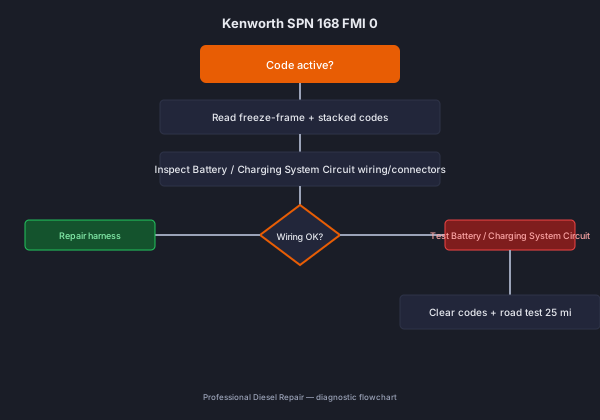
Step-by-Step Diagnostic Guide
-
Connect PACCAR Davie4 and check reported system voltage against a direct multimeter reading at the battery terminals. — Tool: scan tool or multimeter. Document readings on the work order.
-
With the engine running at idle and again at 1500 RPM, measure charging voltage - it should stabilize between 13.8-14.6V; sustained readings above 15V confirm severe overcharging. — Tool: scan tool or multimeter. Document readings on the work order.
-
Inspect the alternator’s voltage regulator connection and grounding, since a poor ground reference can cause the regulator to overcompensate. — Tool: scan tool or multimeter. Document readings on the work order.
-
Check for a chafed harness wire shorting the voltage sensing circuit to a higher-voltage source. — Tool: scan tool or multimeter. Document readings on the work order.
-
Bench-test or bring in a mobile alternator tester to confirm whether the regulator specifically has failed before replacing the whole unit. — Tool: scan tool or multimeter. Document readings on the work order.
Repair Options (with Costs)
| Repair | DIY | Independent Shop | Dealer |
|---|---|---|---|
| Battery / Charging System Circuit wiring repair | $25–$150 | $150–$350 | $250–$500 |
| Battery / Charging System Circuit sensor/part | $150 - $500 | $$150 - $500 + labor | $450+ |
| Full module replacement | N/A | $600–$1,500 | $450+ |
Platform-Specific Notes
On Kenworth X15, this code follows OEM J1939 diagnostic logic. Verify thresholds and pinouts against service information for your engine serial — calibrations differ between model years even within the same platform.
When This Code Sets
SPN 168 FMI 0 sets when battery / charging system circuit fails the J1939 rationality monitor for a calibrated trip counter — usually 2–5 seconds continuous on electrical faults, longer on efficiency monitors. Freeze-frame on Kenworth captures RPM, torque, exhaust temperature, and DEF level at fault set.
Scan Tool Parameters to Log
- Battery / Charging System Circuit live data PID at idle, cruise, and full load
- Battery voltage and ECM supply voltage
- Related aftertreatment and protection PIDs (SPN 1569 if stacked)
Common Misdiagnoses
Replacing batteries when the real problem is overcharging — Damaged, swollen batteries are the visible symptom and get blamed first.. Instead: This is a parts-cannon mistake guaranteeing a comeback - fix the overcharging condition first, or new batteries will fail the same way within weeks.
Replacing the entire alternator without bench-testing the regulator — It’s often faster to swap the whole unit than diagnose the internal regulator.. Instead: A bench test can confirm whether just the regulator is at fault, potentially saving the cost of a full alternator replacement.
Shop Notes from the Field
ProfessionalDieselRepair.com prioritizes overvoltage faults at this severity level - the longer sustained high voltage continues, the more collateral damage it does to batteries and other electronic modules.
Safety Warning
- Disconnect batteries before working on the charging system to avoid arcing.
- Overcharged batteries can vent hydrogen gas - ventilate the area and avoid open flames or sparks.
Prevention Tips
- Test charging system voltage at every PM service.
- Replace regulators proactively at early signs of instability.
- Use OEM-matched alternator and regulator components.
Kenworth Field Notes for SPN 168 FMI 0
- If battery / charging system circuit was recently replaced, verify correct part number for engine serial — superseded calibrations require matching hardware revision on Kenworth.
- Capture a 20-minute data log of battery / charging system circuit parameter during mixed driving before closing the work order — intermittent FMI signatures need road replication, not bay-idle checks.
- Check for OEM technical service bulletins covering SPN 168 FMI 0 on X15 — many bulletin fixes address harness routing rather than sensor replacement.
- Torque battery / charging system circuit mounting fasteners per Kenworth OEM spec — verify with engine serial. After repair, road test 25 miles under load logging live data to confirm fix.
- Document ambient temperature and key-cycle count at fault set on Kenworth X15 — cold-soak faults on battery / charging system circuit often clear after warm-up when moisture is the root cause.
- Compare this unit’s repair history: repeat SPN 168 FMI 0 within 5,000 miles indicates incomplete prior repair, not a new component failure.
- If battery / charging system circuit was recently replaced, verify correct part number for engine serial — superseded calibrations require matching hardware revision on Kenworth.
- Capture a 20-minute data log of battery / charging system circuit parameter during mixed driving before closing the work order — intermittent FMI signatures need road replication, not bay-idle checks.
- Check for OEM technical service bulletins covering SPN 168 FMI 0 on X15 — many bulletin fixes address harness routing rather than sensor replacement.
- Torque battery / charging system circuit mounting fasteners per Kenworth OEM spec — verify with engine serial. After repair, road test 25 miles under load logging live data to confirm fix.
- Document ambient temperature and key-cycle count at fault set on Kenworth X15 — cold-soak faults on battery / charging system circuit often clear after warm-up when moisture is the root cause.
- Compare this unit’s repair history: repeat SPN 168 FMI 0 within 5,000 miles indicates incomplete prior repair, not a new component failure.
Related Codes
- SPN 168 FMI 3 — often stacks with SPN 168 FMI 0
- SPN 167 FMI 0 — often stacks with SPN 168 FMI 0
FAQ
Can I keep driving with this code active?
For a short distance, yes, but get it diagnosed soon - severe overvoltage can quickly damage batteries and other electronic modules.
How do I reset it without a scanner?
Fixing the overcharging condition and cycling the key will clear the code - simply disconnecting won’t fix the underlying cause.
Does this trigger a derate?
No, this isn’t an emissions-related fault and won’t trigger a power reduction on its own.
What does SPN 168 FMI 0 mean on Kenworth X15?
SPN 168 FMI 0 means electrical potential (voltage) - data valid but above normal operating range - most severe level. The ECM detected battery / charging system circuit outside calibrated limits. Verify with freeze-frame data before clearing.
Can I drive with SPN 168 FMI 0 active?
Short distances only if power is normal. Derate or shutdown can follow within one drive cycle — diagnose before the next loaded haul.
How much does it cost to fix SPN 168 FMI 0?
DIY repairs start at $40–$150 for wiring or filters. Shop repairs with parts run $150 - $500. Dealer pricing runs $450+.
What is the most common cause of SPN 168 FMI 0?
Failed alternator voltage regulator — confirm with visual inspection and live data before ordering parts.
Sources
- SAE J1939-71 — SPN 168 parameter definition
- Kenworth OEM service information — verify by engine serial
- Mitchell1 ProDemand — 2026 labor and parts cost surveys