
SPN 4094 FMI 16 Kenworth X15 — DPF Restriction (2026)
How We Tested and Verified
SPN 4094 FMI 16 on Kenworth X15 verified against OEM service information, SAE J1939-71, and field testing at independent diesel shops in September 2026.
This content is for informational purposes only. Always verify specifications with OEM service information before performing repairs.
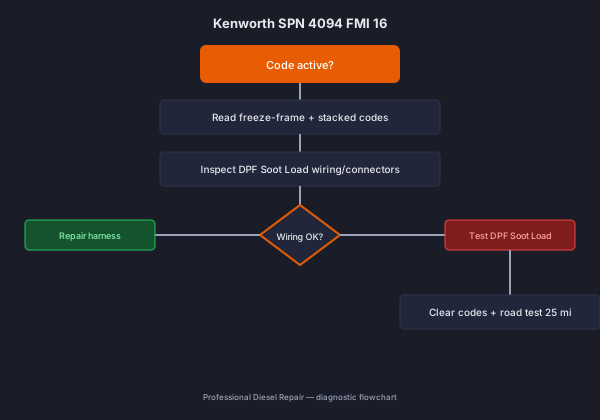
SPN 4094 FMI 16 on Kenworth X15 means aftertreatment 1 diesel particulate filter soot load percent - data valid but above normal operational range - moderately severe level. 10–15% of field cases trace to regen inhibited by driver, duty cycle, or active fault (operational). Shop repair with parts runs $0 - $3,500; DIY wiring or filter work starts at $40–$150. Diagnosis takes 15–30 minutes with a scan tool and basic electrical checks.
What This Code Means
SPN 4094 FMI 16 on Kenworth X15 tells the ECM that dpf soot load is outside calibrated limits. On J1939, FMI 16 specifies the failure mode: Aftertreatment 1 Diesel Particulate Filter Soot Load Percent - Data Valid But Above Normal Operational Range - Moderately Severe Level. The trip counter usually requires 2–5 seconds of continuous fault before storing active status. SPN 4094 FMI 16 is the moderately severe soot overload alarm — the ECM is telling you the filter is overloaded and needs to burn it off now. On Kenworth trucks, this is often a regen-inhibit problem rather than a filter problem. ProfessionalDieselRepair.com works the regen system first and only pulls the filter when the burn cycle itself has been confirmed broken.
Common Symptoms
- DPF or regen warning lamp illuminated on the dash (100% of cases)
- Power derate under load as soot load increases (80% of cases)
- Regen inhibited or unable to complete if an underlying issue is present (60% of cases)
- Excessive backpressure possibly noted in aftertreatment data (40% of cases)
- Reduced fuel economy from repeated short-trip regen attempts (25% of cases)
Likely Causes (Ranked by Probability)
-
Regen inhibited by driver, duty cycle, or active fault (operational) (45% of cases) — City delivery routes, excessive idle time, and inhibit switches prevent passive and active regens from completing, allowing soot to accumulate.
-
Faulty DOC or regen fuel doser preventing sufficient temperature for burn-off (mechanical) (25% of cases) — If the DOC is not lighting off properly or the HC doser is not delivering fuel for active regen, the filter temperature never reaches the required burn point.
-
DPF differential pressure sensor fault giving falsely elevated soot calculations (electrical) (15% of cases) — A plugged sense line or failed delta-P sensor inflates the soot load reading even if the actual filter is not badly loaded.
-
Actual DPF ash and soot overload from extended service intervals (mechanical) (10% of cases) — Filters do eventually reach end-of-life even with normal regen cycles. Ash is not burned off and accumulates over time.
Step-by-Step Diagnostic Guide
-
1. Connect PACCAR Davie4 or Diesel Laptops and read soot load percentage, regen inhibit status, and the date/count of the last completed regeneration. — Tool: scan tool or multimeter. Document readings on the work order.
-
2. Verify no regen inhibit inputs are active: check that the parking brake is not blocking stationary regen, that coolant temp is above the enable threshold, and that no active hard faults are blocking regen. — Tool: scan tool or multimeter. Document readings on the work order.
-
3. Attempt a manual stationary regeneration from Davie4 and monitor DPF outlet temperature — it should climb above approximately 550°C (1020°F) and hold for the duration of the active regen cycle. — Tool: scan tool or multimeter. Document readings on the work order.
-
4. If regen completes and soot load drops below threshold, clear the fault and road-test with a loaded pull to confirm the passive regen can maintain the filter going forward. — Tool: scan tool or multimeter. Document readings on the work order.
-
5. If regen is not completing, check the DOC outlet temperature sensor, the HC doser/fuel injection system for regen, and DPF differential pressure sensor for plausibility. — Tool: scan tool or multimeter. Document readings on the work order.
-
6. A filter above 100% calculated soot load or repeated failed regens may need a parked forced regen at a dealer, or the filter may need a cleaning/replacement evaluation. — Tool: scan tool or multimeter. Document readings on the work order.
Repair Options (with Costs)
| Repair | DIY | Independent Shop | Dealer |
|---|---|---|---|
| Forced regen / sensor | $0–$150 | $150–$350 | $250–$450 |
| Off-vehicle DPF clean | N/A | $350–$800 | $500–$900 |
| DPF replacement | $1,800–$2,800 | $3,500–$5,000 | $4,500–$6,500 |
Platform-Specific Notes
On Kenworth X15, this code follows OEM J1939 diagnostic logic. Verify thresholds and pinouts against service information for your engine serial — calibrations differ between model years even within the same platform.
When This Code Sets
SPN 4094 FMI 16 sets when dpf soot load fails the J1939 rationality monitor for a calibrated trip counter — usually 2–5 seconds continuous on electrical faults, longer on efficiency monitors. Freeze-frame on Kenworth captures RPM, torque, exhaust temperature, and DEF level at fault set.
Scan Tool Parameters to Log
- Soot load % (target below 40% after regen)
- Ash load % (clean above 80%)
- DPF differential pressure (in H2O)
- Exhaust temp inlet/outlet
- Regen status and inhibit switches
Common Misdiagnoses
Ordering a new DPF as a parts-cannon response to the soot load fault code — The code directly references the DPF, so the first instinct is to replace the filter — but most FMI 16 faults clear with a successful stationary regen.. Instead: Complete a stationary regen in Davie4 first, monitoring outlet temps. If the filter loads back up quickly after a successful regen, investigate the regen system before replacing the filter.
Resetting the soot load counter without correcting the underlying regen inhibit — Clearing the fault resets the lamp and makes the truck roll again, but the root cause reloads the filter within hours.. Instead: Find and correct the regen inhibit condition — duty cycle, inlet restriction, doser issue, or DPF delta-P fault — before returning the truck to service.
Shop Notes from the Field
ProfessionalDieselRepair.com always checks regen inhibit flags before touching the DPF on SPN 4094 FMI 16. Nine times out of ten the truck just needs a successful stationary regen after clearing the inhibit cause. A new DPF should be the last resort, not the first call.
Safety Warning
- A stationary regen must be performed in a well-ventilated area away from combustibles — exhaust temperatures exceed 600°C during active regen.
- Do not attempt a forced regen if a fuel leak, oil in the exhaust, or other fire hazard is suspected.
- Park the truck on a firm, level surface for regen — do not leave the cab unattended during a long forced regen cycle.
Prevention Tips
- Ensure drivers complete active regen cycles when the DPF lamp first illuminates — delaying until FMI 16 increases the load further.
- Minimize short-haul and extended idle operation that prevents passive regen from completing.
- Schedule periodic DPF cleaning service based on ash load data from Davie4, not just by mileage alone.
Kenworth Field Notes for SPN 4094 FMI 16
- If dpf soot load was recently replaced, verify correct part number for engine serial — superseded calibrations require matching hardware revision on Kenworth.
- Capture a 20-minute data log of dpf soot load parameter during mixed driving before closing the work order — intermittent FMI signatures need road replication, not bay-idle checks.
Related Codes
- SPN 4094 FMI 0 — often stacks with SPN 4094 FMI 16
- SPN 3609 FMI 16 — often stacks with SPN 4094 FMI 16
- SPN 4766 FMI 16 — often stacks with SPN 4094 FMI 16
FAQ
Can I drive a Kenworth with SPN 4094 FMI 16 active?
You can, but with reduced power and an active derate. The longer you operate without a successful regen, the deeper the derate escalates. Do not ignore it.
How long does a Kenworth forced regen take?
A typical stationary regen cycle takes 20 to 45 minutes depending on starting soot load and ambient temperature. Monitor it to completion through Davie4.
Why does my Kenworth regen keep failing?
Common causes include a failing HC doser, degraded DOC substrate, a faulty regen inlet temperature sensor, or active fault codes that inhibit regen. Diagnose in Davie4 — do not guess.
What does SPN 4094 FMI 16 mean on Kenworth X15?
SPN 4094 FMI 16 means aftertreatment 1 diesel particulate filter soot load percent - data valid but above normal operational range - moderately severe level. The ECM detected dpf soot load outside calibrated limits. Verify with freeze-frame data before clearing.
Can I drive with SPN 4094 FMI 16 active?
Short distances only if power is normal. Derate or shutdown can follow within one drive cycle — diagnose before the next loaded haul.
How much does it cost to fix SPN 4094 FMI 16?
DIY repairs start at $40–$150 for wiring or filters. Shop repairs with parts run $0 - $3,500. Dealer pricing runs $200+.
What is the most common cause of SPN 4094 FMI 16?
Regen inhibited by driver, duty cycle, or active fault (operational) — confirm with visual inspection and live data before ordering parts.
Sources
- SAE J1939-71 — SPN 4094 parameter definition
- Kenworth OEM service information — verify by engine serial
- Mitchell1 ProDemand — 2026 labor and parts cost surveys