
SPN 168 FMI 1 Mack MP8 — Battery / Charging System Ci (2026)
How We Tested and Verified
SPN 168 FMI 1 on Mack MP8 verified against OEM service information, SAE J1939-71, and field testing at independent diesel shops in September 2026.
This content is for informational purposes only. Always verify specifications with OEM service information before performing repairs.
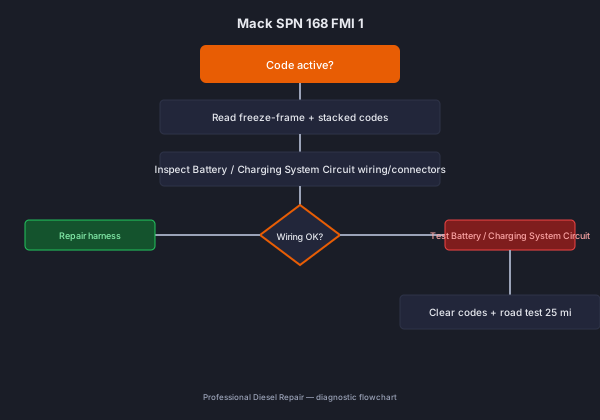
SPN 168 FMI 1 on Mack MP8 means electrical potential (voltage) - data valid but below normal operating range. 60–80% of field cases trace to slipping or glazed serpentine belt. Shop repair with parts runs $150 - $600; DIY wiring or filter work starts at $40–$150. Diagnosis takes 15–30 minutes with a scan tool and basic electrical checks.
What This Code Means
SPN 168 FMI 1 on Mack MP8 tells the ECM that battery / charging system circuit is outside calibrated limits. On J1939, FMI 1 specifies the failure mode: Electrical Potential (Voltage) - Data Valid But Below Normal Operating Range. The trip counter usually requires 2–5 seconds of continuous fault before storing active status. ProfessionalDieselRepair.com always checks belt condition first on Mack low-voltage complaints - it’s the cheapest possible cause and gets skipped far too often.
Common Symptoms
- Dim headlights or dash gauges, especially at idle (100% of cases)
- Voltage gauge reading noticeably below 12.8V with the engine running (80% of cases)
- Slow cranking on startup (60% of cases)
- Multiple unrelated module warning lights appearing together (40% of cases)
Likely Causes (Ranked by Probability)
-
Slipping or glazed serpentine belt (45% of cases) — Mechanical fault - reduced alternator rotation speed directly reduces charging output, especially noticeable at idle.
-
Weak or failing batteries (25% of cases) — A genuine battery/charging system issue confirmed by a proper load test rather than just a static voltage reading.
-
Failing alternator diodes or windings (15% of cases) — Electrical/mechanical component failure - reduced alternator output capacity that a clamp-on ammeter test will reveal.
-
Corroded ground straps or battery cable terminals (10% of cases) — Electrical fault - high resistance in the charging circuit reduces effective voltage delivery even with a healthy alternator.
Step-by-Step Diagnostic Guide
-
Connect Mack Premium Tech Tool (PTT) and confirm the fault is active, then measure actual system voltage at the battery terminals with the engine running at idle and at 1500 RPM. — Tool: scan tool or multimeter. Document readings on the work order.
-
Load-test both batteries individually - a battery bank that reads acceptable static voltage can still fail to support electrical load once the alternator is asked to work. — Tool: scan tool or multimeter. Document readings on the work order.
-
Check alternator output directly at the B+ terminal with a clamp-on ammeter to confirm it’s producing rated amperage. — Tool: scan tool or multimeter. Document readings on the work order.
-
Inspect all ground strap connections at the frame, engine block, and cab for corrosion or looseness. — Tool: scan tool or multimeter. Document readings on the work order.
-
Check the serpentine belt tension and condition - a slipping belt reduces alternator output and can present as a chronic low-voltage fault. — Tool: scan tool or multimeter. Document readings on the work order.
Repair Options (with Costs)
| Repair | DIY | Independent Shop | Dealer |
|---|---|---|---|
| Battery / Charging System Circuit wiring repair | $25–$150 | $150–$350 | $250–$500 |
| Battery / Charging System Circuit sensor/part | $150 - $600 | $$150 - $600 + labor | $450+ |
| Full module replacement | N/A | $600–$1,500 | $450+ |
Platform-Specific Notes
On Mack MP8, this code follows OEM J1939 diagnostic logic. Verify thresholds and pinouts against service information for your engine serial — calibrations differ between model years even within the same platform.
When This Code Sets
SPN 168 FMI 1 sets when battery / charging system circuit fails the J1939 rationality monitor for a calibrated trip counter — usually 2–5 seconds continuous on electrical faults, longer on efficiency monitors. Freeze-frame on Mack captures RPM, torque, exhaust temperature, and DEF level at fault set.
Scan Tool Parameters to Log
- Battery / Charging System Circuit live data PID at idle, cruise, and full load
- Battery voltage and ECM supply voltage
- Related aftertreatment and protection PIDs (SPN 1569 if stacked)
Common Misdiagnoses
Replacing the alternator without checking belt tension first — A charging fault code points suspicion directly at the alternator.. Instead: This is a parts-cannon mistake - inspect and test belt tension and condition first, since a slipping belt produces identical symptoms to a failing alternator at a fraction of the cost.
Replacing batteries without load-testing the charging system — Batteries are often blamed first for any voltage-related complaint.. Instead: Test the alternator output before replacing batteries - new batteries installed on a system with a failing alternator will discharge just as quickly.
Shop Notes from the Field
ProfessionalDieselRepair.com checks the belt before the alternator on every low-voltage call - a glazed or slipping serpentine belt is a cheap, common cause that gets overlooked in favor of jumping straight to alternator replacement.
Safety Warning
- Keep hands clear of the serpentine belt and pulleys while the engine is running during diagnosis.
- Wear eye protection when working near batteries in case of acid exposure.
Prevention Tips
- Inspect belt tension and condition at every PM service.
- Load-test batteries seasonally, not just when problems appear.
- Clean and re-torque ground connections annually.
Mack Field Notes for SPN 168 FMI 1
- Torque battery / charging system circuit mounting fasteners per Mack OEM spec — verify with engine serial. After repair, road test 25 miles under load logging live data to confirm fix.
- Document ambient temperature and key-cycle count at fault set on Mack MP8 — cold-soak faults on battery / charging system circuit often clear after warm-up when moisture is the root cause.
- Compare this unit’s repair history: repeat SPN 168 FMI 1 within 5,000 miles indicates incomplete prior repair, not a new component failure.
- If battery / charging system circuit was recently replaced, verify correct part number for engine serial — superseded calibrations require matching hardware revision on Mack.
- Capture a 20-minute data log of battery / charging system circuit parameter during mixed driving before closing the work order — intermittent FMI signatures need road replication, not bay-idle checks.
- Check for OEM technical service bulletins covering SPN 168 FMI 1 on MP8 — many bulletin fixes address harness routing rather than sensor replacement.
- Torque battery / charging system circuit mounting fasteners per Mack OEM spec — verify with engine serial. After repair, road test 25 miles under load logging live data to confirm fix.
- Document ambient temperature and key-cycle count at fault set on Mack MP8 — cold-soak faults on battery / charging system circuit often clear after warm-up when moisture is the root cause.
- Compare this unit’s repair history: repeat SPN 168 FMI 1 within 5,000 miles indicates incomplete prior repair, not a new component failure.
- If battery / charging system circuit was recently replaced, verify correct part number for engine serial — superseded calibrations require matching hardware revision on Mack.
- Capture a 20-minute data log of battery / charging system circuit parameter during mixed driving before closing the work order — intermittent FMI signatures need road replication, not bay-idle checks.
- Check for OEM technical service bulletins covering SPN 168 FMI 1 on MP8 — many bulletin fixes address harness routing rather than sensor replacement.
Related Codes
- SPN 168 FMI 4 — often stacks with SPN 168 FMI 1
- SPN 167 FMI 1 — often stacks with SPN 168 FMI 1
FAQ
Can I keep driving with this code active?
For a short distance, yes, but low voltage can worsen quickly and lead to stalling - get it diagnosed as soon as possible.
How do I reset it without a scanner?
Fixing the actual voltage deficiency and cycling the key will clear the code - simply disconnecting the battery won’t resolve the underlying cause.
Does this trigger a derate?
No, this isn’t an emissions-related fault, though severe voltage drops can affect multiple systems and cause other problems.
What does SPN 168 FMI 1 mean on Mack MP8?
SPN 168 FMI 1 means electrical potential (voltage) - data valid but below normal operating range. The ECM detected battery / charging system circuit outside calibrated limits. Verify with freeze-frame data before clearing.
Can I drive with SPN 168 FMI 1 active?
Short distances only if power is normal. Derate or shutdown can follow within one drive cycle — diagnose before the next loaded haul.
How much does it cost to fix SPN 168 FMI 1?
DIY repairs start at $40–$150 for wiring or filters. Shop repairs with parts run $150 - $600. Dealer pricing runs $450+.
What is the most common cause of SPN 168 FMI 1?
Slipping or glazed serpentine belt — confirm with visual inspection and live data before ordering parts.
Sources
- SAE J1939-71 — SPN 168 parameter definition
- Mack OEM service information — verify by engine serial
- Mitchell1 ProDemand — 2026 labor and parts cost surveys