
SPN 4363 FMI 1 Mack MP8 — SCR Efficiency Low (2026)
How We Tested and Verified
SPN 4363 FMI 1 on Mack MP8 verified against OEM service information, SAE J1939-71, and field testing at independent diesel shops in September 2026.
This content is for informational purposes only. Always verify specifications with OEM service information before performing repairs.
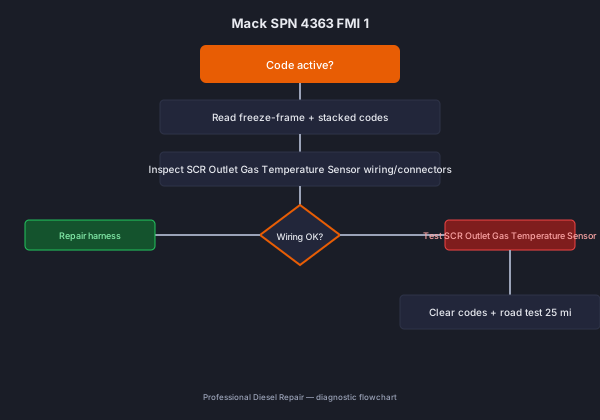
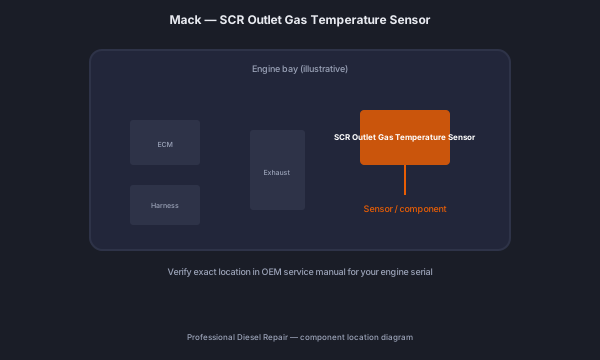
SPN 4363 FMI 1 on Mack MP8 means scr outlet gas temperature reading is below normal operating range during active regeneration — fmi 1 indicating sensor failure, exhaust leak, or impaired regen process. 60–80% of field cases trace to failed ntc thermistor in the scr outlet sensor (open or degraded). Shop repair with parts runs $60 - $200; DIY wiring or filter work starts at $40–$150. Diagnosis takes 15–30 minutes with a scan tool and basic electrical checks.
What This Code Means
SPN 4363 FMI 1 on Mack MP8 tells the ECM that scr outlet gas temperature sensor is outside calibrated limits. On J1939, FMI 1 specifies the failure mode: SCR outlet gas temperature reading is below normal operating range during active regeneration — FMI 1 indicating sensor failure, exhaust leak, or impaired regen process. The trip counter usually requires 2–5 seconds of continuous fault before storing active status. When a Mack MP8 or MP7 truck logs SPN 4363 FMI 1, the aftertreatment control module has determined the SCR outlet gas temperature is below the expected range for current operating conditions. Unlike SPN 4363 FMI 3 (voltage above normal), FMI 1 means the reading is in a valid but below-normal range — which on a hot engine under load or during active regen points to sensor failure rather than actual cold exhaust. At ProfessionalDieselRepair.com, the most reliable diagnostic step is comparing the SCR inlet temperature (SPN 4360) against the outlet (SPN 4363) using Jaltest during a commanded stationary regen. If the inlet climbs normally but the outlet stays near ambient temperature, the outlet sensor has failed. If both stay low, the regen process itself is incomplete due to a DEF or fuel doser issue.
Common Symptoms
- SCR outlet temperature reads below 150 degrees C during a commanded regeneration event. (100% of cases)
- Active regeneration fails to complete, leaving the DPF at elevated soot load. (80% of cases)
- Amber aftertreatment lamp and possible derate warning if the incomplete regen cycle accumulates. (60% of cases)
- Diesel Laptops or Jaltest live data shows SPN 4363 value significantly lower than SPN 4360 (inlet) during regen. (40% of cases)
- Mack instrument cluster may display a service aftertreatment system message. (25% of cases)
Likely Causes (Ranked by Probability)
-
Failed NTC thermistor in the SCR outlet sensor (open or degraded) (45% of cases) — The thermistor element degrades from long-term exposure to high-temperature exhaust gases. An open thermistor causes the ACM to read an implausibly low temperature, setting FMI 1.
-
DEF or exhaust condensation contaminating the sensor connector (25% of cases) — The SCR outlet is downstream of the DEF dosing point. DEF vapor or condensation migrates into the sensor connector, creating partial grounds that pull the signal below the FMI 1 threshold.
-
Exhaust system air leak upstream of the SCR outlet sensor (15% of cases) — A gasket failure or loose clamp between the SCR catalyst outlet and the sensor mounting point allows ambient air to cool the exhaust stream near the sensor, producing a genuinely low temperature reading during light-load operation.
-
Incomplete regeneration lowering actual SCR outlet temperature (10% of cases) — If a fuel doser or DEF dosing fault prevents the regen from reaching full temperature, the outlet sensor may read correctly but below the expected regen temperature, triggering FMI 1 as a secondary fault.
Step-by-Step Diagnostic Guide
-
Connect Jaltest Trucks diagnostic software to the Mack 9-pin diagnostic port. Navigate to the aftertreatment module data and command a stationary regeneration test. Monitor SPN 4363 (SCR outlet temperature) during the regen cycle. If the outlet temperature fails to climb above 200 degrees C while the SCR inlet (SPN 4360) is reading above 350 degrees C, the outlet sensor circuit is suspect. — Tool: scan tool or multimeter. Document readings on the work order.
-
After the regen test with the engine off and exhaust cooled for at least 45 minutes, disconnect the SCR outlet temperature sensor connector. Measure resistance between the sensor pins. For Mack MP8 NTC thermistors, expect 50 to 120 kOhm at ambient temperature (25 degrees C). An open reading (OL) or a reading above 500 kOhm confirms thermistor failure. Use Diesel Laptops with a J1939 adapter for a pre-test and post-test parameter comparison. — Tool: scan tool or multimeter. Document readings on the work order.
-
If resistance is in spec, inspect the connector for DEF crystallization, corrosion, or physical damage. The SCR outlet sensor is located downstream of the DEF injection point, where DEF vapor can migrate into the connector cavity. Clean with electrical contact cleaner and re-test resistance. — Tool: scan tool or multimeter. Document readings on the work order.
-
Back-probe the signal pin to sensor ground with the connector attached and key on (engine off). The voltage should reflect the current ambient temperature on the NTC curve. A signal below 0.2 V with a confirmed 5 V reference on the supply pin indicates a short-to-ground path in the connector or harness. — Tool: scan tool or multimeter. Document readings on the work order.
-
If the connector is clean and the harness is intact, replace the SCR outlet temperature sensor. Use Jaltest to command another stationary regen and confirm the outlet temperature rises to the expected 400 to 600 degrees C range during peak regen activity. — Tool: scan tool or multimeter. Document readings on the work order.
Repair Options (with Costs)
| Repair | DIY | Independent Shop | Dealer |
|---|---|---|---|
| SCR Outlet Gas Temperature Sensor wiring repair | $25–$150 | $150–$350 | $250–$500 |
| SCR Outlet Gas Temperature Sensor sensor/part | $60 - $200 | $$60 - $200 + labor | $400+ |
| Full module replacement | N/A | $600–$1,500 | $400+ |
Platform-Specific Notes
On Mack MP8, this code follows OEM J1939 diagnostic logic. Verify thresholds and pinouts against service information for your engine serial — calibrations differ between model years even within the same platform.
When This Code Sets
SPN 4363 FMI 1 sets when scr outlet gas temperature sensor fails the J1939 rationality monitor for a calibrated trip counter — usually 2–5 seconds continuous on electrical faults, longer on efficiency monitors. Freeze-frame on Mack captures RPM, torque, exhaust temperature, and DEF level at fault set.
Scan Tool Parameters to Log
- Inlet vs outlet NOx (ppm)
- SCR efficiency %
- DEF level and quality/concentration
- DEF tank temperature
Common Misdiagnoses
Replacing the SCR outlet sensor without comparing inlet vs outlet temperature — A parts-cannon approach replaces the sensor without confirming whether the fault is in the sensor or in the regen process itself, which requires the inlet-versus-outlet temperature comparison.. Instead: Use Jaltest to monitor both SPN 4360 (inlet) and SPN 4363 (outlet) simultaneously during a commanded regen. If inlet is normal and outlet is low, the outlet sensor has failed.
Attributing FMI 1 to a catalyst efficiency problem — Technicians familiar with SPN 4364 (NOx efficiency) faults may assume FMI 1 on the outlet temperature sensor means the catalyst is degraded and needs replacement.. Instead: A degraded catalyst affects NOx conversion but does not necessarily cause the outlet temperature sensor to read below normal. Verify the sensor circuit first.
Confusing SPN 4363 FMI 1 with SPN 4363 FMI 3 — Both involve the same component but different FMI codes require different diagnostic approaches. FMI 3 is a high-voltage fault; FMI 1 is a below-normal range fault.. Instead: Always confirm the FMI number before beginning diagnosis. FMI 1 — measure sensor resistance and compare inlet vs outlet temperature. FMI 3 — trace the signal circuit for a short to supply voltage.
Shop Notes from the Field
SPN 4363 FMI 1 differs from SPN 4363 FMI 3 (high voltage, which was documented in a prior run). FMI 1 is a below-normal range fault meaning the temperature reading is plausible but lower than expected for the operating condition. The most important diagnostic step is comparing SPN 4360 (SCR inlet) against SPN 4363 (SCR outlet) during a commanded regen: if the inlet is climbing normally but the outlet stays low, the outlet sensor is failed. If both are low, the regen process itself may be incomplete due to a DEF dosing issue. Always use Jaltest for Mack MP8 aftertreatment work — it provides full bi-directional regen commands and sensor parameter access. Diesel Laptops is an effective complement for J1939 live data capture. Full sensor R&R procedure for the Mack MP8 SCR outlet is at ProfessionalDieselRepair.com.
Safety Warning
- Allow the SCR canister and exhaust piping to cool for at least 45 minutes before handling the outlet temperature sensor — regen temperatures can exceed 600 degrees C.
- Do not command a stationary regen in an enclosed space — regen produces high exhaust temperatures and concentrations of exhaust gas.
- Wear heat-resistant gloves and eye protection when working near the aftertreatment system.
- Ensure the DEF system has been depressurized before disconnecting any DEF line connectors in the SCR section.
Prevention Tips
- Inspect the SCR outlet temperature sensor connector for DEF vapor deposits at every DPF service interval.
- Check for exhaust leaks at the SCR outlet connection during PM inspections — an air leak can cause genuine low-temperature readings.
- Monitor SCR outlet temperature trends in Jaltest live data to catch gradual sensor drift before an FMI 1 fault develops.
- Replace the sensor connector seal if any DEF contamination is found in the connector cavity.
Related Codes
- SPN 4363 FMI 3 — often stacks with SPN 4363 FMI 1
- SPN 4360 FMI 1 — often stacks with SPN 4363 FMI 1
- SPN 4364 FMI 18 — often stacks with SPN 4363 FMI 1
FAQ
What does Mack SPN 4363 FMI 1 mean?
SPN 4363 FMI 1 means the SCR outlet gas temperature sensor is reading below its normal operating range. On a hot engine or during active regen, this indicates sensor failure rather than actual cold exhaust.
What temperature should the SCR outlet read during regen on a Mack MP8?
During peak active regeneration on a Mack MP8, the SCR outlet temperature should reach 400 to 600 degrees C. A reading below 150 degrees C during a commanded regen event is the FMI 1 trigger.
How do I distinguish a sensor fault from an incomplete regen?
Monitor SCR inlet temperature (SPN 4360) alongside the outlet (SPN 4363) in Jaltest during a commanded regen. If the inlet climbs to above 350 degrees C but the outlet stays near ambient, the outlet sensor is failed. If both stay low, the regen process is incomplete.
What does SPN 4363 FMI 1 mean on Mack MP8?
SPN 4363 FMI 1 means scr outlet gas temperature reading is below normal operating range during active regeneration — fmi 1 indicating sensor failure, exhaust leak, or impaired regen process. The ECM detected scr outlet gas temperature sensor outside calibrated limits. Verify with freeze-frame data before clearing.
Can I drive with SPN 4363 FMI 1 active?
Short distances only if power is normal. Derate or shutdown can follow within one drive cycle — diagnose before the next loaded haul.
How much does it cost to fix SPN 4363 FMI 1?
DIY repairs start at $40–$150 for wiring or filters. Shop repairs with parts run $60 - $200. Dealer pricing runs $400+.
What is the most common cause of SPN 4363 FMI 1?
Failed NTC thermistor in the SCR outlet sensor (open or degraded) — confirm with visual inspection and live data before ordering parts.
Sources
- SAE J1939-71 — SPN 4363 parameter definition
- Mack OEM service information — verify by engine serial
- Mitchell1 ProDemand — 2026 labor and parts cost surveys