
SPN 4094 FMI 18 Mercedes-Benz OM471 — DPF Restriction (2026)
How We Tested and Verified
SPN 4094 FMI 18 on Mercedes-Benz OM471 verified against OEM service information, SAE J1939-71, and field testing at independent diesel shops in September 2026.
This content is for informational purposes only. Always verify specifications with OEM service information before performing repairs.
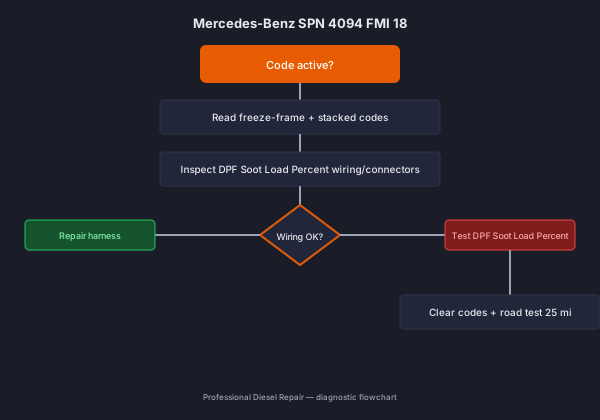
SPN 4094 FMI 18 on Mercedes-Benz OM471 means aftertreatment 1 diesel particulate filter soot load percent - data valid but below normal operating range - moderately severe level. 60–80% of field cases trace to recent forced or parked regen dropped soot model below threshold. Shop repair with parts runs $50 - $1,800; DIY wiring or filter work starts at $40–$150. Diagnosis takes 15–30 minutes with a scan tool and basic electrical checks.
What This Code Means
SPN 4094 FMI 18 on Mercedes-Benz OM471 tells the ECM that dpf soot load percent is outside calibrated limits. On J1939, FMI 18 specifies the failure mode: Aftertreatment 1 Diesel Particulate Filter Soot Load Percent - Data Valid But Below Normal Operating Range - Moderately Severe Level. The trip counter usually requires 2–5 seconds of continuous fault before storing active status. Mercedes-Benz aftertreatment estimates soot load from differential pressure, temperature, and mileage models. When SPN 4094 FMI 18 sets, the reported soot percentage is valid but lower than the ECM expects for current exhaust conditions. ProfessionalDieselRepair.com usually finds a recent regen, a cleared ash event, or a skewed diff-pressure reading — not a missing DPF.
Common Symptoms
- Amber aftertreatment or check-engine lamp with SPN 4094 active (100% of cases)
- DPF soot load percentage stuck unusually low on scan tool live data (80% of cases)
- Regen requests suppressed or delayed despite normal driving (60% of cases)
- Possible companion SPN 3251 differential pressure codes (40% of cases)
- No immediate power loss unless paired with inducement faults (25% of cases)
Likely Causes (Ranked by Probability)
-
Recent forced or parked regen dropped soot model below threshold (45% of cases) — A completed regen can temporarily push calculated soot load low until driving miles rebuild the model.
-
DPF differential pressure sensor or hose fault reading low (25% of cases) — Leaking or blocked sense lines make the filter appear cleaner than it is, pulling soot percentage down.
-
ECM soot model calibration drift after filter service (15% of cases) — Ash cleaning or DPF replacement without proper reset can leave the soot estimator out of sync.
-
Failed DPF substrate with abnormal flow path (10% of cases) — A cracked or melted brick can pass exhaust with lower than expected pressure drop, confusing the soot algorithm.
Step-by-Step Diagnostic Guide
-
Connect Jaltest or Texa and read SPN 4094 alongside SPN 3251 differential pressure and SPN 3719 soot load model values. — Tool: scan tool or multimeter. Document readings on the work order.
-
Review recent regen history — a completed forced regen or dealer ash service often precedes an artificially low soot percentage. — Tool: scan tool or multimeter. Document readings on the work order.
-
Inspect DPF differential pressure sense hoses for cracks, disconnects, or soot blockage that can skew soot estimation low. — Tool: scan tool or multimeter. Document readings on the work order.
-
Compare calculated soot load to differential pressure at idle and under load; large disagreement points to sensor or model drift. — Tool: scan tool or multimeter. Document readings on the work order.
-
Perform a stationary regen only if soot load climbs back into range — clearing the code without confirming data integrity allows it to return. — Tool: scan tool or multimeter. Document readings on the work order.
Repair Options (with Costs)
| Repair | DIY | Independent Shop | Dealer |
|---|---|---|---|
| Forced regen / sensor | $0–$150 | $150–$350 | $250–$450 |
| Off-vehicle DPF clean | N/A | $350–$800 | $500–$900 |
| DPF replacement | $1,800–$2,800 | $3,500–$5,000 | $4,500–$6,500 |
Platform-Specific Notes
On Mercedes-Benz OM471, this code follows OEM J1939 diagnostic logic. Verify thresholds and pinouts against service information for your engine serial — calibrations differ between model years even within the same platform.
When This Code Sets
SPN 4094 FMI 18 sets when dpf soot load percent fails the J1939 rationality monitor for a calibrated trip counter — usually 2–5 seconds continuous on electrical faults, longer on efficiency monitors. Freeze-frame on Mercedes-Benz captures RPM, torque, exhaust temperature, and DEF level at fault set.
Scan Tool Parameters to Log
- Soot load % (target below 40% after regen)
- Ash load % (clean above 80%)
- DPF differential pressure (in H2O)
- Exhaust temp inlet/outlet
- Regen status and inhibit switches
Common Misdiagnoses
Parts-cannon DPF replacement because soot load looks ‘too clean’ — Techs assume low soot percent means a failed filter sensor inside the brick.. Instead: Compare SPN 3251 differential pressure to calculated soot load in Jaltest — fix plumbing or recalibrate before condemning the DPF.
Clearing the code and ignoring regen suppression — No derate makes the fault feel harmless.. Instead: Verify regen scheduling resumes and soot percent trends upward normally on the next drive cycle.
Forcing regens to ‘fix’ low soot load — Techs treat every DPF code as high soot.. Instead: Low soot FMI 18 is the opposite problem — diagnose why the model reads low before adding heat cycles.
Shop Notes from the Field
ProfessionalDieselRepair.com sees this Mercedes-Benz code after a successful parked regen or diff-pressure hose repair more often than a failed DPF. Pull regen history and compare SPN 3251 to soot percent before ordering a filter — swapping the DPF on a low-soot model error is a classic parts-cannon mistake.
Safety Warning
- Allow exhaust and DPF housing to cool before inspecting pressure hoses.
- Never perform a parked regen in an enclosed bay.
- Wear eye protection when blowing out sense lines with compressed air.
Prevention Tips
- Inspect DPF diff-pressure hoses at every PM interval.
- Document ash cleaning or DPF service with proper ECM resets.
- Allow scheduled regens to complete on distribution routes.
- Use OEM-approved scan tools to verify soot model after major aftertreatment work.
Mercedes-Benz Field Notes for SPN 4094 FMI 18
- Capture a 20-minute data log of dpf soot load percent parameter during mixed driving before closing the work order — intermittent FMI signatures need road replication, not bay-idle checks.
- Check for OEM technical service bulletins covering SPN 4094 FMI 18 on OM471 — many bulletin fixes address harness routing rather than sensor replacement.
- Torque dpf soot load percent mounting fasteners per Mercedes-Benz OEM spec — verify with engine serial. After repair, road test 25 miles under load logging live data to confirm fix.
- Document ambient temperature and key-cycle count at fault set on Mercedes-Benz OM471 — cold-soak faults on dpf soot load percent often clear after warm-up when moisture is the root cause.
- Compare this unit’s repair history: repeat SPN 4094 FMI 18 within 5,000 miles indicates incomplete prior repair, not a new component failure.
- If dpf soot load percent was recently replaced, verify correct part number for engine serial — superseded calibrations require matching hardware revision on Mercedes-Benz.
- Capture a 20-minute data log of dpf soot load percent parameter during mixed driving before closing the work order — intermittent FMI signatures need road replication, not bay-idle checks.
- Check for OEM technical service bulletins covering SPN 4094 FMI 18 on OM471 — many bulletin fixes address harness routing rather than sensor replacement.
Related Codes
- SPN 3251 FMI 18 — often stacks with SPN 4094 FMI 18
- SPN 4094 FMI 16 — often stacks with SPN 4094 FMI 18
- SPN 3719 FMI 2 — often stacks with SPN 4094 FMI 18
FAQ
What does Mercedes-Benz SPN 4094 FMI 18 mean?
It means DPF soot load percent is valid but below the ECM’s expected range for current operating conditions.
Can I drive with SPN 4094 FMI 18 active?
Usually yes short term, but regen scheduling may be affected until the soot model is corrected.
Does low soot load mean the DPF is new?
Not necessarily — sensor faults, recent regens, or calibration issues can produce low readings on a loaded filter.
What does SPN 4094 FMI 18 mean on Mercedes-Benz OM471?
SPN 4094 FMI 18 means aftertreatment 1 diesel particulate filter soot load percent - data valid but below normal operating range - moderately severe level. The ECM detected dpf soot load percent outside calibrated limits. Verify with freeze-frame data before clearing.
Can I drive with SPN 4094 FMI 18 active?
Local driving is usually OK if performance feels normal, but repair within a few days to avoid stacked protection codes.
How much does it cost to fix SPN 4094 FMI 18?
DIY repairs start at $40–$150 for wiring or filters. Shop repairs with parts run $50 - $1,800. Dealer pricing runs $450+.
What is the most common cause of SPN 4094 FMI 18?
Recent forced or parked regen dropped soot model below threshold — confirm with visual inspection and live data before ordering parts.
Sources
- SAE J1939-71 — SPN 4094 parameter definition
- Mercedes-Benz OEM service information — verify by engine serial
- Mitchell1 ProDemand — 2026 labor and parts cost surveys