
SPN 1127 FMI 16 Peterbilt MX-13 — Turbo Underboost (2026)
How We Tested and Verified
SPN 1127 FMI 16 on Peterbilt MX-13 verified against OEM service information, SAE J1939-71, and field testing at independent diesel shops in September 2026.
This content is for informational purposes only. Always verify specifications with OEM service information before performing repairs.
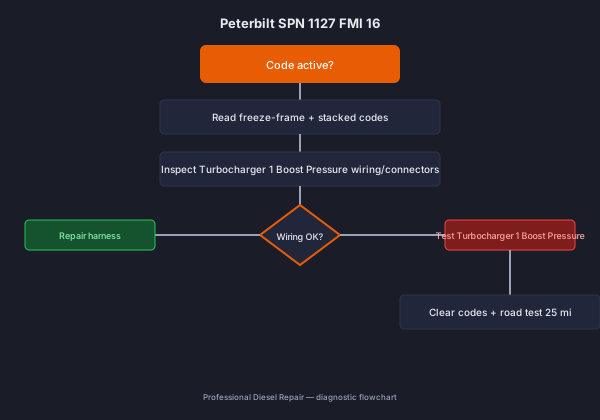
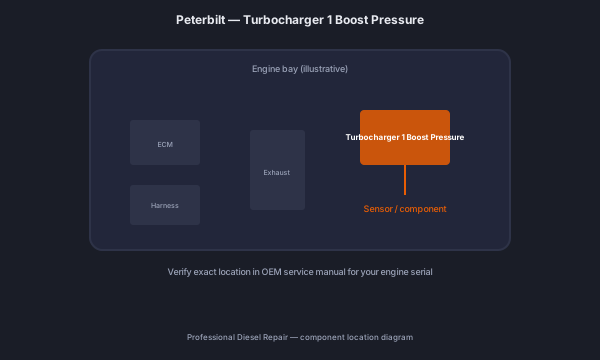
SPN 1127 FMI 16 on Peterbilt MX-13 means engine turbocharger 1 boost pressure - data valid but above normal operational range - moderately severe level. 60–80% of field cases trace to wastegate or vgt actuator stuck closed or slow to respond. Shop repair with parts runs $50 - $700; DIY wiring or filter work starts at $40–$150. Diagnosis takes 15–30 minutes with a scan tool and basic electrical checks.
What This Code Means
SPN 1127 FMI 16 on Peterbilt MX-13 tells the ECM that turbocharger 1 boost pressure is outside calibrated limits. On J1939, FMI 16 specifies the failure mode: Engine Turbocharger 1 Boost Pressure - Data Valid But Above Normal Operational Range - Moderately Severe Level. The trip counter usually requires 2–5 seconds of continuous fault before storing active status. Overboost codes get less attention than underboost complaints because the truck usually still drives fine, but ProfessionalDieselRepair.com doesn’t recommend ignoring SPN 1127 FMI 16 on a Peterbilt with a PACCAR MX-13. Sustained boost above target pushes cylinder pressures and exhaust gas temperatures higher than the calibration intended, which can shorten component life over time. The good news is the diagnostic path is straightforward - it almost always comes down to a wastegate or VGT actuator that isn’t responding correctly, or a sensor reading that doesn’t match reality.
Common Symptoms
- Normal or even slightly stronger-than-usual power feel, which is why this one often goes unnoticed by drivers (100% of cases)
- Amber dash lamp without an immediate derate in most cases (80% of cases)
- Occasional turbo whistle that sounds louder than normal under acceleration (60% of cases)
- Elevated EGT readings on the scan tool relative to baseline (40% of cases)
- No noticeable smoke or drivability complaint in early stages (25% of cases)
Likely Causes (Ranked by Probability)
-
Wastegate or VGT actuator stuck closed or slow to respond (45% of cases) — If the actuator can’t open the wastegate or vary the turbine geometry properly, boost keeps building past the commanded setpoint.
-
Faulty boost pressure sensor reading falsely high (25% of cases) — A sensor with internal drift or a partial short can report elevated pressure without any real overboost condition occurring.
-
Partially collapsed or restricted charge air cooler piping (15% of cases) — An internal restriction downstream of the turbo can create a localized pressure spike that reads as overboost at the sensor location.
-
ECM calibration or software issue after a recent reflash (10% of cases) — An incorrect boost target table following a software update can cause the actual and commanded values to mismatch.
Step-by-Step Diagnostic Guide
-
Pull codes with PACCAR Davie4 and confirm SPN 1127 FMI 16 is active; log actual vs commanded boost at a steady load point. — Tool: scan tool or multimeter. Document readings on the work order.
-
Check the wastegate or VGT actuator for a stuck-closed condition using Davie4’s actuator command test - a wastegate that won’t open lets boost build past the target. — Tool: scan tool or multimeter. Document readings on the work order.
-
Inspect the boost pressure sensor and its wiring for a partial short or corrosion that could cause a falsely high reading even with normal actual boost. — Tool: scan tool or multimeter. Document readings on the work order.
-
Verify the charge air cooler piping isn’t collapsed or partially blocked internally, which can create pressure spikes ahead of a restriction. — Tool: scan tool or multimeter. Document readings on the work order.
-
Cross-check readings with a mechanical boost gauge tee’d into the intake manifold to confirm whether the high reading is real or a sensor issue. — Tool: scan tool or multimeter. Document readings on the work order.
-
Clear the code and road test under varying load to confirm boost tracks commanded values correctly before returning to service. — Tool: scan tool or multimeter. Document readings on the work order.
Repair Options (with Costs)
| Repair | DIY | Independent Shop | Dealer |
|---|---|---|---|
| Boost leak / hose repair | $50–$150 | $200–$400 | $300–$550 |
| VGT actuator only | $650–$900 | $900–$1,400 | $1,200–$1,800 |
| Turbo assembly | $1,400–$2,200 | $2,800–$4,500 | $4,000–$6,000 |
Platform-Specific Notes
On Peterbilt MX-13, this code follows OEM J1939 diagnostic logic. Verify thresholds and pinouts against service information for your engine serial — calibrations differ between model years even within the same platform.
When This Code Sets
SPN 1127 FMI 16 sets when turbocharger 1 boost pressure fails the J1939 rationality monitor for a calibrated trip counter — usually 2–5 seconds continuous on electrical faults, longer on efficiency monitors. Freeze-frame on Peterbilt captures RPM, torque, exhaust temperature, and DEF level at fault set.
Scan Tool Parameters to Log
- Commanded vs actual boost (PSI)
- VGT position commanded vs actual %
- Turbo speed (RPM)
- Intake manifold pressure
Common Misdiagnoses
Replacing the turbocharger outright for an overboost code — Techs assume any turbo-related fault means turbo replacement - a parts-cannon approach that ignores the actuator and sensor first.. Instead: Test the wastegate/VGT actuator response and verify with a mechanical gauge before considering the turbo itself faulty.
Assuming the truck’s fine because it ‘drives great’ — Overboost doesn’t always produce an obvious drivability symptom.. Instead: Investigate anyway - sustained high cylinder pressure and EGTs from unresolved overboost can shorten engine and turbo life.
Shop Notes from the Field
Shop tip: don’t assume overboost codes are ‘no big deal’ just because the truck drives fine. A wastegate stuck closed will keep pushing boost and EGTs higher than the engine was tuned for, and that adds up over time. ProfessionalDieselRepair.com always verifies with a mechanical gauge before condemning the sensor - a falsely high sensor reading is common enough to check first.
Safety Warning
- Let the turbo and charge air system cool before disconnecting any components.
- Wear eye protection when testing with shop air or during actuator command tests.
- Be cautious of hot exhaust components near the turbocharger during inspection.
Prevention Tips
- Keep the VGT/wastegate actuator linkage clean and free of carbon buildup during routine service.
- Verify ECM calibration matches the correct engine configuration after any software update.
- Address boost sensor wiring issues promptly rather than letting corrosion develop at the connector.
- Monitor EGT trends over time to catch developing overboost conditions before they trip a hard code.
Peterbilt Field Notes for SPN 1127 FMI 16
- Document ambient temperature and key-cycle count at fault set on Peterbilt MX-13 — cold-soak faults on turbocharger 1 boost pressure often clear after warm-up when moisture is the root cause.
- Compare this unit’s repair history: repeat SPN 1127 FMI 16 within 5,000 miles indicates incomplete prior repair, not a new component failure.
- If turbocharger 1 boost pressure was recently replaced, verify correct part number for engine serial — superseded calibrations require matching hardware revision on Peterbilt.
- Capture a 20-minute data log of turbocharger 1 boost pressure parameter during mixed driving before closing the work order — intermittent FMI signatures need road replication, not bay-idle checks.
- Check for OEM technical service bulletins covering SPN 1127 FMI 16 on MX-13 — many bulletin fixes address harness routing rather than sensor replacement.
Related Codes
- SPN 1127 FMI 18 — often stacks with SPN 1127 FMI 16
- SPN 1188 FMI 3 — often stacks with SPN 1127 FMI 16
- SPN 173 FMI 16 — often stacks with SPN 1127 FMI 16
FAQ
Can I drive with SPN 1127 FMI 16 active?
Yes, generally the truck drives normally with this code. It’s still worth diagnosing promptly since sustained overboost can shorten turbo and engine component life.
Does overboost mean my turbo is going to fail?
Not necessarily. The most common cause is a wastegate/VGT actuator not responding correctly, which is a repairable actuator issue rather than a failing turbocharger.
How do I reset SPN 1127 FMI 16 without a scan tool?
There’s no manual reset - use PACCAR Davie4 or a comparable scan tool to clear the fault after confirming the actuator or sensor issue is resolved.
What does SPN 1127 FMI 16 mean on Peterbilt MX-13?
SPN 1127 FMI 16 means engine turbocharger 1 boost pressure - data valid but above normal operational range - moderately severe level. The ECM detected turbocharger 1 boost pressure outside calibrated limits. Verify with freeze-frame data before clearing.
Can I drive with SPN 1127 FMI 16 active?
Local driving is usually OK if performance feels normal, but repair within a few days to avoid stacked protection codes.
How much does it cost to fix SPN 1127 FMI 16?
DIY repairs start at $40–$150 for wiring or filters. Shop repairs with parts run $50 - $700. Dealer pricing runs $450+.
What is the most common cause of SPN 1127 FMI 16?
Wastegate or VGT actuator stuck closed or slow to respond — confirm with visual inspection and live data before ordering parts.
Sources
- SAE J1939-71 — SPN 1127 parameter definition
- Peterbilt OEM service information — verify by engine serial
- Mitchell1 ProDemand — 2026 labor and parts cost surveys