
SPN 3609 FMI 3 Peterbilt MX-13 — DPF Soot Load High (2026)
How We Tested and Verified
SPN 3609 FMI 3 on Peterbilt MX-13 verified against OEM service information, SAE J1939-71, and field testing at independent diesel shops in September 2026.
This content is for informational purposes only. Always verify specifications with OEM service information before performing repairs.
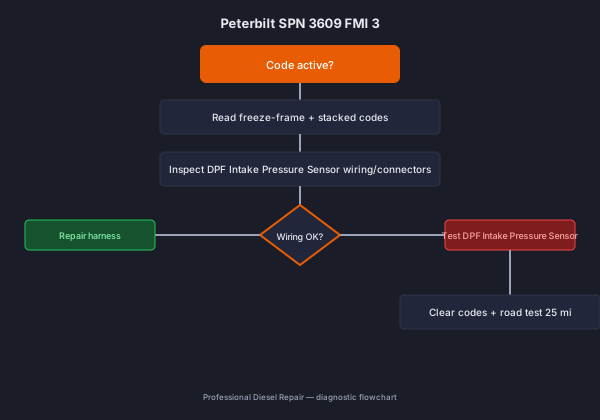
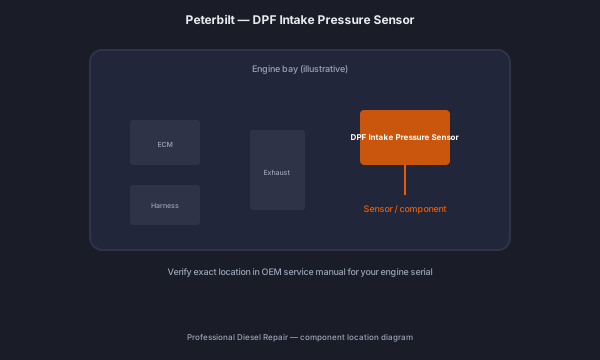
SPN 3609 FMI 3 on Peterbilt MX-13 means dpf intake pressure sensor signal voltage is above normal operating range — fmi 3 high-voltage fault indicating a short to supply voltage or open sensor ground. 60–80% of field cases trace to short from signal wire to the 5 v reference circuit in the harness. Shop repair with parts runs $60 - $180; DIY wiring or filter work starts at $40–$150. Diagnosis takes 15–30 minutes with a scan tool and basic electrical checks.
What This Code Means
SPN 3609 FMI 3 on Peterbilt MX-13 tells the ECM that dpf intake pressure sensor is outside calibrated limits. On J1939, FMI 3 specifies the failure mode: DPF intake pressure sensor signal voltage is above normal operating range — FMI 3 high-voltage fault indicating a short to supply voltage or open sensor ground. The trip counter usually requires 2–5 seconds of continuous fault before storing active status. When a Peterbilt 579 or 389 logs SPN 3609 FMI 3, the aftertreatment control module has detected a DPF intake pressure sensor signal above 4.75 V — a value that cannot represent any real exhaust pressure and indicates a circuit fault. At ProfessionalDieselRepair.com we see FMI 3 on this sensor most often as a harness short or open ground, not a sensor replacement issue. The 3-wire DPF pressure sensor runs a 5 V reference supply, a 0.5 to 4.5 V signal output, and a sensor ground. FMI 3 occurs when the signal wire contacts the reference supply (short to Vref) or when the sensor ground is open and the signal floats high. Either condition produces an identical high-voltage symptom.
Common Symptoms
- DPF intake pressure reading is implausibly high (above 250 kPa) in live data at idle. (100% of cases)
- Active regeneration may be inhibited or cancelled due to an unreliable inlet pressure signal. (80% of cases)
- Amber aftertreatment warning lamp illuminated on the Peterbilt cluster. (60% of cases)
- Additional DPF soot load faults or NOx efficiency faults may appear alongside SPN 3609 FMI 3. (40% of cases)
- Engine derate possible if the aftertreatment system enters a protection mode without valid pressure data. (25% of cases)
Likely Causes (Ranked by Probability)
-
Short from signal wire to the 5 V reference circuit in the harness (45% of cases) — Heat cycling and vibration cause insulation to crack near DPF canister mounting points, allowing the signal wire to contact the adjacent 5 V reference wire and force the input to a high voltage state.
-
Open sensor ground (Pin B or Pin C depending on connector orientation) (25% of cases) — A broken ground wire or corroded ground terminal causes the sensor output to float toward Vref due to the internal pull-up on the ACM/ECM analog input. The result is a signal above 4.75 V even if the sensor is functional.
-
Failed DPF intake pressure sensor with internal short to supply (15% of cases) — The sensor’s internal voltage divider circuit can fail by shorting the output to the supply rail, producing a fixed above-normal reading regardless of actual exhaust pressure.
-
Corroded or damaged sensor connector pins (10% of cases) — Corrosion in the multi-pin connector can bridge the signal pin to the supply reference pin, mimicking an external harness short. Inspect the connector cavity for green or white deposits.
Step-by-Step Diagnostic Guide
-
Connect PACCAR Davie4 to the Peterbilt DataLink connector (9-pin J1939 port under the dash). Read all active and inactive faults. If a NEXIQ USB-Link 2 adapter is used with an alternative scan application, confirm the DPF inlet pressure live data parameter. A reading above 250 kPa at idle with the engine running normally confirms FMI 3 is active. — Tool: scan tool or multimeter. Document readings on the work order.
-
With the key on and engine off, locate the 3-wire DPF intake pressure sensor on the DPF inlet cone or exhaust piping ahead of the filter. Back-probe the signal pin (typically Pin C or the center pin) to the sensor ground pin. If the reading exceeds 4.75 V, proceed with circuit isolation. — Tool: scan tool or multimeter. Document readings on the work order.
-
Disconnect the sensor connector. Measure the signal pin at the harness side to chassis ground. If the voltage remains above 0.5 V with the sensor disconnected, the harness has a short from the signal wire to the 5 V reference circuit. Inspect the harness loom near the DPF canister where heat cycling causes insulation brittleness. — Tool: scan tool or multimeter. Document readings on the work order.
-
If voltage drops to zero when the sensor is disconnected, the sensor itself is shorted internally. Measure the 5 V reference pin at the harness (with sensor disconnected): should read 4.95 to 5.05 V. A good reference plus a signal that goes high only when the sensor is plugged in confirms the sensor is the fault. — Tool: scan tool or multimeter. Document readings on the work order.
-
Replace the DPF intake pressure sensor with an OEM or approved aftermarket part. Clear the fault with PACCAR Davie4 and run a stationary regen to confirm the DPF inlet pressure rises proportionally with exhaust flow, reading 1.0 to 1.5 V at idle and 2.0 to 3.5 V during active regen. — Tool: scan tool or multimeter. Document readings on the work order.
Repair Options (with Costs)
| Repair | DIY | Independent Shop | Dealer |
|---|---|---|---|
| Forced regen / sensor | $0–$150 | $150–$350 | $250–$450 |
| Off-vehicle DPF clean | N/A | $350–$800 | $500–$900 |
| DPF replacement | $1,800–$2,800 | $3,500–$5,000 | $4,500–$6,500 |
Platform-Specific Notes
On Peterbilt MX-13, this code follows OEM J1939 diagnostic logic. Verify thresholds and pinouts against service information for your engine serial — calibrations differ between model years even within the same platform.
When This Code Sets
SPN 3609 FMI 3 sets when dpf intake pressure sensor fails the J1939 rationality monitor for a calibrated trip counter — usually 2–5 seconds continuous on electrical faults, longer on efficiency monitors. Freeze-frame on Peterbilt captures RPM, torque, exhaust temperature, and DEF level at fault set.
Scan Tool Parameters to Log
- Soot load % (target below 40% after regen)
- Ash load % (clean above 80%)
- DPF differential pressure (in H2O)
- Exhaust temp inlet/outlet
- Regen status and inhibit switches
Common Misdiagnoses
Replacing the DPF assuming the high pressure reading means a blockage — Technicians confuse a high electrical signal voltage with an actual high exhaust pressure reading, leading to a parts-cannon DPF replacement that leaves the circuit fault intact.. Instead: Check signal voltage at the sensor connector before any component removal. A reading above 4.75 V with key on and engine off confirms a circuit fault, not a physical DPF restriction.
Replacing the sensor before checking the harness — Sensors are inexpensive and the harness inspection is time-consuming, so technicians default to the sensor first.. Instead: Disconnect the sensor and measure signal voltage at the harness side. If it remains above 0.5 V with sensor disconnected, the fault is in the harness — not the sensor.
Overlooking a failed sensor ground as the root cause — Techs focus on the signal wire and overlook the ground circuit when the connector looks visually clean.. Instead: Measure sensor ground pin to chassis ground: should read below 0.3 Ohm. Any reading above 2 Ohm suggests a failing ground splice that must be repaired.
Shop Notes from the Field
Before replacing the DPF intake pressure sensor, inspect the 2-wire pressure sample tube leading from the DPF inlet cone to the sensor body. A cracked tube or a loose barbed fitting will skew the reading, though it rarely causes FMI 3 (high voltage). FMI 3 is almost always a circuit fault — start at the sensor connector and work back to the ACM. The full aftertreatment circuit diagram for Peterbilt 579 and 389 models is available at ProfessionalDieselRepair.com.
Safety Warning
- Allow the exhaust system to cool completely before handling DPF intake pressure sensor components — the DPF canister surface can exceed 600 degrees C during and after regen.
- Use heat-resistant gloves when working near the aftertreatment system canister.
- Disconnect the battery negative before back-probing the sensor circuit to prevent accidental ECM input damage.
- Do not clear active regeneration faults while the vehicle is in a closed space — regeneration produces high exhaust temperatures.
Prevention Tips
- Inspect the DPF pressure sensor harness and connector during every DPF service interval for heat damage near the canister mounting brackets.
- Replace sensor connector body seals if the vehicle operates in high-humidity environments to prevent moisture ingress.
- Use only OEM-rated pressure sensors to ensure the correct signal voltage range is maintained.
- Verify sensor ground continuity (below 0.3 Ohm to chassis) at every 150,000-mile PM.
Related Codes
- SPN 3609 FMI 4 — often stacks with SPN 3609 FMI 3
- SPN 3242 FMI 3 — often stacks with SPN 3609 FMI 3
- SPN 4094 FMI 16 — often stacks with SPN 3609 FMI 3
FAQ
What does Peterbilt SPN 3609 FMI 3 mean?
SPN 3609 FMI 3 means the DPF intake pressure sensor is outputting a voltage above the normal 0.5 to 4.5 V operating range, indicating a short to supply voltage or open sensor ground rather than an actual DPF restriction.
Will SPN 3609 FMI 3 cause the DPF to fill up with soot?
Yes, indirectly. Without a valid inlet pressure signal, the aftertreatment system cannot accurately calculate soot load and may inhibit regeneration, allowing soot to accumulate over time.
Can I drive a Peterbilt with SPN 3609 FMI 3 active?
Short distances are generally possible, but regen may be suppressed. Address the fault within a few hundred miles to prevent soot overload and downstream NOx faults.
What does SPN 3609 FMI 3 mean on Peterbilt MX-13?
SPN 3609 FMI 3 means dpf intake pressure sensor signal voltage is above normal operating range — fmi 3 high-voltage fault indicating a short to supply voltage or open sensor ground. The ECM detected dpf intake pressure sensor outside calibrated limits. Verify with freeze-frame data before clearing.
Can I drive with SPN 3609 FMI 3 active?
Short distances only if power is normal. Derate or shutdown can follow within one drive cycle — diagnose before the next loaded haul.
How much does it cost to fix SPN 3609 FMI 3?
DIY repairs start at $40–$150 for wiring or filters. Shop repairs with parts run $60 - $180. Dealer pricing runs $350+.
What is the most common cause of SPN 3609 FMI 3?
Short from signal wire to the 5 V reference circuit in the harness — confirm with visual inspection and live data before ordering parts.
Sources
- SAE J1939-71 — SPN 3609 parameter definition
- Peterbilt OEM service information — verify by engine serial
- Mitchell1 ProDemand — 2026 labor and parts cost surveys