
SPN 132 FMI 1 Scania DC13 — Inlet Air Mass Flow / MAF (2026)
How We Tested and Verified
SPN 132 FMI 1 on Scania DC13 verified against OEM service information, SAE J1939-71, and field testing at independent diesel shops in September 2026.
This content is for informational purposes only. Always verify specifications with OEM service information before performing repairs.
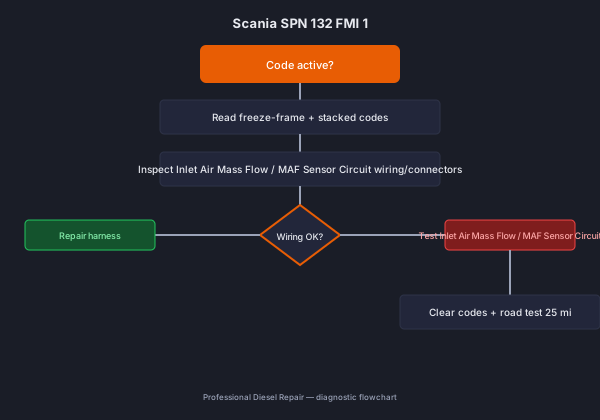
SPN 132 FMI 1 on Scania DC13 means inlet air mass flow rate - data valid but below normal operating range - moderately severe level. 60–80% of field cases trace to restricted or collapsed air filter element. Shop repair with parts runs $80 - $1,200; DIY wiring or filter work starts at $40–$150. Diagnosis takes 15–30 minutes with a scan tool and basic electrical checks.
What This Code Means
SPN 132 FMI 1 on Scania DC13 tells the ECM that inlet air mass flow / maf sensor circuit is outside calibrated limits. On J1939, FMI 1 specifies the failure mode: Inlet Air Mass Flow Rate - Data Valid But Below Normal Operating Range - Moderately Severe Level. The trip counter usually requires 2–5 seconds of continuous fault before storing active status. Low airflow codes on Scania trucks often start with a forgotten hose clamp. ProfessionalDieselRepair.com compares MAF readings to boost pressure in Jaltest because FMI 1 confirms the ECM sees genuinely low flow data, not a communication error.
Common Symptoms
- Check engine lamp with SPN 132 FMI 1 in SDP3 or Jaltest (100% of cases)
- Reduced engine power and slow acceleration under load (80% of cases)
- Black smoke under load indicating rich combustion from low measured airflow (60% of cases)
- Turbo boost lower than commanded in live data (40% of cases)
- Fault may appear after air filter service or CAC hose removal (25% of cases)
Likely Causes (Ranked by Probability)
-
Restricted or collapsed air filter element (45% of cases) — High restriction reduces measured mass flow even when the turbo can still produce moderate boost.
-
Intake leak between MAF sensor and turbo compressor inlet (25% of cases) — Unmetered air leaks lower MAF reading relative to actual engine demand, setting FMI 1.
-
Contaminated or failed hot-film MAF sensor (15% of cases) — Oil mist from a failed turbo seal coats the sensing element, under-reporting airflow.
Step-by-Step Diagnostic Guide
-
Log SPN 132 mass airflow in Jaltest at 1500 RPM no-load versus full-load; compare to OEM spec table for your engine rating. — Tool: scan tool or multimeter. Document readings on the work order.
-
Inspect and replace the air filter element if restriction indicator is tripped or element is visibly dirty. — Tool: scan tool or multimeter. Document readings on the work order.
-
Pressure-test intake plumbing from air filter to turbo inlet at 15 psi; soap-test clamps and sensor gaskets for leaks. — Tool: scan tool or multimeter. Document readings on the work order.
-
Clean the hot-film MAF sensor with approved cleaner only; do not touch the sensing element with tools. — Tool: scan tool or multimeter. Document readings on the work order.
-
If MAF reads low with clean filter and tight plumbing, measure supply voltage 11-14V and signal output at idle, typically 1-3 g/s on DC13 platforms. — Tool: scan tool or multimeter. Document readings on the work order.
Repair Options (with Costs)
| Repair | DIY | Independent Shop | Dealer |
|---|---|---|---|
| Inlet Air Mass Flow / MAF Sensor Circuit wiring repair | $25–$150 | $150–$350 | $250–$500 |
| Inlet Air Mass Flow / MAF Sensor Circuit sensor/part | $80 - $1,200 | $$80 - $1,200 + labor | $600+ |
| Full module replacement | N/A | $600–$1,500 | $600+ |
Platform-Specific Notes
On Scania DC13, this code follows OEM J1939 diagnostic logic. Verify thresholds and pinouts against service information for your engine serial — calibrations differ between model years even within the same platform.
When This Code Sets
SPN 132 FMI 1 sets when inlet air mass flow / maf sensor circuit fails the J1939 rationality monitor for a calibrated trip counter — usually 2–5 seconds continuous on electrical faults, longer on efficiency monitors. Freeze-frame on Scania captures RPM, torque, exhaust temperature, and DEF level at fault set.
Scan Tool Parameters to Log
- Inlet Air Mass Flow / MAF Sensor Circuit live data PID at idle, cruise, and full load
- Battery voltage and ECM supply voltage
- Related aftertreatment and protection PIDs (SPN 1569 if stacked)
Common Misdiagnoses
Replacing the turbo for a low MAF reading — Low flow feels like turbo failure.. Instead: Parts-cannon turbo swaps are expensive. Verify boost pressure matches load; low MAF with normal boost points to sensor or intake leak.
Ignoring the air filter after a quick blow-out — Compressed air seems to restore flow.. Instead: Replace the element per Scania interval; partial clogging returns under highway pull.
Shop Notes from the Field
ProfessionalDieselRepair.com finds Scania SPN 132 FMI 1 frequently traces to a loose clamp after air filter service, not a failed turbo. Low MAF with normal boost on a smoke test means the sensor is under-reporting, not that air is actually missing.
Safety Warning
- Keep hands clear of rotating fan when performing intake leak tests with engine running.
- Do not use brake cleaner on MAF hot-film elements.
- Secure intake hoses before road test after service.
Prevention Tips
- Replace air filters at Scania recommended intervals, sooner in dusty environments.
- Inspect turbo oil drain and seals when MAF contamination recurs.
- Torque intake clamps to spec after any filter or CAC service.
Scania Field Notes for SPN 132 FMI 1
- Compare this unit’s repair history: repeat SPN 132 FMI 1 within 5,000 miles indicates incomplete prior repair, not a new component failure.
- If inlet air mass flow / maf sensor circuit was recently replaced, verify correct part number for engine serial — superseded calibrations require matching hardware revision on Scania.
- Capture a 20-minute data log of inlet air mass flow / maf sensor circuit parameter during mixed driving before closing the work order — intermittent FMI signatures need road replication, not bay-idle checks.
- Check for OEM technical service bulletins covering SPN 132 FMI 1 on DC13 — many bulletin fixes address harness routing rather than sensor replacement.
- Torque inlet air mass flow / maf sensor circuit mounting fasteners per Scania OEM spec — verify with engine serial. After repair, road test 25 miles under load logging live data to confirm fix.
- Document ambient temperature and key-cycle count at fault set on Scania DC13 — cold-soak faults on inlet air mass flow / maf sensor circuit often clear after warm-up when moisture is the root cause.
- Compare this unit’s repair history: repeat SPN 132 FMI 1 within 5,000 miles indicates incomplete prior repair, not a new component failure.
- If inlet air mass flow / maf sensor circuit was recently replaced, verify correct part number for engine serial — superseded calibrations require matching hardware revision on Scania.
- Capture a 20-minute data log of inlet air mass flow / maf sensor circuit parameter during mixed driving before closing the work order — intermittent FMI signatures need road replication, not bay-idle checks.
- Check for OEM technical service bulletins covering SPN 132 FMI 1 on DC13 — many bulletin fixes address harness routing rather than sensor replacement.
- Torque inlet air mass flow / maf sensor circuit mounting fasteners per Scania OEM spec — verify with engine serial. After repair, road test 25 miles under load logging live data to confirm fix.
Related Codes
- SPN 132 FMI 16 — often stacks with SPN 132 FMI 1
- SPN 102 FMI 1 — often stacks with SPN 132 FMI 1
- SPN 105 FMI 16 — often stacks with SPN 132 FMI 1
FAQ
What does Scania SPN 132 FMI 1 mean?
Inlet air mass flow is below the normal operating range with valid sensor data at moderately severe level.
Will low MAF cause derate?
Yes. Scania reduces torque when measured airflow cannot support commanded fuel delivery safely.
Can a dirty air filter set this code?
Yes. Restricted filters are one of the most common and cheapest causes.
What does SPN 132 FMI 1 mean on Scania DC13?
SPN 132 FMI 1 means inlet air mass flow rate - data valid but below normal operating range - moderately severe level. The ECM detected inlet air mass flow / maf sensor circuit outside calibrated limits. Verify with freeze-frame data before clearing.
Can I drive with SPN 132 FMI 1 active?
Short distances only if power is normal. Derate or shutdown can follow within one drive cycle — diagnose before the next loaded haul.
How much does it cost to fix SPN 132 FMI 1?
DIY repairs start at $40–$150 for wiring or filters. Shop repairs with parts run $80 - $1,200. Dealer pricing runs $600+.
What is the most common cause of SPN 132 FMI 1?
Restricted or collapsed air filter element — confirm with visual inspection and live data before ordering parts.
Sources
- SAE J1939-71 — SPN 132 parameter definition
- Scania OEM service information — verify by engine serial
- Mitchell1 ProDemand — 2026 labor and parts cost surveys