
CODE-ORDER All Brands J1939 — ECM Diagnostic Strategy (2026)
How We Tested and Verified
CODE-ORDER on All Brands J1939 verified against OEM service information, SAE J2012, and field testing at independent diesel shops in September 2026.
This content is for informational purposes only. Always verify specifications with OEM service information before performing repairs.
CODE-ORDER on All Brands J1939 means diagnostic guide for diagnosing companion fault codes in correct root-cause order on heavy-duty diesel. 60–80% of field cases trace to fuel contamination cascading to injection codes. Shop repair with parts runs $50 - $3,000; DIY wiring or filter work starts at $40–$150. Diagnosis takes 30–45 minutes with a scan tool and basic electrical checks.
What This Code Means
CODE-ORDER on All Brands J1939 tells the ECM that ecm diagnostic strategy is outside calibrated limits. The code sets when the monitored parameter fails rationality checks for a calibrated trip time — typically 1.4–4 seconds continuous on OBD-II diesel platforms. A single failure cascades into multiple codes. Water in fuel sets rail pressure low, which sets misfire, which sets exhaust temp high. Replacing the misfiring injector fixes nothing if water is still in the tank. Companion code diagnosis means finding the first domino, not replacing every part each code names.
Common Symptoms
- 5–15 codes active simultaneously after single event (100% of cases)
- Codes across multiple systems — fuel, engine, aftertreatment (80% of cases)
- Repairing one code causes two new codes to appear (60% of cases)
- Same code family recurring after component replacement (40% of cases)
- Voltage supply codes (FMI 3/4) present with sensor codes (FMI 2/9) (25% of cases)
Likely Causes (Ranked by Probability)
-
Fuel contamination cascading to injection codes (45% of cases) — SPN 97 water in fuel leads to SPN 157 rail pressure low and SPN 1323 misfire — fix fuel, injection codes clear.
-
DEF quality failure cascading to SCR codes (25% of cases) — SPN 4334 DEF quality triggers SPN 3361 SCR efficiency and SPN 3226 outlet NOx — fix DEF before sensors or catalyst.
-
Battery or ground supply affecting multiple sensor circuits (15% of cases) — Low supply voltage sets FMI 4 on multiple sensors simultaneously — one ground strap fix clears 5+ codes.
Step-by-Step Diagnostic Guide
-
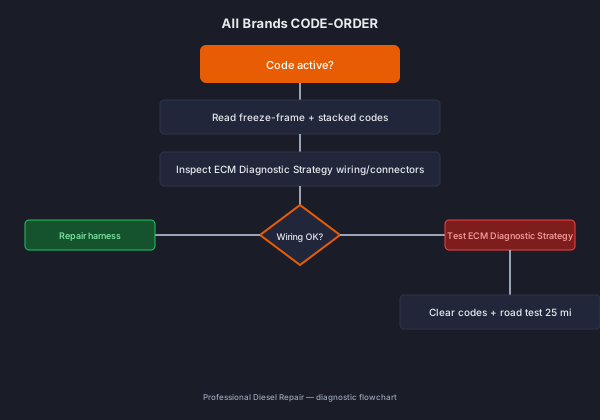
Snapshot all active codes with timestamps in JPRO or INSITE — group by system: power/supply, fuel, engine, aftertreatment, chassis. — Tool: scan tool or multimeter. Document readings on the work order.
-
Fix FMI 3 (voltage high) and FMI 4 (voltage low) supply codes first — sensor codes downstream are often symptoms of bad power. — Tool: scan tool or multimeter. Document readings on the work order.
-
Follow OEM code tree: fuel supply (SPN 1209, SPN 157) before injection (SPN 1323); DEF quality (SPN 4334) before SCR efficiency (SPN 3361, SPN 4364). — Tool: scan tool or multimeter. Document readings on the work order.
-
Repair highest-upstream code in each chain, then clear codes and drive cycle — companion codes should drop without separate repair. — Tool: scan tool or multimeter. Document readings on the work order.
-
If companion codes return after upstream fix, the root cause repair was incomplete — recheck supply voltage at 12.0–12.6 V and component operation. — Tool: scan tool or multimeter. Document readings on the work order.
Repair Options (with Costs)
| Repair | DIY | Independent Shop | Dealer |
|---|---|---|---|
| ECM Diagnostic Strategy wiring repair | $25–$150 | $150–$350 | $250–$500 |
| ECM Diagnostic Strategy sensor/part | $50 - $3,000 | $$50 - $3,000 + labor | $300+ |
| Full module replacement | N/A | $600–$1,500 | $300+ |
Platform-Specific Notes
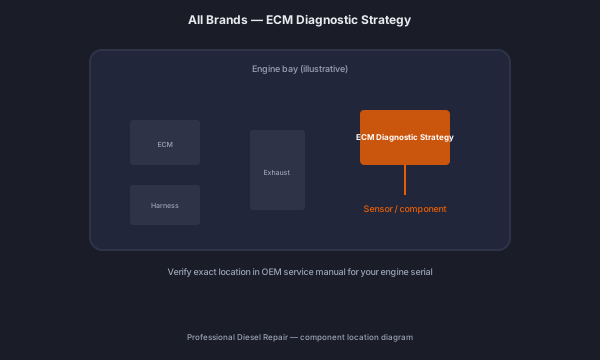
On All Brands J1939, this code follows OEM J1939 diagnostic logic. Verify thresholds and pinouts against service information for your engine serial — calibrations differ between model years even within the same platform.
When This Code Sets
CODE-ORDER typically stores after the ECM detects ecm diagnostic strategy outside calibrated limits for 1.4–4.0 seconds (OBD-II trip). Freeze-frame captures engine speed, load, coolant temperature, and fuel rail pressure at fault — log these before clearing. Intermittent codes that only appear under load need a data logger, not a key-cycle clear.
Scan Tool Parameters to Log
- ECM Diagnostic Strategy live data PID at idle, cruise, and full load
- Battery voltage and ECM supply voltage
- Related aftertreatment and protection PIDs (SPN 1569 if stacked)
Common Misdiagnoses
Replacing every component each code names — Code list looks like a parts order.. Instead: Group codes by system and find upstream fault — one fuel filter fixes SPN 1209, 157, and 1323 together.
Fixing SCR catalyst for efficiency codes with bad DEF — SPN 3361 points at SCR component.. Instead: Parts-cannon trap — verify DEF at 32.5% and dosing pressure at 130–145 PSI before any catalyst work.
Clearing all codes after partial repair — Some companions cleared, screen looks clean.. Instead: Drive cycle first — unfixe upstream fault repopulates entire code chain within one trip.
Shop Notes from the Field
Ten codes on the screen is usually two problems, not ten. Water in fuel (SPN 97) creates rail pressure (SPN 157) creates misfire (SPN 1323) — fix the water, the other two clear. Start at the beginning of the chain.
Safety Warning
- Do not clear companion codes without fixing upstream root cause — derate timers may reset but fault returns.
- Fuel system companions from water contamination can cause injector damage — address SPN 97 before cranking extensively.
- Multiple active stop-engine codes require shutdown — prioritize SPN 100 (oil pressure) and SPN 110 (coolant temp).
Prevention Tips
- Use OEM fault code trees for your engine platform — Cummins INSITE and DDDL include diagnostic flowcharts.
- Address first-occurrence pending codes before they cascade into active companion sets.
- Maintain fuel and DEF quality to prevent multi-code cascade events.
- Document code groups in repair orders — pattern recognition speeds future diagnosis.
All Brands Field Notes for CODE-ORDER
- Check for OEM technical service bulletins covering CODE-ORDER on J1939 — many bulletin fixes address harness routing rather than sensor replacement.
- Torque ecm diagnostic strategy mounting fasteners per All Brands OEM spec — verify with engine serial. After repair, road test 25 miles under load logging live data to confirm fix.
- Document ambient temperature and key-cycle count at fault set on All Brands J1939 — cold-soak faults on ecm diagnostic strategy often clear after warm-up when moisture is the root cause.
- Compare this unit’s repair history: repeat CODE-ORDER within 5,000 miles indicates incomplete prior repair, not a new component failure.
- If ecm diagnostic strategy was recently replaced, verify correct part number for engine serial — superseded calibrations require matching hardware revision on All Brands.
- Capture a 20-minute data log of ecm diagnostic strategy parameter during mixed driving before closing the work order — intermittent FMI signatures need road replication, not bay-idle checks.
- Check for OEM technical service bulletins covering CODE-ORDER on J1939 — many bulletin fixes address harness routing rather than sensor replacement.
- Torque ecm diagnostic strategy mounting fasteners per All Brands OEM spec — verify with engine serial. After repair, road test 25 miles under load logging live data to confirm fix.
- Document ambient temperature and key-cycle count at fault set on All Brands J1939 — cold-soak faults on ecm diagnostic strategy often clear after warm-up when moisture is the root cause.
- Compare this unit’s repair history: repeat CODE-ORDER within 5,000 miles indicates incomplete prior repair, not a new component failure.
Related Codes
- SPN 97 FMI 1 — often stacks with CODE-ORDER
- SPN 4334 FMI 18 — often stacks with CODE-ORDER
- SPN 168 FMI 3 — often stacks with CODE-ORDER
FAQ
What are companion fault codes?
Codes that share a root cause and set together. Fixing the upstream fault clears downstream companions without separate repairs.
What order should I diagnose fault codes?
Power supply (FMI 3/4) first, then fuel supply, then injection, then aftertreatment. DEF quality before SCR efficiency.
Why do new codes appear after I fix one?
The original root cause is still present — downstream systems now report faults that were masked. Keep tracing upstream.
What does CODE-ORDER mean on All Brands J1939?
CODE-ORDER means diagnostic guide for diagnosing companion fault codes in correct root-cause order on heavy-duty diesel. The ECM detected ecm diagnostic strategy outside calibrated limits. Verify with freeze-frame data before clearing.
Can I drive with CODE-ORDER active?
Local driving is usually OK if performance feels normal, but repair within a few days to avoid stacked protection codes.
How much does it cost to fix CODE-ORDER?
DIY repairs start at $40–$150 for wiring or filters. Shop repairs with parts run $50 - $3,000. Dealer pricing runs $300+.
What is the most common cause of CODE-ORDER?
Fuel contamination cascading to injection codes — confirm with visual inspection and live data before ordering parts.
Sources
- OEM service information — All Brands J1939 diagnostic procedures
- SAE J2012 — OBD-II DTC definition for CODE-ORDER
- Mitchell1 ProDemand — 2026 labor and parts cost surveys