
SPN 1209 FMI 16 Volvo D13 — Exhaust Pressure 1 (2026)
How We Tested and Verified
SPN 1209 FMI 16 on Volvo D13 verified against OEM service information, SAE J1939-71, and field testing at independent diesel shops in September 2026.
This content is for informational purposes only. Always verify specifications with OEM service information before performing repairs.
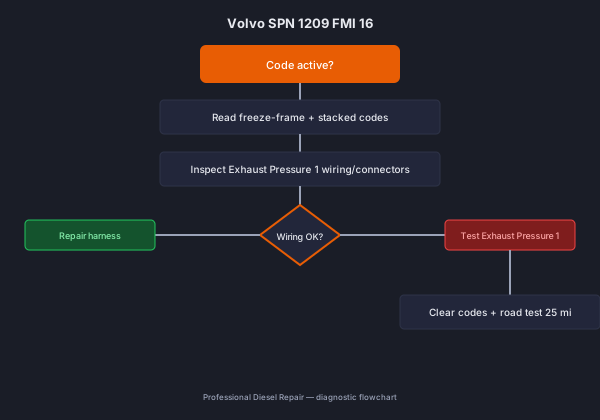
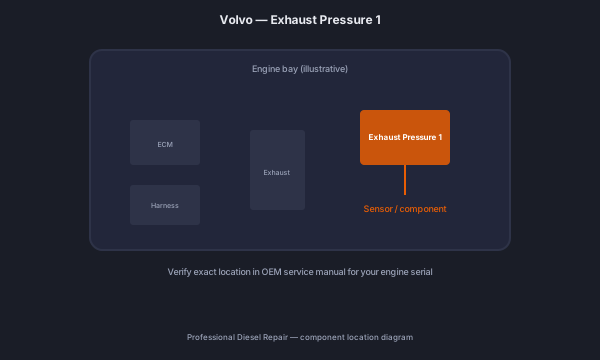
SPN 1209 FMI 16 on Volvo D13 means engine exhaust pressure 1 - data valid but above normal operational range - moderately severe level. 60–80% of field cases trace to clogged or disconnected exhaust pressure sensor sense tube. Shop repair with parts runs $50 - $600; DIY wiring or filter work starts at $40–$150. Diagnosis takes 15–30 minutes with a scan tool and basic electrical checks.
What This Code Means
SPN 1209 FMI 16 on Volvo D13 tells the ECM that exhaust pressure 1 is outside calibrated limits. On J1939, FMI 16 specifies the failure mode: Engine Exhaust Pressure 1 - Data Valid But Above Normal Operational Range - Moderately Severe Level. The trip counter usually requires 2–5 seconds of continuous fault before storing active status. Exhaust pressure faults like SPN 1209 FMI 16 sit in a gray area on Volvo engines - not an immediate derate, but a sign something’s restricting flow through the exhaust path. ProfessionalDieselRepair.com treats this as a triage code: check the cheap and common cause first (a plugged sensor sense line) before assuming the DPF or exhaust piping is physically restricted. Left unaddressed, sustained high backpressure works against the turbo and accelerates soot accumulation, so it’s worth a proper look even without a hard fault light on the dash.
Common Symptoms
- Slight reduction in power or fuel economy that builds gradually (100% of cases)
- More frequent DPF regeneration cycles than normal (80% of cases)
- Occasional whistling or hissing sound from the exhaust under load (60% of cases)
- Amber dash lamp without an immediate derate (40% of cases)
- Elevated exhaust temperatures reported on the scan tool (25% of cases)
Likely Causes (Ranked by Probability)
-
Clogged or disconnected exhaust pressure sensor sense tube (45% of cases) — Soot and condensation build up in the small sense line over time, producing an artificially high pressure reading with no actual restriction.
-
Elevated DPF soot load (25% of cases) — A DPF nearing its regeneration threshold restricts exhaust flow and drives up measured backpressure ahead of the filter.
-
Physical exhaust restriction (damaged pipe, aftermarket muffler, or collapsed liner) (15% of cases) — Mechanical damage or a non-OEM exhaust component can restrict flow enough to read as elevated backpressure under load.
-
Faulty exhaust pressure sensor (10% of cases) — Internal sensor drift can produce a false high reading even with clean sense lines and normal actual pressure.
Step-by-Step Diagnostic Guide
-
Connect Volvo’s Premium Tech Tool (or a Jaltest heavy-duty interface) and confirm whether SPN 1209 FMI 16 is active and check the logged exhaust pressure value against the expected range for current RPM and load. — Tool: scan tool or multimeter. Document readings on the work order.
-
Visually inspect the exhaust system from the turbo outlet back through the DOC and DPF for any obvious dents, kinks, or aftermarket exhaust modifications that could restrict flow. — Tool: scan tool or multimeter. Document readings on the work order.
-
Check the DPF differential pressure (SPN 3251) alongside this code - if soot load is climbing, the DPF itself is the likely source of the added backpressure rather than the exhaust piping. — Tool: scan tool or multimeter. Document readings on the work order.
-
Verify the exhaust pressure sensor’s sense tube isn’t cracked, disconnected, or plugged with soot - a blocked sense line will read artificially high even with normal actual backpressure. — Tool: scan tool or multimeter. Document readings on the work order.
-
If the sensor and lines check out and soot load is within range, inspect the DPF for physical damage or a partially melted substrate using a borescope through the inlet. — Tool: scan tool or multimeter. Document readings on the work order.
-
Clear the code, run a road test under load, and compare live exhaust pressure readings to a known-good baseline before returning the truck to service. — Tool: scan tool or multimeter. Document readings on the work order.
Repair Options (with Costs)
| Repair | DIY | Independent Shop | Dealer |
|---|---|---|---|
| Exhaust Pressure 1 wiring repair | $25–$150 | $150–$350 | $250–$500 |
| Exhaust Pressure 1 sensor/part | $50 - $600 | $$50 - $600 + labor | $400+ |
| Full module replacement | N/A | $600–$1,500 | $400+ |
Platform-Specific Notes
On Volvo D13, this code follows OEM J1939 diagnostic logic. Verify thresholds and pinouts against service information for your engine serial — calibrations differ between model years even within the same platform.
When This Code Sets
SPN 1209 FMI 16 sets when exhaust pressure 1 fails the J1939 rationality monitor for a calibrated trip counter — usually 2–5 seconds continuous on electrical faults, longer on efficiency monitors. Freeze-frame on Volvo captures RPM, torque, exhaust temperature, and DEF level at fault set.
Scan Tool Parameters to Log
- Exhaust Pressure 1 live data PID at idle, cruise, and full load
- Battery voltage and ECM supply voltage
- Related aftertreatment and protection PIDs (SPN 1569 if stacked)
Common Misdiagnoses
Ordering a new DPF before checking soot load data — Techs see ‘exhaust pressure high’ and assume the filter must be packed - a parts-cannon jump straight to the most expensive component.. Instead: Pull actual DPF differential pressure and soot load percentage from the scan tool first; if soot load is normal, the DPF isn’t the problem.
Replacing the exhaust pressure sensor without checking the sense tube — The sensor is a quick, inexpensive swap compared to tracing a small hose.. Instead: Inspect and blow out the sense tube first - a clogged line is a far more common cause than a bad sensor.
Shop Notes from the Field
Shop tip: check the sense tube to the exhaust pressure sensor before you even think about the DPF. Soot and condensation clog that little line constantly, and a plugged sense tube reads high pressure that isn’t really there. ProfessionalDieselRepair.com has pulled plenty of these codes with nothing more than a clogged 1/4-inch tube.
Safety Warning
- Allow the exhaust system to cool completely before inspecting sensors or sense tubes.
- Wear gloves when handling any exhaust component - soot residue can be caustic to skin.
- Use proper jack stands and wheel chocks if inspection requires going underneath the vehicle.
Prevention Tips
- Inspect the exhaust pressure sensor sense tube for soot buildup during routine PM services.
- Address DPF regeneration issues promptly rather than letting soot load climb repeatedly.
- Avoid non-OEM exhaust modifications that can restrict flow and skew backpressure readings.
- Keep the aftertreatment system on its scheduled ash cleaning interval.
Volvo Field Notes for SPN 1209 FMI 16
- Document ambient temperature and key-cycle count at fault set on Volvo D13 — cold-soak faults on exhaust pressure 1 often clear after warm-up when moisture is the root cause.
- Compare this unit’s repair history: repeat SPN 1209 FMI 16 within 5,000 miles indicates incomplete prior repair, not a new component failure.
- If exhaust pressure 1 was recently replaced, verify correct part number for engine serial — superseded calibrations require matching hardware revision on Volvo.
- Capture a 20-minute data log of exhaust pressure 1 parameter during mixed driving before closing the work order — intermittent FMI signatures need road replication, not bay-idle checks.
Related Codes
- SPN 3251 FMI 16 — often stacks with SPN 1209 FMI 16
- SPN 4094 FMI 16 — often stacks with SPN 1209 FMI 16
- SPN 1127 FMI 18 — often stacks with SPN 1209 FMI 16
FAQ
Can I keep driving with SPN 1209 FMI 16 active?
Yes in most cases, since this is a medium-severity code without an immediate derate, but don’t ignore it long-term - sustained high backpressure stresses the turbo and accelerates DPF loading.
Does this code mean my DPF is clogged?
Not necessarily. Check DPF differential pressure and soot load data first - a clogged sensor sense tube is just as common a cause and much cheaper to fix.
How do I reset SPN 1209 FMI 16 without a scan tool?
There’s no dash-button reset for this fault; you need Premium Tech Tool, Jaltest, or an equivalent scan tool to clear the stored code after the cause is corrected.
What does SPN 1209 FMI 16 mean on Volvo D13?
SPN 1209 FMI 16 means engine exhaust pressure 1 - data valid but above normal operational range - moderately severe level. The ECM detected exhaust pressure 1 outside calibrated limits. Verify with freeze-frame data before clearing.
Can I drive with SPN 1209 FMI 16 active?
Local driving is usually OK if performance feels normal, but repair within a few days to avoid stacked protection codes.
How much does it cost to fix SPN 1209 FMI 16?
DIY repairs start at $40–$150 for wiring or filters. Shop repairs with parts run $50 - $600. Dealer pricing runs $400+.
What is the most common cause of SPN 1209 FMI 16?
Clogged or disconnected exhaust pressure sensor sense tube — confirm with visual inspection and live data before ordering parts.
Sources
- SAE J1939-71 — SPN 1209 parameter definition
- Volvo OEM service information — verify by engine serial
- Mitchell1 ProDemand — 2026 labor and parts cost surveys