
SPN 157 FMI 18 Volvo D13 — Fuel Rail Pressure Sensor (2026)
How We Tested and Verified
SPN 157 FMI 18 on Volvo D13 verified against OEM service information, SAE J1939-71, and field testing at independent diesel shops in September 2026.
This content is for informational purposes only. Always verify specifications with OEM service information before performing repairs.
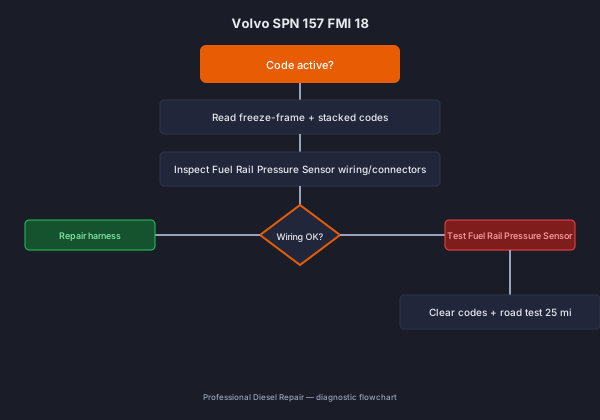
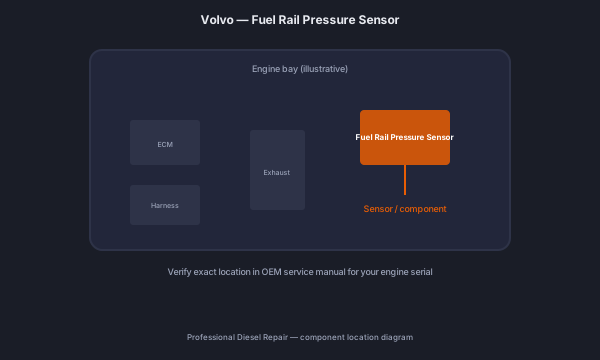
SPN 157 FMI 18 on Volvo D13 means engine injector metering rail 1 pressure - data valid but below normal operational range - moderately severe level. 10–15% of field cases trace to worn high-pressure fuel pump with reduced output (mechanical). Shop repair with parts runs $50–$1,800 (filter $50–$120; FRP sensor $80–$200; HP pump $800–$1,800); DIY wiring or filter work starts at $40–$150. Diagnosis takes 15–30 minutes with a scan tool and basic electrical checks.
What This Code Means
SPN 157 FMI 18 on Volvo D13 tells the ECM that fuel rail pressure sensor is outside calibrated limits. On J1939, FMI 18 specifies the failure mode: Engine Injector Metering Rail 1 Pressure - Data Valid But Below Normal Operational Range - Moderately Severe Level. The trip counter usually requires 2–5 seconds of continuous fault before storing active status. Volvo SPN 157 FMI 18 tells you the fuel rail is genuinely under-pressurized—not a wiring fault, not electrical noise, but real low rail pressure confirmed by a working sensor. On D13 and D11 PRIME engines the common rail system is designed to sustain 1,800–2,000 bar under full injection demand; FMI 18 activates when actual pressure falls moderately below the commanded target. The fault often appears as an intermittent derate under heavy load before it becomes persistent, which makes systematic diagnostics more important than component guessing. The full D13 common rail diagnostic sequence—supply pressure, injector return flow, HP pump output—is documented at ProfessionalDieselRepair.com.
Common Symptoms
- Yellow check engine lamp with SPN 157 FMI 18 logged in Volvo PTT (100% of cases)
- Engine torque derate with rough or hesitant acceleration (80% of cases)
- Fuel rail pressure reading below target in Volvo PTT live data (typically 300+ bar below commanded target at high load) (60% of cases)
- Possible hard start when fault is active—rail pressure insufficient for injection pulse timing (40% of cases)
- Black smoke under load if ECM compensates by extending injection duration (25% of cases)
Likely Causes (Ranked by Probability)
-
Worn high-pressure fuel pump with reduced output (mechanical) (45% of cases) — On D13 PRIME engines above 600,000 miles, HP pump plunger and barrel wear reduces maximum output flow, making it unable to sustain target rail pressure (1,800–2,000 bar) under high injection demand. Pressure at idle may appear normal while pressure under load drops into FMI 18 territory.
-
Internal injector return leak (mechanical) (25% of cases) — Worn injector needle or spool valve internals allow excess fuel to bypass back to the return rail rather than being injected. One leaking injector on a 6-cylinder D13 can drop rail pressure 200–400 bar at full load. Perform an individual injector return-flow test to identify the leaking unit.
-
Plugged or restricted secondary fuel filter (mechanical) (15% of cases) — A fuel filter approaching end-of-life restricts flow to the HP pump inlet, reducing the pressure differential available to the pump, especially under peak fuel demand. Rail pressure drops are most pronounced at high load and high RPM where fuel consumption is greatest.
-
Failed or aerated fuel supply (mechanical) (10% of cases) — A cracked or loose fitting on the supply line from tank to lift pump introduces air into the fuel system. Aerated fuel compresses differently than liquid in the HP pump, reducing effective pressurization and causing intermittent rail pressure drops—often worse when the tank is below a quarter-full.
-
Drifted fuel rail pressure sensor (electrical/sensor) (5% of cases) — The FRP sensor’s piezoelectric element can drift toward lower signal voltage over time, producing a below-threshold reading while actual rail pressure is within spec. FMI 18 from a drifted sensor typically appears consistently at a specific load level rather than varying with fuel demand changes.
Step-by-Step Diagnostic Guide
-
1. Connect Volvo Premium Tech Tool (PTT) and record active faults plus freeze-frame data—note commanded vs. actual fuel rail pressure at fault activation and the engine operating condition (load, RPM, temperature). — Tool: scan tool or multimeter. Document readings on the work order.
-
2. Inspect the fuel filter service indicator or check the filter restriction parameter in Volvo PTT. A partially plugged secondary filter starves the HP pump inlet and drops rail pressure under load. — Tool: scan tool or multimeter. Document readings on the work order.
-
3. Check the fuel tank level and primary fuel filter condition. Aerated fuel from a low tank or a leaking supply line fitting upstream of the low-pressure pump can cause intermittent rail pressure drops. — Tool: scan tool or multimeter. Document readings on the work order.
-
4. Measure fuel supply pressure at the HP pump inlet with a low-pressure fuel gauge (spec: 55–90 psi on a D13 PRIME depending on load). Supply pressure below 45 psi at any RPM points to a supply-side restriction or a failed lift pump. — Tool: scan tool or multimeter. Document readings on the work order.
-
5. With a Jaltest or Texa scan tool, command a static fuel rail pressure test if the platform supports it—this pressurizes the rail without running the engine and helps isolate the HP pump from the injectors. — Tool: scan tool or multimeter. Document readings on the work order.
-
6. Perform an injector return-flow test: compare actual vs. spec return flow volume per injector to identify an internal injector leak that is bleeding rail pressure down. — Tool: scan tool or multimeter. Document readings on the work order.
-
7. If supply pressure, filter condition, and injector return flows are all normal, measure the FRP sensor 5V reference supply and signal voltage at the sensor connector. Compare the signal voltage to pressure curve in Volvo SIS. — Tool: scan tool or multimeter. Document readings on the work order.
Repair Options (with Costs)
| Repair | DIY | Independent Shop | Dealer |
|---|---|---|---|
| Fuel filter / supply repair | $40–$120 | $120–$250 | $180–$320 |
| Lift pump replacement | $200–$450 | $500–$900 | $800–$1,200 |
| High-pressure pump | $1,200–$2,000 | $3,500–$6,500 | $5,000–$8,500 |
Platform-Specific Notes
On Volvo D13, this code follows OEM J1939 diagnostic logic. Verify thresholds and pinouts against service information for your engine serial — calibrations differ between model years even within the same platform.
When This Code Sets
SPN 157 FMI 18 sets when fuel rail pressure sensor fails the J1939 rationality monitor for a calibrated trip counter — usually 2–5 seconds continuous on electrical faults, longer on efficiency monitors. Freeze-frame on Volvo captures RPM, torque, exhaust temperature, and DEF level at fault set.
Scan Tool Parameters to Log
- Commanded vs actual rail pressure (psi)
- Fuel supply pressure at HPFP inlet (8–12 psi target)
- Injector balance rates / contribution
- Fuel temperature and volume
Common Misdiagnoses
Replacing the high-pressure fuel pump as a parts-cannon reflex before checking supply pressure and injector return flows — The HP pump is the most expensive component in the common rail system and gets blamed first when rail pressure is low. It is also a real failure mode, so the diagnosis is not wrong—it’s just premature without ruling out supply-side issues and injector leaks first.. Instead: Measure supply pressure at the HP pump inlet (should be 55–90 psi) and perform an injector return-flow test before condemning the pump. A leaking injector is cheaper to fix than an HP pump and will drop rail pressure just as effectively.
Replacing the fuel filter and calling it fixed without verifying rail pressure recovery — A plugged fuel filter is a common and legitimate cause of SPN 157 FMI 18, so replacing it is often appropriate. But if rail pressure doesn’t recover to target after the filter change, the HP pump or injectors are involved and the filter change only partially addressed the root cause.. Instead: After any filter replacement, use Volvo PTT to perform a full-load rail pressure test and confirm commanded vs. actual pressure is within 100 bar. If pressure is still below target, proceed to injector return-flow testing.
Assuming the fuel rail pressure sensor is faulty without comparing commanded vs. actual pressure behavior — FMI 18 seems like it could be a sensor issue since it involves a ‘data valid but below normal’ reading, and shops sometimes swap the sensor before doing mechanical tests.. Instead: Use Volvo PTT or Texa to log commanded vs. actual rail pressure under varying load conditions. If the two curves track together at the same low value, the sensor is reading accurately—the actual rail pressure is genuinely low. Only if they diverge (commanded high, actual high, but ECM-reported value low) is a sensor fault likely.
Shop Notes from the Field
FMI 18 is a load-dependent fault more often than not on D13 PRIME engines—rail pressure is adequate at idle but can’t sustain target pressure (typically 1,800–2,000 bar) under full load. The most common cause on D13s with 500k–700k miles is HP pump rotor wear that reduces max output enough to drop below the FMI 18 threshold only during high-demand injection events. Always do the injector return-flow test before condemning the HP pump—a single leaking injector on a 6-cylinder D13 will drop rail pressure by 200–400 bar at full load. Jaltest’s guided common rail diagnostics are solid for this platform. ProfessionalDieselRepair.com covers the D13 PRIME high-pressure fuel system inspection sequence.
Safety Warning
- Common rail fuel systems operate at up to 2,000 bar (29,000 psi)—never loosen any high-pressure fitting while the engine is running or within 60 seconds of shutdown. High-pressure fuel at this level penetrates skin like a needle and causes serious injection injuries.
- Perform all fuel system work in a well-ventilated area with no ignition sources—diesel mist from a pressurized line is highly combustible.
- After any HP pump or injector work, perform a leak-down pressure hold test before starting the engine to verify no fittings are loose.
Prevention Tips
- Replace the Volvo D13 secondary fuel filter on the recommended interval—typically every 75,000 miles or 1,200 hours for on-highway applications.
- Use only ultra-low sulfur diesel (ULSD) meeting EN 590 or ASTM D975 Grade 2-D spec—off-spec fuel accelerates HP pump plunger wear.
- Perform an injector return-flow test at each 150,000-mile PM on D13 engines—identifying a leaking injector early avoids damage to the HP pump.
- Check for supply-side air leaks by inspecting all fuel line fittings and the lift pump inlet connection annually, especially after any fuel filter service.
Related Codes
- SPN 157 FMI 1 — often stacks with SPN 157 FMI 18
- SPN 94 FMI 18 — often stacks with SPN 157 FMI 18
- SPN 1381 FMI 18 — often stacks with SPN 157 FMI 18
FAQ
What is the normal fuel rail pressure for a Volvo D13 PRIME?
The D13 PRIME common rail system targets approximately 1,800–2,000 bar (26,100–29,000 psi) at full injection demand and around 250–350 bar at idle with no fuel delivery requested. SPN 157 FMI 18 activates when actual rail pressure falls moderately below the commanded target—the exact threshold is calibration-specific.
Can a clogged fuel filter cause SPN 157 FMI 18 on a Volvo D13?
Yes. A fuel filter at or beyond its service interval restricts flow to the HP pump inlet. Under high fuel demand (full load, high RPM), the reduced inlet flow prevents the pump from sustaining target rail pressure, triggering FMI 18. This is typically the first thing to check and replace before pursuing more expensive repairs.
How do I test for an injector return leak on a Volvo D13?
With the engine running at idle or a specified low-speed, disconnect the fuel return line from each injector (using the appropriate low-pressure return fitting adapter) and measure the volume of fuel returning from each injector over a set time window. Volvo SIS and Texa both provide the per-injector pass/fail return volume specifications. Injectors exceeding the return limit are worn and need replacement.
What does SPN 157 FMI 18 mean on Volvo D13?
SPN 157 FMI 18 means engine injector metering rail 1 pressure - data valid but below normal operational range - moderately severe level. The ECM detected fuel rail pressure sensor outside calibrated limits. Verify with freeze-frame data before clearing.
Can I drive with SPN 157 FMI 18 active?
Short distances only if power is normal. Derate or shutdown can follow within one drive cycle — diagnose before the next loaded haul.
How much does it cost to fix SPN 157 FMI 18?
DIY repairs start at $40–$150 for wiring or filters. Shop repairs with parts run $50–$1,800 (filter $50–$120; FRP sensor $80–$200; HP pump $800–$1,800). Dealer pricing runs $200–$2,400.
What is the most common cause of SPN 157 FMI 18?
Worn high-pressure fuel pump with reduced output (mechanical) — confirm with visual inspection and live data before ordering parts.
Sources
- SAE J1939-71 — SPN 157 parameter definition
- Volvo OEM service information — verify by engine serial
- Mitchell1 ProDemand — 2026 labor and parts cost surveys