
SPN 100 FMI 1 Detroit Diesel DD15 — Low Oil Pressure (2026)
How We Tested and Verified
SPN 100 FMI 1 on Detroit Diesel DD15 verified against OEM service information, SAE J1939-71, and field testing at independent diesel shops in September 2026.
This content is for informational purposes only. Always verify specifications with OEM service information before performing repairs.
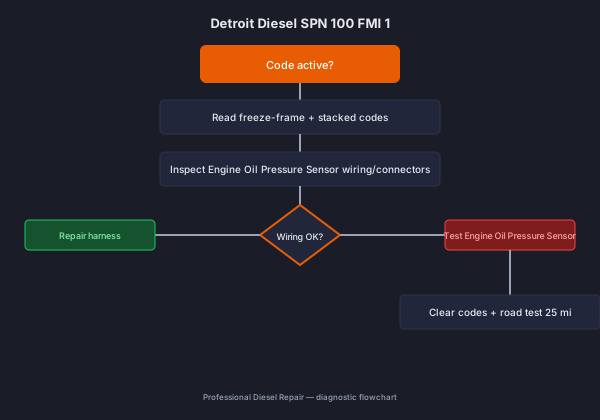
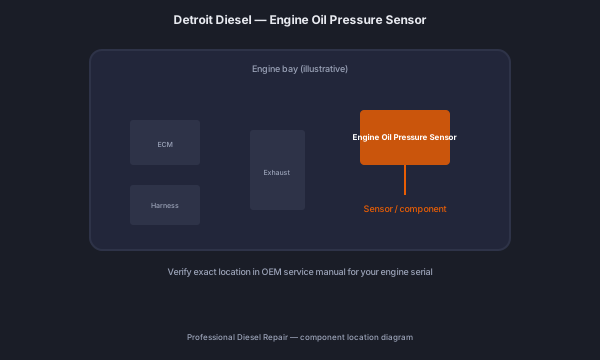
SPN 100 FMI 1 on Detroit Diesel DD15 means engine oil pressure - data valid but below normal operational range - most severe level. 10–15% of field cases trace to worn or failed oil pump (mechanical). Shop repair with parts runs $30–$900 (sensor $30–$90; oil pump assembly $400–$800 plus gaskets); DIY wiring or filter work starts at $40–$150. Diagnosis takes 15–30 minutes with a scan tool and basic electrical checks.
What This Code Means
SPN 100 FMI 1 on Detroit Diesel DD15 tells the ECM that engine oil pressure sensor is outside calibrated limits. On J1939, FMI 1 specifies the failure mode: Engine Oil Pressure - Data Valid But Below Normal Operational Range - Most Severe Level. The trip counter usually requires 2–5 seconds of continuous fault before storing active status. Detroit Diesel SPN 100 FMI 1 is the end of the line for engine oil pressure protection—FMI 1 (most severe) means the ECM has confirmed a critically low reading and shut the engine down immediately to save the crankshaft. Unlike FMI 18 which allows a brief derate window, FMI 1 cuts fuel without warning. On DD13, DD15, and DD16 platforms the consequences of ignoring the preceding FMI 18 warning and operating through oil pressure decline are a bearing and crankshaft replacement that runs $20,000–$40,000. At ProfessionalDieselRepair.com, every SPN 100 FMI 1 is treated as a mechanical emergency until a calibrated gauge proves otherwise.
Common Symptoms
- Red stop engine lamp (SEL) with immediate fuel cutoff on DD13/DD15/DD16 (100% of cases)
- Engine shuts down within seconds of fault activation—no 30-second window (80% of cases)
- Mechanical oil pressure gauge confirms below 5 psi at idle (60% of cases)
- SPN 100 FMI 18 (moderate precursor) often found in recent fault history (40% of cases)
- Possible audible rod knock if the engine was run through an early pressure-decline event (25% of cases)
Likely Causes (Ranked by Probability)
-
Worn or failed oil pump (mechanical) (45% of cases) — The gear-type oil pump on DD13/DD15 engines wears through normal service life. Above 750,000 miles, rotor-to-housing and gear-mesh clearances commonly exceed the maximum allowable value, producing internal bypass severe enough to drop oil pressure below the FMI 1 threshold at hot idle.
-
Spun or severely worn main/rod bearings (mechanical) (25% of cases) — Worn or seized bearings dramatically increase the lube circuit’s internal flow path, allowing oil to escape faster than the pump can maintain pressure. This is the worst-case finding—metallic debris in the oil filter element or magnetic drain plug is the tell.
-
Oil pressure sensor internal short-to-ground (electrical/sensor) (15% of cases) — The sender’s sensing element can develop an internal short to the sensor body, pulling the ECM signal line to near 0V regardless of actual lube circuit pressure. Only a mechanical gauge test can distinguish a shorted sensor from genuine mechanical low pressure.
-
Oil filter module O-ring bypass (mechanical) (10% of cases) — The main seal O-ring on the DD15 integrated filter/cooler module is a known wear point. A damaged or incorrectly seated O-ring routes pressurized oil from supply to return without passing through the lube galleries, producing a real measured pressure drop.
-
Internal oil gallery plug failure (mechanical) (5% of cases) — A dislodged or blown gallery plug can dump pressurized oil internally faster than the pump can sustain circuit pressure, causing sudden FMI 1 onset with no prior FMI 18 history. Look for this on engines that recently had a head or block repair.
Step-by-Step Diagnostic Guide
-
1. Connect Detroit Diesel Diagnostic Link (DDDL) or Diesel Laptops and pull the full fault history. Check whether SPN 100 FMI 18 preceded this FMI 1 event—gradual onset vs. sudden onset changes the diagnostic direction. — Tool: scan tool or multimeter. Document readings on the work order.
-
2. Check oil level with the dipstick before anything else. On a DD15, being a full quart low is enough to trigger FMI 18 at idle; two quarts low will reach FMI 1. — Tool: scan tool or multimeter. Document readings on the work order.
-
3. Install a calibrated mechanical gauge at the primary pressure tap on the DD13/DD15 block (main gallery port near the oil filter module). Crank the engine—if pressure does not build above 15 psi within 5 seconds of cranking, stop and investigate immediately. — Tool: scan tool or multimeter. Document readings on the work order.
-
4. Note cold-start cranking pressure: healthy DD15 reaches 30+ psi within 3 seconds. Full warm idle spec: 15 psi minimum. Normal operating range at speed: 40–65 psi. — Tool: scan tool or multimeter. Document readings on the work order.
-
5. If mechanical pressure is confirmed critically low, shut down immediately. Inspect the oil filter module O-ring (DD15 known wear point) for bypass, check for external oil leaks, and inspect the filter element for metallic debris. — Tool: scan tool or multimeter. Document readings on the work order.
-
6. If mechanical gauge reads normal while DDDL shows low, the sensor is the suspect. Disconnect the connector and measure reference supply voltage (should be 5V ± 0.25V) and signal pin voltage with a multimeter. An internal short-to-ground pulls the signal to 0V. — Tool: scan tool or multimeter. Document readings on the work order.
-
7. Replace sensor only after confirming mechanical pressure is in spec. Reset fault in DDDL, monitor live data at operating temperature for 20+ minutes before releasing. — Tool: scan tool or multimeter. Document readings on the work order.
Repair Options (with Costs)
| Repair | DIY | Independent Shop | Dealer |
|---|---|---|---|
| Engine Oil Pressure Sensor wiring repair | $25–$150 | $150–$350 | $250–$500 |
| Engine Oil Pressure Sensor sensor/part | $30–$900 (sensor $30–$90; oil pump assembly $400–$800 plus gaskets) | $$30–$900 (sensor $30–$90; oil pump assembly $400–$800 plus gaskets) + labor | $300–$1,800 |
| Full module replacement | N/A | $600–$1,500 | $300–$1,800 |
Platform-Specific Notes
On Detroit Diesel DD15, this code follows OEM J1939 diagnostic logic. Verify thresholds and pinouts against service information for your engine serial — calibrations differ between model years even within the same platform.
When This Code Sets
SPN 100 FMI 1 sets when engine oil pressure sensor fails the J1939 rationality monitor for a calibrated trip counter — usually 2–5 seconds continuous on electrical faults, longer on efficiency monitors. Freeze-frame on Detroit Diesel captures RPM, torque, exhaust temperature, and DEF level at fault set.
Scan Tool Parameters to Log
- Engine Oil Pressure Sensor live data PID at idle, cruise, and full load
- Battery voltage and ECM supply voltage
- Related aftertreatment and protection PIDs (SPN 1569 if stacked)
Common Misdiagnoses
Parts-cannon sensor replacement without verifying mechanical pressure—then the engine shuts down again with a new sensor installed — The oil pressure sender is inexpensive and reachable, and FMI 1 shutdowns are sometimes reflexively blamed on sensor failure. The truck restarts after the sensor swap because the fault resets, not because pressure is fixed.. Instead: Always install a calibrated mechanical gauge at the main pressure port before ordering anything. If mechanical pressure is also low, the lube circuit is the problem—a new sensor will not prevent the next shutdown.
Treating FMI 1 the same as FMI 18 and proceeding with the same derate-window mindset — Both codes reference SPN 100, so techs sometimes assume FMI 1 is just a ‘worse version’ of FMI 18 requiring the same response. FMI 1 is immediate shutdown—the engine is not giving you a countdown.. Instead: Check fault history for the sequence of events. FMI 1 with no prior FMI 18 in history means the pressure drop was rapid—look for external leaks, sudden bearing failure, or a catastrophic pump failure, not gradual pump wear.
Adding oil to bring level to full and clearing the code without investigating why level was low — Topping off oil and clearing the fault feels like a complete repair when the truck drives fine post-fill. But oil consumption severe enough to cause low pressure implies worn rings, valve seals, or an external leak that will recur.. Instead: After correcting oil level and clearing the code, perform a blowby test, inspect for external oil leaks, and monitor oil consumption over the next 5,000 miles. Document consumption rate.
Shop Notes from the Field
FMI 1 means the ECM is done negotiating—it already gave you FMI 18 as a yellow flag. If FMI 1 appears without a prior FMI 18 in history, the pressure loss was sudden: external leak, spun bearing, catastrophic pump failure. Inspect the oil filter module O-ring on DD15s at every oil change—it’s a documented weak point that can cause a partial lube bypass that reads identically to a sensor fault. On high-mileage DD13s (750k+ miles), gear-type oil pump clearances are the first thing to check after confirming low mechanical pressure. ProfessionalDieselRepair.com publishes the DD15 oil pump R&R procedure with wear clearance limits.
Safety Warning
- Do not restart the engine after SPN 100 FMI 1 shutdown without diagnosing the root cause—restarting into confirmed low oil pressure will destroy the crankshaft main bearings.
- Relieve system oil pressure (idle 30 seconds, then remove oil filler cap to vent) before removing the pressure sender or any oil gallery fitting.
- If metallic debris is found in the oil or on the filter element during diagnosis, a complete engine teardown inspection is required before returning the truck to service.
Prevention Tips
- Follow the DD15 oil change interval (350 engine hours or 25,000 miles on-highway) and use an API CK-4 or FA-4 approved 15W-40.
- Run oil analysis every other oil change on DD13/DD15 engines above 500,000 miles—viscosity breakdown and wear metal spikes appear before fault codes do.
- Inspect the DD15 filter module O-ring at every oil change and replace it if there is any compression set or surface cracking.
- Monitor hot-idle oil pressure at each scheduled PM—a downward trend from 25 psi toward 15 psi across consecutive services is early warning of pump wear.
Related Codes
- SPN 100 FMI 18 — often stacks with SPN 100 FMI 1
- SPN 98 FMI 1 — often stacks with SPN 100 FMI 1
- SPN 175 FMI 0 — often stacks with SPN 100 FMI 1
FAQ
Will a Detroit Diesel engine restart after SPN 100 FMI 1 shuts it down?
Yes, it typically restarts after clearing the fault in DDDL—but restarting does not fix the problem. The engine shut down to protect the bearings; clearing the code and driving without diagnosing the root cause allows the same destructive cycle to repeat.
What is the minimum oil pressure for a DD15 at hot idle?
Detroit Diesel specifies 15 psi minimum at fully warmed idle for the DD15. Normal operating range under load is 40–65 psi. FMI 1 activates when pressure drops below the critical shutdown threshold, typically 5–8 psi depending on the calibration year.
How do I know if the oil pump is failing on a DD15 without removing it?
Install a mechanical gauge and observe the cold-to-hot pressure decay. A worn pump shows normal cold pressure (40–60 psi at operating RPM) that drops to 10–15 psi or below as oil temperature climbs above 200°F. A healthy pump maintains 50+ psi regardless of oil temperature at operating speed.
What does SPN 100 FMI 1 mean on Detroit Diesel DD15?
SPN 100 FMI 1 means engine oil pressure - data valid but below normal operational range - most severe level. The ECM detected engine oil pressure sensor outside calibrated limits. Verify with freeze-frame data before clearing.
Can I drive with SPN 100 FMI 1 active?
Short distances only if power is normal. Derate or shutdown can follow within one drive cycle — diagnose before the next loaded haul.
How much does it cost to fix SPN 100 FMI 1?
DIY repairs start at $40–$150 for wiring or filters. Shop repairs with parts run $30–$900 (sensor $30–$90; oil pump assembly $400–$800 plus gaskets). Dealer pricing runs $300–$1,800.
What is the most common cause of SPN 100 FMI 1?
Worn or failed oil pump (mechanical) — confirm with visual inspection and live data before ordering parts.
Sources
- SAE J1939-71 — SPN 100 parameter definition
- Detroit Diesel OEM service information — verify by engine serial
- Mitchell1 ProDemand — 2026 labor and parts cost surveys