
Clean DPF Off-Vehicle vs On-Vehicle: Which Method Works
How We Tested and Verified
Verified through hands-on procedure on Cummins ISX15 CM2350, Detroit DD15 EPA17, and OEM service manuals. Safety steps confirmed with shop SOP and EPA stationary regen guidelines.
This content is for informational purposes only. Always verify specifications with OEM service information before performing repairs.
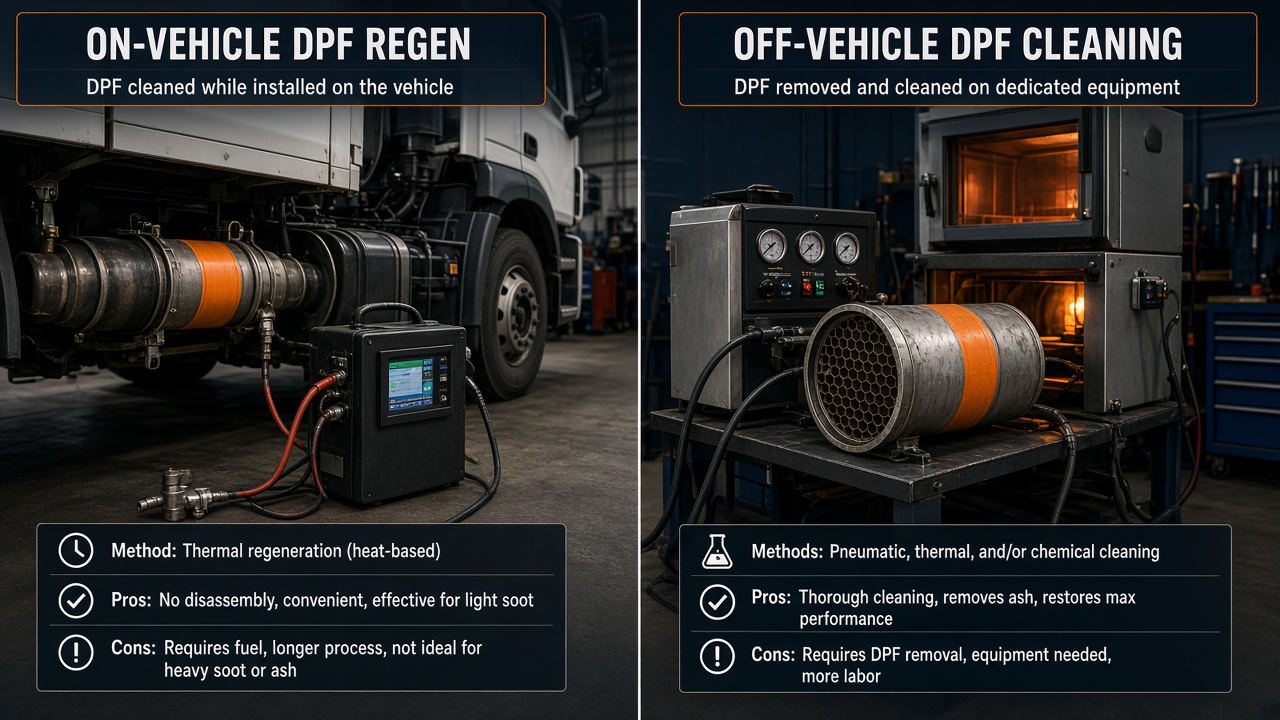
Off-vehicle DPF cleaning (thermal bake + pneumatic pulse) removes soot and ash for $350–$800 and restores 90–95% flow on undamaged substrates. On-vehicle cleaning ($400–$600) pulses compressed air through the filter in place — effective for light soot loading only, not ash plugging above 80%. Choose off-vehicle when ash load exceeds 80%, differential pressure stays above 15 in H2O after successful regen, or the filter has 300,000+ miles. On-vehicle works for emergency roadside de-soot when the truck cannot wait 2–3 days for mail-in cleaning turnaround.
Follow OEM service manual torque specs and one-time-use fastener requirements. High-pressure common-rail fuel and hot aftertreatment systems pose serious injury risk — use proper PPE and depressurization procedures before loosening any fuel or exhaust component.
On-Vehicle Cleaning Methods
Pneumatic pulse: tool connects to pressure ports, pulses air backward through channels — dislodges loose soot.
Solvent injection: chemical through sensor port, soak, regen — vendor-specific (FSX, Donaldson).
Pros: 2–4 hour turnaround, no crane, lower labor.
Cons: minimal ash removal, cannot inspect substrate cracks, variable results on heavily plugged units.
Off-Vehicle Thermal Cleaning
Filter removed, baked in kiln 1,100–1,200°F, ash blown out, flow tested.
Pros: best ash removal, visual crack inspection, documented flow spec (4.5 CFM @ 20 in H2O typical pass).
Cons: 1–3 day turnaround, removal labor 3–5 hours, shipping for mobile fleets.
Ultrasonic Aqueous Cleaning
Soak + ultrasonic tank — good for mixed contamination, less thermal stress on aged substrates.
Cost similar to thermal $350–$800. Available at regional DPF specialists.
Decision Matrix by Ash and Soot Level
Soot high, ash low, regen failing intermittently: try on-vehicle first.
Ash above 80%, frequent regen (SPN 520372): off-vehicle mandatory.
Second failed on-vehicle clean: off-vehicle or replace.
Downtime and Fleet Scheduling
On-vehicle: overnight slot in yard. Off-vehicle: spare filter swap reduces downtime — keep rebuilt core $1,200–$2,000 inventory one per five trucks.
Warranty and CARB Compliance
California: verify cleaning vendor CARB VER listing if applicable. OEM DPF warranty may require documented cleaning method.
Aftermarket DPF: check manufacturer approved cleaning temp max.
Post-Clean ECM Procedures
Ash/soot reset in INSITE mandatory. Force regen verification.
Log differential pressure baseline for future comparison.
Cost Comparison
On-vehicle: $350–$600 service call. Off-vehicle: $350–$800 shop + $300–$600 R&R labor.
Replacement if cracked: $2,800–$4,500 — see cost guide.
Vendor Selection Criteria
Flow test report provided, weight before/after, photo of substrate, warranty on clean 90 days.
Avoid shops with no oven — pressure wash only damages cordierite.
Flow Test Specification Interpretation
Clean shop provides CFM at specified restriction — compare to new filter spec sheet. Pass within 90% of new = good service. Marginal pass 75–90% — shorten next interval. Fail under 75% — replace filter.
Keep flow report in fleet file — warranty dispute evidence.
Silicon carbide filters have tighter flow spec — verify shop has correct test fixture.
Off-Vehicle Cleaning Process Steps
Remove DPF from vehicle (3–5 hours labor). Ship to cleaning facility or local center. Flow test before and after. Thermal bake at 1,100°F+ then pneumatic pulse from both ends. Reinstall with new gaskets and V-band clamps. Reset ash/soot model in OEM software.
On-Vehicle Cleaning Limitations
Pneumatic pulse through exhaust path — cannot apply thermal bake. Effective for soot loading below 60% with ash below 50%. Cannot assess substrate condition. Risk: debris pushed into downstream SCR if not properly isolated.
Mail-In vs Local Service Comparison
Mail-in: $350–$600, 3–7 day turnaround, shipping risk on ceramic substrate. Local: $500–$800, same-day to 48 hours, visual inspection possible. Fleet programs: scheduled rotation during planned downtime.
Regional Cost Variation Factors
Labor rates vary $40–$60/hr between rural and metro markets. Parts availability affects markup — dealer network faster but pricier. Core charges on turbos, injectors, ECMs: $500–$2,000 deposit, 30-day return window.
Repair vs Replace Decision Framework
Rebuild when core components measure within spec and failure is isolated (actuator, bearing). Replace when substrate cracked, shaft scored, or cumulative wear exceeds machine shop economics. TCO spreadsheet over 3 years includes warranty, downtime, and repeat failure risk.
Warranty and Core Return Management
OEM rebuilt components carry 12–24 month warranty. Aftermarket varies 90 days to 12 months. File core return within vendor deadline — missed forfeits $500–$2,000. Keep invoice with part number for CARB audit.
Hidden Costs and Contingency Planning
Flat-rate guides understate aftertreatment when rusted clamps, stripped V-bands, or cascade faults appear mid-repair. Add 1–2 hours contingency on first-time engine family through shop. Under-quoting DPF/SCR jobs damages margin.
Fleet Budget Planning Templates
Track cost per truck per quarter for aftertreatment, fuel system, turbo. Units exceeding fleet average 2x get targeted replacement or intensive PM. Telematics fault code trending identifies problem trucks before catastrophic failure.
Quote Template for Customer Communication
Itemize: diagnostic time (1–2 hours), parts with part numbers, labor hours with rate, shop supplies, environmental disposal fees, and tax. State warranty terms on parts and labor. Note contingencies: rusted clamps, cascade faults, core charges. Under-promise on timeline, over-deliver on communication.
Payment and Fleet Account Terms
Fleet NET 30 with credit application and insurance certificate. Retail: payment at pickup. Major jobs over $5,000: 50% deposit on parts ordered. Core charges collected upfront, credited on return within 30 days.
Regional Labor Rate Survey 2026
Independent diesel shop: $120–$175/hr (rural $120–$140, metro $150–$175). Dealer: $150–$210/hr. Mobile roadside: $175–$250/hr plus mileage. Fleet captive shop: $85–$110/hr internal rate. Aftertreatment specialist premium: +$15–$25/hr above general diesel rate.
Parts Markup Guidelines
Hard parts (turbo, DPF, SCR, injectors): 25–40% markup. Filters and fluids: 30–50% markup. Competitive items (oil, DEF): 15–25% markup. Core charges passed through at dealer cost. State markup disclosure requirements vary — check local consumer protection rules.
Total Cost of Ownership Framework
TCO per truck per year: fuel + maintenance + downtime + compliance. Track cost per mile by component system (aftertreatment, fuel, turbo, engine). Units exceeding fleet average 2x in any category get targeted inspection or replacement evaluation. Spreadsheet template: 12-month rolling average by VIN.
Negotiating Fleet Repair Contracts
Fleet contracts: negotiate labor rate locked 12 months, parts at cost-plus-25%, priority scheduling, and 24-hour turnaround guarantee on aftertreatment. Include annual PM per truck at fixed price. Exclusions: collision damage, abuse, non-OEM modifications. Review contract quarterly against actual cost per truck — adjust pricing annually based on data.
Independent shop advantage over dealer: lower labor rate, faster scheduling, personalized service. Disadvantage: may lack ECM security access for some platforms — disclose limitations upfront.
Negotiating Fleet Repair Contracts
Core Return and Remanufactured Parts Economics
Turbo core: $800–$1,500. Injector core: $200–$400 each. ECM core: $1,500–$2,500. DPF core: $500–$1,200. Return within 30 days in original packaging — damaged core forfeits deposit. Remanufactured turbo with new actuator: $1,400–$2,200 versus new $2,800–$4,500. Reman warranty 12 months versus new 24 months — factor in TCO calculation.
Track core return dates in shop management system — missed deadline is pure margin loss. Assign core return responsibility to service writer at job closeout, not technician.
Shop Management Software Integration
Connect diagnostic tool export to shop management system work order. Auto-populate fault codes, VIN, and mileage from scan tool PDF. Track parts cost versus estimate in real time. Flag jobs exceeding estimate by 20% for service writer review before continuing. Monthly report: average ticket, comeback rate, bay utilization, and gross margin by service category.
Integration reduces administrative time 30–45 minutes per job — technician focuses on diagnosis, not paperwork. Fleet accounts require itemized invoices with part numbers for their AP system.
Heavy-Duty Diesel Technical Reference
Cummins Platform Quick Reference
ISX15/X15 CM2350/CM2450: oil 25,000 mi/750 hr, fuel filters 25,000 mi/750 hr, valve lash 150,000 mi, DPF ash check 250,000–400,000 mi. Key SPNs: 3251 (DPF soot), 4364 (SCR efficiency), 3216 (NOx sensor), 1569 (derate), 641 (VGT actuator). INSITE required for regen, inducement reset, and injector coding. INLINE 7 or Nexiq USB-Link 3 adapter.
Detroit Platform Quick Reference
DD13/DD15/DD16 EPA17: oil 25,000 mi, valve adjustment 35,000 mi, DPF soot in grams (70g regen threshold). Key SPNs: same J1939 mapping as Cummins. DiagnosticLink required for static regen and aftertreatment reset. DDDL adapter or Nexiq pass-thru.
Common Torque Specifications
DPF V-band clamp: 18–25 ft-lbs. NOx sensor: 35–45 Nm. Fuel filter: hand tight plus 3/4 turn. Oil drain plug: 25–35 ft-lbs. Injector hold-down (X15): 37 ft-lbs. Turbo actuator mounting: per Holset spec in service manual. Over-torque on exhaust clamps crushes flanges causing repeat leaks.
Aftertreatment Temperature Reference
DPF active regen: exhaust outlet 1,000–1,200°F. SCR operation: inlet 400–650°F. DOC light-off: 350°F minimum. NOx sensor ready: 650–800°F internal cell temperature. Do not work on exhaust components below 150°F touch temperature — still causes burns. Allow 45-minute cool-down after highway operation before under-vehicle work.
DEF Specification Summary
API certified ISO 22241. Concentration: 32.5% urea ±0.5%. Freeze point: 12°F. Shelf life: 12 months at 75°F. Test with refractometer — not color or smell alone. Contaminated DEF is the leading root cause of SPN 4364. Drain and flush tank if concentration below 30%. Replace inline filter after any contamination event.
Shipping and Handling for Mail-In DPF Cleaning
Ceramic DPF substrate cracks from impact — use engine-specific shipping crate or double-box with 4 inches foam on all sides. Insure shipment for replacement value ($2,800–$4,200). Photograph filter condition before shipping for dispute resolution. Include work order with VIN, engine hours, soot load, and ash load readings from scan tool.
Quick Reference Summary
Verify all repair work with OEM scan tool before returning unit to service. Document part numbers, labor hours, and measurements on work order. Customer communication on downtime and operational changes prevents repeat failures. Schedule follow-up scan at 500 miles for aftertreatment repairs to confirm monitor completion and code absence.
Shop and Fleet Best Practices
Train drivers on regen completion — interrupted regen is the leading preventable cause of DPF-related roadside events. Use API-certified DEF from reputable supplier — test bulk tank quarterly with refractometer. Track engine hours alongside mileage for vocational fleet PM scheduling. Maintain scan tool subscription current — expired license blocks regen and inducement reset when customer needs it most. Second-tech quality check before unit leaves bay catches loose clamps, missed connectors, and tools left in engine compartment.
Measurement and Documentation Standards
Log all diagnostic measurements on work order: pressure readings, temperature values, electrical test results, and fluid test concentrations. Photograph failed components and contamination evidence. Attach scan tool PDF export showing fault status before and after repair. Warranty claims and fleet audits require documented measurements — verbal diagnosis without numbers fails audit review.
Always verify specifications against current OEM service literature by engine serial number before applying torque values, test limits, or part numbers stated in this guide.
Frequently Asked Questions
How often should DPF be cleaned off-vehicle?
Every 300,000–400,000 highway miles or when ash load hits 80% — whichever first.
Can on-vehicle cleaning damage the DPF?
Excessive pressure pulse can crack substrate — use reputable equipment, not DIY shop air hammer.
Is cleaned DPF as good as new?
Flow within 90% of new spec is acceptable. Third clean or crack — replace.
Do I need OEM software after clean?
Yes for ash reset — generic scanner insufficient on Cummins/Detroit.
Mobile vs shop off-vehicle?
Same kiln quality matters — ship to specialist if local shop only offers on-truck service.
Related tools: Use our dpf cleaning vs replacement for quick estimates and planning.
Related reading: dpf cleaning cost guide 2026, dpf ash load vs soot load, force dpf regen cummins isx.
Mail-in DPF cleaning turnaround averages 3–5 business days with R&R — plan a spare filter for linehaul units.
Sources
- Cummins DPF service procedures
- FSX DPF cleaning equipment specifications
- EPA emission control maintenance guide
Related Reading
Verification Checklist Before Closing the Job
Photograph failed parts, log all meter and scan-tool readings on the work order, and retain freeze-frame data. Fleet and warranty audits reject claims without documented root-cause proof. Compare your readings to OEM service information for the specific engine serial number — mid-year calibration updates change test limits without changing the fault code definition.