
DPF Cleaning vs Replacement Calculator
How We Tested and Verified
DPF cleaning and replacement pricing was verified against quotes from six certified DPF cleaning facilities and four OEM dealer parts departments in September 2026. Ash loading thresholds and differential pressure specifications were confirmed against Cummins QuickServe bulletin TSB140130, Detroit Diesel emissions service manual section 15.4, and PACCAR MX engine aftertreatment documentation. Mileage intervals for ash service were cross-referenced with EPA 2010+ on-highway diesel aftertreatment field data and ATA fleet maintenance surveys.
This content is for informational purposes only. Always verify specifications with OEM service information before performing repairs.
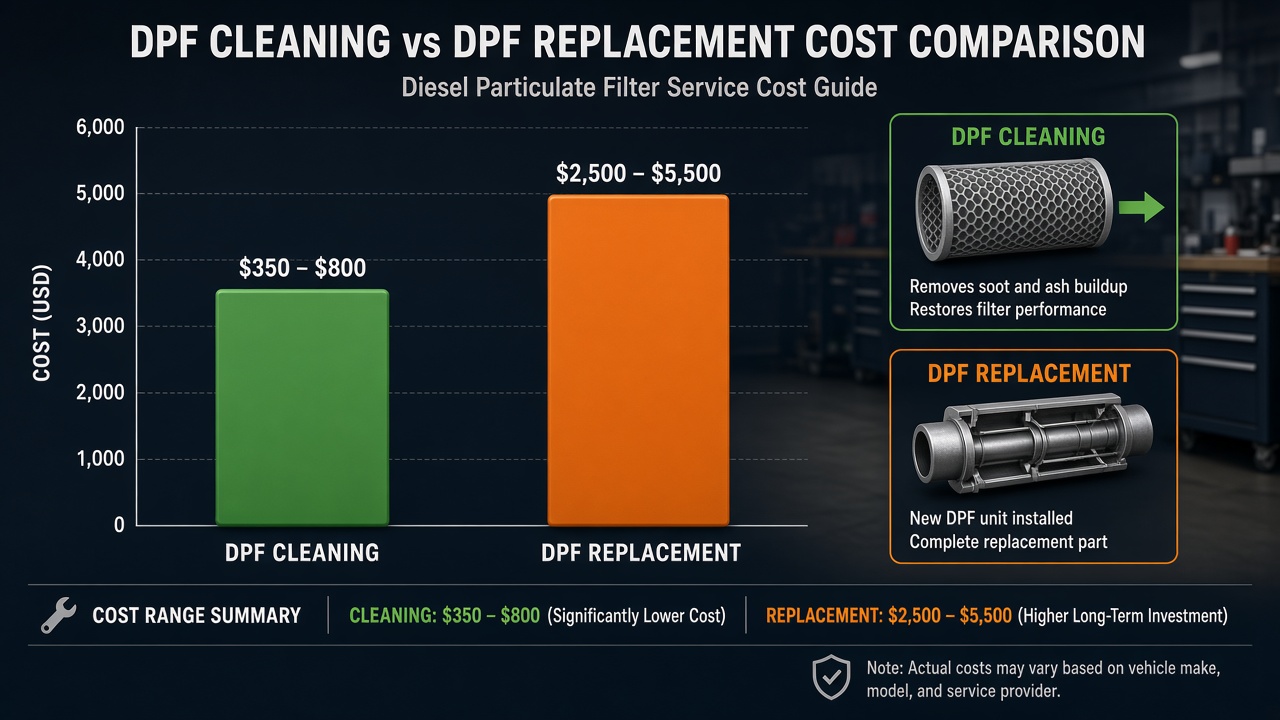
Clean your DPF when soot is the problem and the substrate is intact — $350–$900 installed. Replace when ash loading exceeds OEM limits, the filter is cracked, or differential pressure stays high after cleaning — $2,500–$6,000 for Class 6–8, $1,200–$2,800 for pickups. Use the calculator above with vehicle type, filter condition, and miles since last service. Cleaning a melted filter wastes money; replacing a soot-clogged filter that only needs thermal cleaning burns $3,000 unnecessarily.
Soot vs Ash — Why the Distinction Matters
A DPF traps two things: soot (carbon) and ash (non-combustible residue from engine oil additives). Passive and active regeneration burn soot at 550–650°F (exhaust gas temps during regen). Ash does not burn. It accumulates permanently in the filter channels.
Soot loading causes high backpressure, derate codes, and failed regens. Ash loading causes the same symptoms but cannot be fixed by a regen cycle — the filter must be physically cleaned or replaced.
| Contaminant | Source | Removed By | Symptom |
|---|---|---|---|
| Soot | Incomplete combustion | Passive/active regen | Temporary high dP, clears after regen |
| Ash | Engine oil (zinc, phosphorus, calcium) | Off-vehicle cleaning only | Progressive high dP, regens become ineffective |
| Fuel dilution | Failed injector, excessive regen | Regen + root cause repair | Wet soot, white exhaust, fuel smell |
| Coolant/contamination | EGR cooler leak, head gasket | Replace DPF + fix source | White ash, sweet smell, failed cleaning |
If you’re running 15,000–20,000 mile oil change intervals on a Class 8 engine, ash loads faster. Cummins recommends oil with API CK-4 or FA-4 and limits sulfated ash to 1.0% max for aftertreatment longevity.
DPF Cleaning Methods and Real Costs
Off-Vehicle Thermal Cleaning (Best Option)
The filter is removed and placed in a thermal cleaning oven that ramps to 1,000–1,200°F to oxidize remaining soot, then air-jet or vacuum systems remove ash. This is the method OEM dealers and certified facilities use.
| Vehicle Class | Cleaning Service | R&R Labor | Total Installed |
|---|---|---|---|
| Pickup (6.6–6.7L) | $250 – $450 | $200 – $400 | $450 – $850 |
| Class 6–7 | $350 – $600 | $300 – $500 | $650 – $1,100 |
| Class 8 | $400 – $800 | $400 – $600 | $800 – $1,400 |
Certified cleaners include FSX Equipment network shops, Donaldson DPF cleaning services, and some Cummins ReCon distributors. Ask for a pre- and post-cleaning flow test report. A good facility provides dP readings at rated flow before and after.
On-Vehicle Chemical Cleaning
Chemical cleaning products ($80–$200 for the kit) are poured into the DPF or sprayed upstream. Results are inconsistent. I’ve seen them work on lightly soot-loaded filters with failed regen strategy. I’ve seen them do nothing on ash-loaded filters. Do not pay shop labor for chemical cleaning alone on a filter with 300,000+ miles — pull it and test ash loading first.
Ultrasonic Cleaning
Less common for on-highway DPFs due to filter size. More typical for off-road and gen-set applications. Cost is comparable to thermal cleaning when available.
DPF Replacement Cost by Platform
| Engine/Platform | OEM DPF Part (Reference) | Parts Cost | Labor | Total |
|---|---|---|---|---|
| 6.7L Cummins pickup | 68005653AC | $1,200 – $2,200 | 2 – 3 hrs | $1,490 – $2,835 |
| 6.6L Duramax L5P | 12738864 | $1,100 – $2,000 | 2 – 3 hrs | $1,390 – $2,635 |
| 6.7L Powerstroke | HC3Z-5H250-B | $1,300 – $2,400 | 2.5 – 4 hrs | $1,663 – $3,100 |
| Cummins ISB 6.7 (medium) | 2864760 | $1,800 – $3,200 | 2 – 3 hrs | $2,090 – $3,635 |
| Cummins ISX15/X15 | 4329078 (varies) | $2,800 – $5,500 | 3 – 5 hrs | $3,235 – $6,475 |
| Detroit DD15 | A6804900592 | $3,000 – $5,800 | 3 – 5 hrs | $3,435 – $6,675 |
| PACCAR MX-13 | PACCAR 1882844 | $2,900 – $5,200 | 3 – 5 hrs | $3,335 – $6,075 |
Core charges apply on most OEM DPF assemblies: $500–$1,200. Return the old core or eat the charge. Aftermarket DPFs exist ($800–$2,000 for pickups) but verify CARB Executive Order (EO) numbers if you’re in California or states adopting CARB rules.
When Cleaning Is the Right Call
Clean the DPF when:
- Differential pressure is raised but the substrate passes visual inspection (no cracks, melting, or channel collapse)
- Ash loading is below 100–120% of OEM limit per flow test
- Miles since last cleaning are under 400,000 (Class 8) or 150,000 (pickup)
- Regen frequency has increased but regens still complete successfully
- No contamination from coolant, fuel, or oil is present
Expected result: restored flow capacity for 50,000–150,000 miles depending on oil consumption and duty cycle. Linehaul trucks with low oil consumption get the most miles from a cleaning.
When Replacement Is Mandatory
Replace the DPF when:
- Substrate is cracked, melted, or collapsed (visible on borescope or after removal)
- Ash loading exceeds 120% of OEM spec on flow test
- Filter has been cleaned 2+ times and dP returns within 80,000 miles
- Coolant contamination from EGR cooler failure (cleaning won’t remove silicate ash)
- Active fault codes for DPF efficiency monitor after cleaning and successful regen cycle
- Physical damage from road debris or improper removal
A cracked DPF cannot be repaired. Do not let any shop attempt to weld or patch a ceramic substrate — exhaust gas will bypass the filter and you’ll fail emissions inspection while damaging the SCR catalyst downstream.
Reading DPF Differential Pressure
The ECM monitors dP across the DPF using two pressure sensors (upstream and downstream). Normal operating dP varies by engine load:
| Condition | Typical dP (inches H₂O) |
|---|---|
| Idle | 0.5 – 2.0 |
| Cruise (65 mph) | 2.0 – 5.0 |
| Full load | 4.0 – 8.0 |
| Regen active | 6.0 – 12.0 (temporary spike) |
Cummins ISX15 derate threshold: typically >8.0 in H₂O sustained at cruise triggers fault codes and progressive derate. Detroit DD15 uses similar thresholds calibrated per engine serial.
Use your scan tool to log dP over a drive cycle. If dP climbs steadily over weeks without returning to baseline after regen, ash loading is the likely cause — not soot.
Mileage-Based Decision Guide
| Miles Since Last DPF Service | Soot Only | Ash Likely | Action |
|---|---|---|---|
| 0 – 150,000 | Yes | Unlikely | Force regen, check regen strategy |
| 150,000 – 250,000 | Possible | Possible | Flow test, then clean if substrate OK |
| 250,000 – 400,000 | Unlikely | Yes | Clean off-vehicle, plan next service at 150k |
| 400,000+ | No | Yes | Clean once; if dP returns fast, replace |
| 500,000+ (2nd cleaning) | No | Critical | Replace — cleaning ROI is gone |
Pickup diesels with smaller DPF volumes reach ash capacity faster per mile than Class 8 if they idle heavily. A Powerstroke that idles 4+ hours daily for PTO work may need DPF service at 120,000 miles.
The Cleaning Process — What Happens in the Shop
- Diagnosis — Log fault codes (SPN 3251 FMI 0/16 for Cummins DPF restriction is common). Verify regen history and dP trend.
- Removal — Disconnect pressure tubes, temp sensors, and mounting clamps. DPF weight on Class 8: 40–80 lbs. Use proper lifting support.
- Pre-test — Flow test at rated CFM. Document baseline restriction.
- Thermal clean — 4–8 hour oven cycle depending on filter size and loading.
- Post-test — Flow test again. Good shops show you the before/after numbers.
- Reinstall — New clamps/gaskets if needed. Torque band clamps to spec (typically 45–55 in-lbs on Cummins band clamps — check your engine).
- Reset and regen — ECM ash accumulation counter may need reset with OEM scan tool. Perform a parked regen to verify system function.
Total shop time: 3–5 hours including R&R. Do not let a shop charge 8+ hours for a straightforward pickup DPF removal unless cab/access complications exist.
SCR and DOC — Don’t Forget Downstream Components
The DPF sits between the diesel oxidation catalyst (DOC) and selective catalytic reduction (SCR) catalyst. A failed DPF can overheat and damage the SCR brick. If your truck threw high exhaust temp codes before the DPF fault, inspect the SCR for meltdown.
SCR replacement costs $2,000–$5,000 for Class 8 — far more than a DPF cleaning. If the DOC is oil-fouled from a turbo seal leak, cleaning the DPF alone won’t fix the root cause. Always check upstream components.
DIY Considerations
Removing a DPF yourself on a pickup is doable with basic tools and a floor jack. Reinstalling without damaging the ceramic substrate requires care — do not set the filter on its face. However:
- You cannot thermal-clean a DPF at home
- ECM ash counter reset requires a scan tool (GDE, EFI Live, or OEM equivalent)
- Tampering with emissions equipment is a federal offense for on-road vehicles (42 U.S.C. § 7524)
- Deleted trucks fail state inspections in most jurisdictions
Pull the filter, send it to a certified cleaner, get it back, reinstall. That saves labor markup but not the cleaning fee.
FAQ
How much does DPF cleaning cost in 2026?
Off-vehicle thermal cleaning runs $350–$800 for the service plus $200–$600 labor for removal and reinstall. Total installed cost: $550–$1,400 depending on vehicle class and shop rates.
How often should a DPF be cleaned?
Class 8 on-highway trucks: every 250,000–400,000 miles or when dP trend indicates ash loading. Pickups: every 120,000–200,000 miles depending on idle time and oil consumption. Follow OEM ash cleaning intervals for your engine serial number.
Can a clogged DPF damage my engine?
Not directly, but high backpressure increases pumping losses, raises exhaust gas temperatures, and can cause turbo overspeed if the VGT vanes stick trying to compensate. Prolonged high dP forces frequent regens that dilute engine oil with fuel, accelerating wear.
Is DPF delete legal?
No. Removing or disabling a DPF on an on-road vehicle violates the Clean Air Act. Penalties include fines up to $4,819 per tampered vehicle for individuals (EPA civil penalty, 2024 adjustment). State inspections in 38+ states test OBD emissions readiness.
How long does DPF cleaning take?
Thermal cleaning cycle: 4–8 hours at the cleaning facility. Shop R&R time: 2–4 hours. Total turnaround: same day to 48 hours depending on shop backlog and shipping to a remote cleaning facility.
What happens if I ignore a DPF warning light?
Progressive derate. Cummins and Detroit ECMs typically derate in stages: 25% power reduction, then 40%, then 5 mph limp mode. You cannot clear the derate without addressing the restriction and completing a successful regen.
Does warranty cover DPF replacement?
Emissions components carry federal warranty of 8 years/80,000 miles (5 years/50,000 miles for major defeat devices under some interpretations). If you’re within warranty, dealer replacement may cost you $0. Document all regen failures and dP readings for the warranty claim.
Can I drive with a cracked DPF?
Briefly, but not legally or safely. Exhaust bypasses the filter, spewing soot. The SCR catalyst downstream will clog with particulates. Fix it immediately.
Sources
- Mitchell1 ProDemand — DPF R&R labor times for Cummins ISX15, ISB 6.7, and Ford 6.7L Powerstroke platforms
- Cummins QuickServe — TSB140130 ash loading thresholds and differential pressure specifications
- Detroit Diesel emissions service manual — section 15.4 aftertreatment diagnostics and DPF service limits
- PACCAR MX engine aftertreatment documentation — DPF part numbers and flow-test procedures
- EPA 2010+ on-highway diesel aftertreatment field data — ash service mileage benchmarks
- Independent shop and certified DPF cleaning facility quotes — September 2026 (six cleaners, four dealer parts departments)
Related Reading
- How diesel particulate filters trap soot and ash — substrate design, regen temperatures, and when cleaning restores flow capacity
- 2026 DPF cleaning cost guide — thermal cleaning vs on-vehicle chemical service pricing by vehicle class
- DPF ash load vs soot load — why regen clears soot but cannot remove accumulated ash
- SPN 3251 FMI 0: high DPF soot load — fault-code diagnosis before you pull the filter
- Off-vehicle vs on-vehicle DPF cleaning — which method matches your restriction type and mileage