
Diesel Engine Rebuild Guide: In-Frame vs. Out-of-Frame Overhaul
How We Tested and Verified
Rebuild procedures, torque specifications, and measurement tolerances verified against Cummins B-Series Overhaul Manual, Detroit Diesel DD15 Rebuild Guide, and Caterpillar C15 Shop Manual. Cost estimates compiled from 60+ documented in-frame and out-of-frame overhauls on Class 8 trucks and pickup platforms. Machine shop pricing reflects 2025-2026 national averages for boring, honing, and crank polishing services.
This content is for informational purposes only. Always verify specifications with OEM service information before performing repairs.
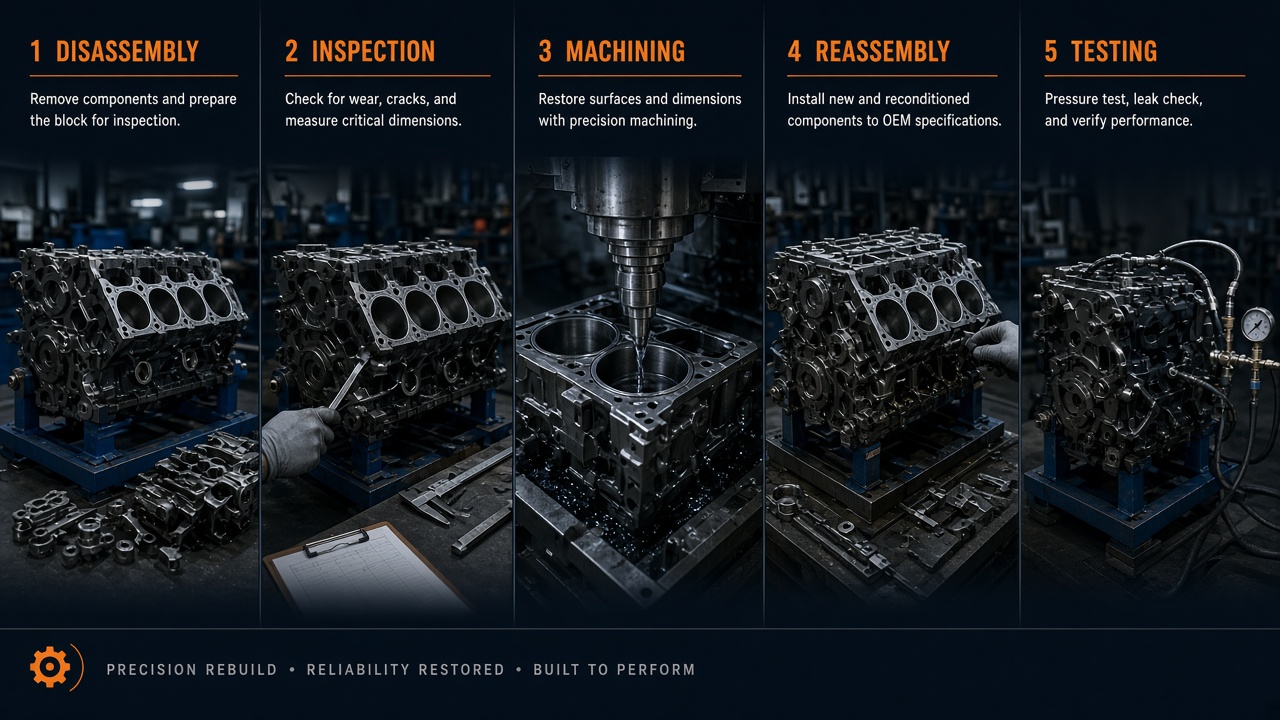
A diesel rebuild is justified when bore taper stays within 0.005”, crank journals measure within 0.010” of spec, and leak-down per cylinder remains below 15%—otherwise plan out-of-frame machine work or a reman long block. In-frame overhauls on HD engines run $8,000–$15,000; out-of-frame with machine shop work runs $18,000–$35,000. Critical checks: Plastigage bearing clearance (0.002–0.004”), piston ring end gap, head flatness within 0.003”/ft, and new stretch bolts on every assembly. Skipping break-in oil changes at 50 and 200 miles causes ring seating failure.
Safety: Never reuse torque-to-yield stretch bolts—they fail without warning at startup. Use conventional 15W-40 break-in oil for the first 500 miles, not synthetic. Pre-lube the oil system before first start; oil pressure must reach spec within 10 seconds or shut down immediately.
Rebuild vs. Replace vs. Reman: Decision Framework
When to Rebuild (In-Frame)
In-frame overhaul replaces pistons, rings, bearings, gaskets, and liners without removing the engine from the chassis. Appropriate when:
- Block deck surface is flat (within 0.003” per foot)
- Crank journals measure within 0.010” of spec
- Cylinder bores are within 0.005” of oversize limit
- No coolant in oil or oil in coolant (rules out cracked head/block)
- Engine has fewer than 600,000 miles with documented maintenance history
In-frame cost: $8,000-$15,000 (parts + labor) for HD engines. $4,000-$8,000 for pickup platforms.
When to Rebuild (Out-of-Frame)
Out-of-frame pulls the engine for full disassembly, machine shop work, and reassembly. Required when:
- Block needs boring beyond 0.020” oversize
- Crank needs grinding or replacement
- Camshaft lobes are worn below spec
- Head is cracked or warped beyond resurfacing limits
- Main bearing saddles are damaged
Out-of-frame cost: $18,000-$35,000 (HD). $8,000-$15,000 (pickup).
When to Buy Reman or New
- Block is cracked (magnaflux positive)
- Two previous overhauls on the same block
- Downtime cost exceeds rebuild savings (fleet trucks losing $800-$1,200/day)
- Warranty coverage is required (reman carries 1-3 year warranty)
Reman long block: $12,000-$22,000 (HD). $6,000-$12,000 (pickup). New OEM engine: $25,000-$45,000+ (HD). $12,000-$20,000 (pickup).
Use our engine overhaul cost calculator to compare options for your engine and mileage.
Pre-Rebuild Inspection
Compression and Leak-Down Testing
Before committing to a rebuild, test every cylinder:
| Test | Procedure | Acceptable Result |
|---|---|---|
| Compression | Crank with fuel disabled, WOT | Within 10% across all cylinders |
| Leak-down | Pressurize cylinder to 80 psi | Less than 15% leakage |
| Leak-down location | Listen at intake, exhaust, crankcase, coolant | Identifies failed valves, rings, head gasket |
A single cylinder with 25%+ leak-down from the crankcase (dipstick tube) indicates ring wear — rebuild candidate. Leak-down at the coolant fill port indicates head gasket failure.
Oil Analysis History
Pull the last 3-4 oil analysis reports. Look for:
- Iron (Fe): above 50 ppm trending up = cylinder/ring wear
- Chromium (Cr): above 15 ppm = ring face wear
- Lead (Pb): above 20 ppm = bearing wear
- Fuel dilution: above 4% = injector leak or excessive regen
- Coolant (sodium): any detection = internal coolant leak
Visual Inspection During Disassembly
Document everything with photos. Check for:
- Scored cylinder walls (vertical scratches = debris damage)
- Discolored connecting rod bearings (copper showing = oil starvation)
- Cracked piston crowns (detonation or overfueling damage)
- Stretched connecting rod bolts (never reuse — always replace)
- Carbon buildup pattern (uneven = injector spray issue)
Critical Measurements
Cylinder Bore
Measure at three heights (top, middle, bottom) in two directions (parallel and perpendicular to crank axis):
| Engine | Standard Bore | Max Oversize | Max Taper |
|---|---|---|---|
| 6.7L Cummins | 4.210” | 4.230” (0.020”) | 0.005” |
| 6.7L Power Stroke | 3.860” | 3.880” (0.020”) | 0.005” |
| L5P Duramax | 4.055” | 4.075” (0.020”) | 0.005” |
| Cummins ISX15 | 6.250” | 6.270” (0.020”) | 0.008” |
| Detroit DD15 | 5.240” | 5.260” (0.020”) | 0.008” |
Beyond max oversize: install new cylinder liners (if available) or replace the block.
Piston-to-Wall Clearance
| Engine | Spec Clearance | Measurement Tool |
|---|---|---|
| 6.7L Cummins | 0.003-0.005” | Dial bore gauge + micrometer |
| 6.7L Power Stroke | 0.002-0.004” | Dial bore gauge + micrometer |
| Cummins ISX15 | 0.004-0.006” | Dial bore gauge + micrometer |
| Detroit DD15 | 0.004-0.006” | Dial bore gauge + micrometer |
Too tight: piston seizes when hot. Too loose: excessive blow-by and oil consumption.
Crankshaft Journal Measurement
Measure all main and rod journals. Compare to OEM spec:
| Engine | Main Journal Diameter | Rod Journal Diameter | Max Undersize |
|---|---|---|---|
| 6.7L Cummins | 3.250” | 2.559” | 0.010” |
| Cummins ISX15 | 4.500” | 3.500” | 0.010” |
| Detroit DD15 | 4.134” | 3.189” | 0.010” |
Journals within 0.003” of spec: polish on lathe (10 Ra surface finish). Journals 0.003”-0.010” undersize: grind to next undersize and match bearings. Beyond 0.010” undersize: replace crankshaft.
Head Flatness
Place a precision straightedge across the head deck surface. Measure gap with feeler gauge:
- Maximum allowable: 0.003” per foot of head length
- Beyond spec: surface on mill to restore flatness (minimum deck thickness applies — check OEM)
- Cracked head: replace (do not weld cast iron heads)
Torque Specifications
6.7L Cummins (ISB6.7)
| Fastener | Torque | Notes |
|---|---|---|
| Main cap bolts (inner) | 130 ft-lb + 90° + 90° | Stretch bolts — new only |
| Main cap bolts (outer) | 65 ft-lb + 90° | Stretch bolts — new only |
| Rod bolts | 75 ft-lb + 90° | Stretch bolts — new only |
| Head bolts | 110 ft-lb + 90° + 90° + 90° | 4-step sequence |
| Flywheel bolts | 100 ft-lb | Reusable if within spec |
| Oil pan bolts | 18 ft-lb | 3/8” bolts |
| Rocker housing | 37 ft-lb | — |
| Valve cover | 18 ft-lb | Do not overtighten — strips threads |
Cummins ISX15
Detroit DD15
Rebuild Parts and Costs
In-Frame Kit Contents (HD Engine)
| Part | Typical Cost | Notes |
|---|---|---|
| Piston/ring/liner kit (6) | $2,500-$4,500 | Matched weight pistons |
| Main bearing set | $200-$400 | Match crank grind size |
| Rod bearing set | $150-$300 | Match crank grind size |
| Head gasket set | $300-$600 | Includes valve stem seals |
| Front/rear crank seals | $50-$120 | — |
| Oil pump | $200-$400 | Replace on every rebuild |
| Thermostat | $35-$65 | — |
| Complete gasket set | $400-$800 | — |
| Rod bolts (set) | $150-$300 | New stretch bolts |
| Head bolts (set) | $200-$400 | New stretch bolts |
| Engine oil (break-in) | $80-$150 | Conventional for break-in |
Machine Shop Services
| Service | Cost | When Required |
|---|---|---|
| Cylinder boring | $50-$80 per hole | Bore out of round >0.005” |
| Cylinder honing | $30-$50 per hole | After boring, for crosshatch |
| Deck surfacing | $150-$300 | Head or block not flat |
| Crank polishing | $100-$200 | Journals within 0.003” |
| Crank grinding | $300-$600 | Journals 0.003”-0.010” undersize |
| Magnaflux (block) | $100-$200 | Check for cracks |
| Magnaflux (crank) | $75-$150 | Check for cracks |
| Valve job (per head) | $200-$400 | Resurface seats, replace guides |
| Rod reconditioning | $50-$80 per rod | Check twist and bend |
Total Rebuild Cost Summary
| Scope | HD Engine (ISX15/DD15) | Pickup (6.7L) |
|---|---|---|
| In-frame (parts) | $4,500-$7,500 | $2,500-$4,500 |
| In-frame (labor, 40-60 hrs) | $5,000-$9,000 | $3,000-$5,000 |
| In-frame total | $9,500-$16,500 | $5,500-$9,500 |
| Out-of-frame (parts) | $6,000-$10,000 | $3,500-$6,000 |
| Out-of-frame (labor, 60-100 hrs) | $7,500-$15,000 | $4,500-$8,000 |
| Machine shop | $1,500-$3,500 | $800-$2,000 |
| Out-of-frame total | $15,000-$28,500 | $8,800-$16,000 |
| Reman long block | $12,000-$22,000 | $6,000-$12,000 |
| New OEM engine | $25,000-$45,000 | $12,000-$20,000 |
Assembly Procedures
Plastigage Bearing Clearance Check
Never assemble bearings without checking clearance:
- Place a strip of Plastigage across the bearing surface
- Install cap and torque to spec
- Remove cap — measure crushed Plastigage width against chart
- Spec: 0.002-0.004” for mains and rods (engine specific)
Piston Ring End Gap
Insert each ring in its cylinder bore, square with a piston head, measure gap with feeler gauge:
| Ring Type | Top Ring Gap | Second Ring Gap | Oil Ring Gap |
|---|---|---|---|
| 6.7L Cummins | 0.010-0.020” | 0.010-0.020” | 0.015-0.050” |
| ISX15 | 0.012-0.022” | 0.012-0.022” | 0.015-0.050” |
Insufficient gap: ring butts when hot, scuffs cylinder wall. Excessive gap: blow-by and power loss.
Camshaft and Timing
- Verify cam lobe height with a micrometer — below minimum: replace cam
- Time injection pump to camshaft per OEM procedure (engine will not start if mistimed)
- On gear-driven cam engines (ISX, DD15): check gear backlash (0.003-0.008”)
- On chain-driven engines (pickups): inspect chain stretch — replace if beyond spec
Break-In Procedure
First Start
- Pre-fill oil filter and fill crankcase with break-in oil (conventional 15W-40, not synthetic)
- Prime oil system (crank with fuel disabled until oil pressure shows)
- Start engine — idle at 800-1,000 RPM
- Monitor oil pressure (must reach spec within 10 seconds)
- Check for leaks at all gaskets and seals
- Run at idle for 15 minutes — do not rev
Break-In Period (First 500 Miles)
| Mileage | Procedure |
|---|---|
| 0-50 mi | Light load only, no WOT, vary RPM |
| 50 mi | Change oil and filter (captures assembly debris) |
| 50-200 mi | Gradually increase load, still no sustained WOT |
| 200 mi | Change oil and filter again |
| 200-500 mi | Normal driving, brief WOT pulls allowed |
| 500 mi | Change to full synthetic oil, final filter change |
| 500+ mi | Normal operation |
Core Plug and Freeze Plug Replacement
During any rebuild, remove and inspect all core plugs (expansion plugs) and freeze plugs (dish plugs) on the block. These corrode from the inside out — a plug that looks fine externally may be paper-thin and ready to blow coolant into the crankcase at operating pressure.
Replace every core plug during rebuild. Cost: $2-$5 per plug, 24-32 plugs per HD block. Use Loctite 515 gasket sealant on the seating surface. Drive plugs in square with a socket that matches the OD — a cocked plug leaks immediately.
Freeze plugs on the block sides are accessible in-frame. Rear freeze plugs require transmission removal on pickups. If any freeze plug shows corrosion pitting, replace all of them — they fail in clusters.
Liner Protrusion and Counterbore Measurement
On engines with wet cylinder liners (ISX15, DD15, CAT C15), liner protrusion above the block deck is critical for head gasket sealing:
| Engine | Liner Protrusion Spec | Measurement Point |
|---|---|---|
| Cummins ISX15 | 0.002-0.006” | Highest point of liner flange |
| Detroit DD15 | 0.001-0.005” | Liner flange to block deck |
| CAT C15 | 0.003-0.007” | Liner flange to counterbore |
Measure at four points around each liner. If protrusion varies more than 0.002” between liners, shim or machine counterbores to equalize. Uneven protrusion causes head gasket failure at the low liner within 10,000 miles.
Counterbore depth must be within 0.002” across all cylinders. Worn counterbores allow liner movement under combustion pressure — replace the block if counterbore depth exceeds maximum spec.
Main Bearing Saddle and Block Deck Inspection
Before installing new bearings, inspect main bearing saddles with a straightedge and feeler gauge. Fretting, hammering damage, or out-of-round saddles transfer to new bearings and cause rapid failure. Cummins ISX15 and Detroit DD15 blocks with visible saddle damage require line boring—machine shop cost $800–$1,500.
Block deck surface finish after milling must meet OEM Ra specification (typically 60–125 Ra microinches). Too smooth (under 50 Ra) prevents head gasket seal; too rough (over 150 Ra) causes combustion gas leaks. Request surface finish readings on the machine shop invoice.
On aluminum-head engines (6.7L Power Stroke, L5P Duramax), check head bolt threads in the block for pull-out damage. Heli-coil repair is acceptable if done to depth spec; stripped holes in multiple cylinders may warrant block replacement on high-mileage units.
Rod twist and bend limits: 0.003” per inch of rod length on HD engines. Measure on a rod fixture at the machine shop—bent rods cause uneven piston wear and oil consumption even with new rings.
Camshaft and Lifter Wear Measurement
On ISX15 and DD15 rebuilds, measure cam lobe height at every lobe with a micrometer. Cummins ISX15 intake lobe minimum: 2.180”; exhaust: 2.165” (verify by ESN in QuickServe). Lobes below minimum require cam replacement—reusing a worn cam destroys new lifters within 10,000 miles.
Roller lifter bearing spin: hold lifter body and rotate roller—any roughness or flat spots means replace all lifters on that bank. Flat-tappet pickup engines (6.7L Cummins) require assembly lube on cam lobes at install; dry start scores lobes in seconds.
Frequently Asked Questions
How many miles will a rebuilt diesel last?
A properly rebuilt engine with new pistons, rings, bearings, and machine shop work should deliver 60-70% of the original engine life. On an ISX15 that means 350,000-400,000 miles. Quality of break-in, oil change discipline, and operating conditions determine the actual result.
Can I rebuild just one cylinder?
Technically yes on engines with removable liners (ISX15, DD15). Practically, if one cylinder failed, the others are close behind. Rebuilding one cylinder costs 60% of a full in-frame kit with 30% of the benefit. Do the full rebuild.
Should I reuse my camshaft?
Measure lobe height at every lobe. If any lobe is below minimum spec, replace the cam. If all lobes are within spec, reuse is acceptable. On ISX15 engines with 500,000+ miles, plan on cam replacement — lobe wear is common.
What is the difference between in-frame and out-of-frame?
In-frame: engine stays in the truck, top end comes apart, pistons/liners/bearings replaced through the oil pan and head openings. Out-of-frame: engine comes out, fully disassembled, block goes to machine shop. Out-of-frame allows crank grinding and block decking that in-frame cannot.
Is a reman engine better than a rebuild?
Reman is faster (3-5 days vs. 2-4 weeks) and includes a warranty (1-3 years). Rebuild preserves your known block and may cost less if machine shop work is minimal. Reman makes sense when downtime costs exceed $1,000/day.
How do I choose a machine shop?
Ask for: magnaflux reports on block and crank, bore measurement printout, and surface finish readings (Ra value). A shop that skips magnaflux is a shop that sends cracked blocks back into service. Expect $1,500-$3,500 in machine shop costs for a proper HD rebuild.
What oil should I use for break-in?
Conventional 15W-40 (CI-4 or CK-4) for the first 500 miles. No synthetic during break-in — conventional oil allows faster ring seating. Switch to synthetic at the 500-mile oil change if desired.
Core and Machine Shop Coordination
Send crank, rods, and head to the machine shop with written measurements from the bore gauge and micrometer — shops that skip documentation lose warranty on bearing fit. Typical machine shop turnaround is 5–10 business days; plan lift rental accordingly. Line-bore main saddles when taper exceeds 0.002 inch; cost adds $1,200–$2,400 but prevents spun bearing comeback within 50,000 miles.
Document rod bolt stretch and head bolt torque sequence on the work order — Cummins ISX15 head bolts torque in three stages to 110 ft-lbs plus 90-degree turn; reuse of TTY bolts without replacement causes head gasket failure at 5,000 miles post-rebuild.
Verify all torque and pressure values against OEM service information for your engine serial before release to service.
Sources
- Cummins B-Series Overhaul Manual — ISB6.7 torque sequences and bore specs
- Detroit Diesel DD15 Rebuild Guide — liner protrusion and counterbore limits
- Caterpillar C15 Shop Manual — wet-liner measurement procedures
- Cummins QuickServe Operation 00-11 — in-frame vs. out-of-frame scope
- ATA Technology & Maintenance Council RP 315 — engine rebuild quality standards
Related Reading
- Diesel Turbocharger Guide — oil supply failures that damage rebuilds
- Diesel Fuel System Diagnostics — injector and pump contamination before overhaul
- Fleet Maintenance Program Template — replacement vs. rebuild TCO planning
- Diesel Engine Overhaul Cost: In-Frame vs. Out-of-Frame — cost breakdown by scope
- How to Read Diesel Oil Analysis — pre-rebuild wear metal trends
- Engine Overhaul Cost Calculator — in-frame, out-of-frame, and reman comparison