Diesel Fuel System Diagnostics: Pressure Testing & Injector Analysis
How We Tested and Verified
Fuel system pressure specifications sourced from Cummins Common Rail Fuel System Service Manual, Bosch CP3/CP4 technical data sheets, and Delphi DFI 2.4/2.7 injector service literature. Return flow test procedures validated on Cummins ISB6.7, L5P Duramax, and 6.7L Power Stroke platforms. CP4 failure analysis data compiled from 80+ documented CP4.2 cam wear cases on GM LML/L5P engines.
This content is for informational purposes only. Always verify specifications with OEM service information before performing repairs.
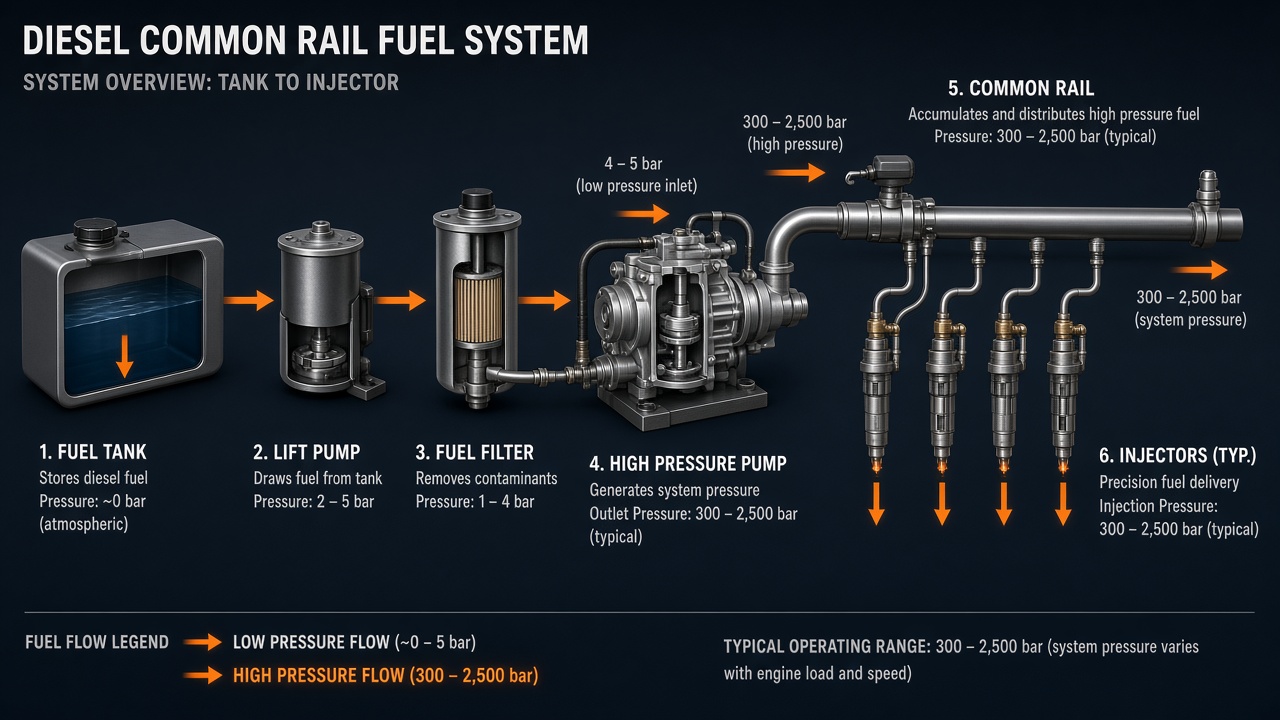
Common-rail diesel fuel faults are diagnosed with pressure tests before parts orders: lift pressure at the filter (8–15 psi pickups, 60–90 psi HD gear pumps), rail pressure build on key-on (4,500–5,500 psi within 3 seconds), running pressure at idle/cruise/WOT, and injector return flow per cylinder. Deviation over 500 psi between commanded and actual rail pressure under load points to filter restriction, pump wear, or excessive return. CP4.2 cam wear on GM and Ford platforms sends metal through injectors—cut open the filter element before replacing only the pump.
Safety: Rail pressure exceeds 25,000 psi on many platforms—use a rated gauge and never open a line without safety glasses and fuel-resistant gloves. If metal appears in the filter on a CP4.2 engine, flush the entire system and replace all injectors before restart.
Common Rail Fuel System Overview
How Common Rail Works
Unlike mechanical injection (PT pump, rotary distributor), common-rail systems store fuel at high pressure in a shared rail — an accumulator that supplies all injectors simultaneously. The ECM controls injection timing and duration by pulsing each injector solenoid or piezo actuator independently.
System components in fuel flow order:
- Fuel tank
- Lift pump (electric or mechanical)
- Primary fuel filter / water separator
- High-pressure pump (CP3, CP4, or gear-type)
- Common rail (with pressure sensor and relief valve)
- Injectors (solenoid or piezo)
- Return lines back to tank
Pressure Ranges by System Type
| System | Lift Pressure | Rail Pressure (Idle) | Rail Pressure (WOT) |
|---|---|---|---|
| Bosch CP3 (6.7 Cummins) | 10-15 psi | 5,200-5,800 psi | 23,000-26,000 psi |
| Bosch CP4.2 (6.7 PS, L5P) | 8-12 psi | 5,000-5,500 psi | 26,000-29,000 psi |
| Delphi DFI 2.7 (Duramax LBZ-LMM) | 8-12 psi | 4,800-5,400 psi | 23,000-26,000 psi |
| Cummins HPCR (ISX15) | 60-90 psi (gear) | 5,500-6,200 psi | 28,000-32,000 psi |
| Detroit DD15 (Amplify) | Integrated | 5,800-6,500 psi | 30,000-34,000 psi |
Lift Pump Testing
Electric Lift Pump (Most Pickups)
The lift pump runs continuously when the key is on (some platforms cycle it). Test at the fuel filter inlet or outlet:
- Install a 0-30 psi gauge at the fuel filter outlet port
- Key on, engine off — pressure should build within 3 seconds
- Spec: 8-15 psi depending on platform
- Start engine — pressure should hold steady, not drop
Low lift pressure causes:
- Air ingestion at connections
- Clogged fuel filter (most common — replace first)
- Failed lift pump (in-tank on GM/Ford, frame-mounted on Cummins)
- Restricted fuel tank vent or pickup screen
Lift pump replacement costs:
- 6.7L Cummins (FASS or OEM): $180-$350
- 6.7L Power Stroke (in-tank module): $280-$450
- L5P Duramax (in-tank module): $250-$400
Mechanical Lift Pump (HD Engines)
Detroit DD13/DD15 and Cummins ISX use a gear-type lift pump integrated into the HP pump assembly. Test with a 0-100 psi gauge at the fuel filter outlet. Spec: 60-90 psi at idle. Below 50 psi indicates worn pump gears or a severely restricted filter.
Rail Pressure Testing
Key-On Pressure Build Test
- Connect a 25,000 psi-rated rail pressure gauge (or use scan tool live data)
- Key on, engine off
- Rail pressure should build to 4,500-5,500 psi within 2-3 seconds
- If pressure does not build: HP pump failure, rail pressure sensor fault, or massive leak
Running Pressure Test
Log rail pressure at three points using a scan tool:
| Test Point | RPM | Expected Rail Pressure |
|---|---|---|
| Idle | 700-800 | 5,000-6,500 psi |
| Cruise | 1,500-1,800 | 8,000-15,000 psi |
| WOT | 2,800+ | 23,000-32,000 psi |
Command vs. actual deviation: The ECM commands a target rail pressure and the pump/servo adjusts to match. If actual pressure is more than 500 psi below command at any test point, you have a supply problem — weak pump, excessive injector return, or rail leak.
Rail Pressure Sensor Diagnosis
A failed rail pressure sensor causes erratic readings, not necessarily low pressure. Cross-check:
- Scan tool rail pressure reading vs. mechanical gauge reading
- If they disagree by more than 1,000 psi, replace the sensor
- Sensor part numbers: Cummins 4928594 ($85), Ford BC3Z-9D280-A ($120), GM 12640380 ($95)
Injector Return Flow Testing
Why Return Flow Matters
Each injector has an internal leak-off circuit that returns excess fuel to the tank. A worn injector returns more fuel than spec, bleeding rail pressure and causing hard starts, rough idle, and power loss.
Test Procedure
- Run engine to operating temperature
- Shut off engine
- Disconnect all injector return lines at the rail
- Install return flow tubes into graduated cylinders (100 mL)
- Crank engine for 30 seconds (or run at idle for 60 seconds)
- Measure return volume per injector
| Platform | Max Return per Injector (60 sec idle) |
|---|---|
| 6.7L Cummins | 80 mL |
| 6.7L Power Stroke | 75 mL |
| L5P Duramax | 70 mL |
| Cummins ISX15 | 120 mL |
| Detroit DD15 | 100 mL |
Any injector exceeding spec by 20%+ is failing. Replace in sets (all 6 or 8 on the same bank) — mixing old and new injectors causes imbalance.
Injector Replacement Costs
| Platform | Single Injector | Full Set (6-8) | Labor |
|---|---|---|---|
| 6.7L Cummins | $350-$550 | $2,100-$3,600 | 4-6 hrs |
| 6.7L Power Stroke | $300-$500 | $1,800-$3,200 | 5-8 hrs |
| L5P Duramax | $400-$650 | $2,400-$4,000 | 4-6 hrs |
| Cummins ISX15 | $500-$800 | $3,000-$5,600 | 6-10 hrs |
| Detroit DD15 | $450-$700 | $2,700-$4,800 | 6-10 hrs |
Use our injector replacement cost calculator for platform-specific estimates.
CP3 vs. CP4 High-Pressure Pump Failures
Bosch CP3 (6.7L Cummins, LBZ/LMM Duramax)
The CP3 is a three-piston radial pump driven by the engine camshaft or gear train. Known for durability — 300,000+ mile service life is common.
Failure symptoms:
- Gradual power loss over weeks/months
- Rail pressure drops under load
- Metal contamination in fuel filter (internal wear)
CP3 replacement: $800-$1,400 (part) + 4-6 hours labor = $1,600-$2,800 total.
Bosch CP4.2 (6.7L Power Stroke, L5P Duramax, LML Duramax)
The CP4.2 uses two counter-rotating lobes (not pistons) to generate pressure. It is lighter and more efficient than the CP3 but has a documented failure pattern:
CP4.2 cam lobe wear — the lobes wear against the housing, generating metal particles that destroy injectors downstream. This is the single most expensive fuel system failure in the pickup diesel world.
Failure symptoms:
- Sudden no-start (not gradual)
- Metal flakes in fuel filter element
- Rail pressure zero or erratic
- Injectors destroyed simultaneously
Prevention:
- Run fuel additive with lubricity enhancer (HFRR score below 460 microns)
- Change fuel filters at half the OEM interval
- Never run the tank below 1/4 full (fuel cools and lubricates the pump)
CP4.2 replacement: $900-$1,500 (part) + injectors if contaminated ($1,800-$4,000 additional) = $3,500-$7,000 total event. If metal is present, flush the system, replace all injectors, and consider a CP3 conversion kit ($2,500-$3,500) to prevent recurrence.
Air-in-Fuel Diagnosis
Symptoms
- Hard starting (requires extended crank)
- Rough idle that smooths as RPM increases
- Intermittent power loss
- Rail pressure slow to build on key-on
Finding the Air Source
- Install a clear fuel line section at the filter outlet
- Run engine and look for bubbles in the fuel stream
- Common entry points:
- Loose filter housing cap (most common — torque to spec)
- Cracked clear primer bulb on aftermarket filters
- Suction-side leak at tank pickup gasket
- Failed O-ring on filter head
Filter housing cap torque specs:
- 6.7L Cummins: 25 ft-lb
- 6.7L Power Stroke: hand tight + 1/4 turn
- L5P Duramax: 20 ft-lb
Water-in-Fuel Detection
Water Separator Function
The primary fuel filter on diesel engines includes a water separator element. Water is heavier than diesel and collects at the bottom of the filter bowl.
- Drain the water separator weekly in humid climates (daily in marine/coastal)
- If water appears frequently, check fuel source — the station tank may be contaminated
- Water in common-rail injectors causes tip erosion and misfire — repair cost per injector: $400-$650
Water-in-fuel sensor (WIF) triggers a dash warning. Do not ignore it — drain immediately. Running water through a CP4.2 pump causes catastrophic failure within minutes.
Fuel Contamination and Filter Service
Filter Change Intervals
| Platform | OEM Interval | Recommended (Severe Duty) |
|---|---|---|
| 6.7L Cummins | 15,000 mi | 10,000 mi |
| 6.7L Power Stroke | 15,000-20,000 mi | 10,000 mi |
| L5P Duramax | 15,000 mi | 10,000 mi |
| Cummins ISX15 | 25,000 mi / 500 hrs | 15,000 mi |
| Detroit DD15 | 25,000 mi / 500 hrs | 15,000 mi |
Filter Part Numbers
| Platform | Primary Filter | Secondary Filter |
|---|---|---|
| 6.7L Cummins | Fleetguard FS43258 ($35) | Fleetguard FF5825 ($28) |
| 6.7L Power Stroke | Motorcraft FD-4615 ($42) | — |
| L5P Duramax | ACDelco TP1015 ($38) | — |
| Cummins ISX15 | Fleetguard FF63013 ($45) | Fleetguard FS53040 ($32) |
| Detroit DD15 | Detroit A0000901551 ($48) | — |
Always fill the new filter with clean diesel before installation. Never install a dry filter — the lift pump takes 30+ seconds to prime, and the engine starves during that time.
Fuel System Repair Cost Summary
| Repair | Parts | Labor | Total |
|---|---|---|---|
| Fuel filter (pickup) | $35-$45 | $75-$150 | $110-$195 |
| Fuel filter (HD) | $45-$80 | $100-$200 | $145-$280 |
| Lift pump (pickup) | $180-$450 | $200-$400 | $380-$850 |
| CP3 pump (reman) | $800-$1,400 | $400-$800 | $1,200-$2,200 |
| CP4.2 pump (reman) | $900-$1,500 | $400-$800 | $1,300-$2,300 |
| CP3 conversion kit (CP4 replacement) | $2,500-$3,500 | $800-$1,200 | $3,300-$4,700 |
| Single injector | $300-$650 | $150-$300 | $450-$950 |
| Full injector set (6) | $1,800-$3,600 | $400-$800 | $2,200-$4,400 |
| Rail pressure sensor | $85-$120 | $75-$150 | $160-$270 |
| Fuel system flush | $50-$80 | $200-$350 | $250-$430 |
Mechanical Injection Systems (Pre-Common-Rail)
Not every diesel on the road runs common-rail. Pre-2003 HD engines and older pickups use mechanical injection that requires different diagnostic approaches.
PT (Pressure-Time) Fuel System (Cummins 5.9L, 8.3L, early ISB)
Cummins PT pumps meter fuel by pressure and time — no electronic injectors. Diagnosis:
- Fuel pressure at idle: 13-21 psi at the filter head (measured with 0-30 psi gauge)
- Fuel pressure at high idle: 27-35 psi
- Timing adjustment: PT pump timing pin aligns with engine TDC — misalignment by one tooth causes hard start and white smoke
- Injector adjustment: Valve lash and injector height set together — incorrect height causes black smoke and power loss
PT injector replacement: $200-$350 each, 6-8 injectors per engine. Full set: $1,200-$2,400 + 6-8 hours labor.
Rotary Distributor Pump (6.5L Detroit, 7.3L IDI Ford)
Mechanical pump with electronic shutdown solenoid. Test fuel delivery volume: 1 pint in 30 seconds at crank (pump primed). Below spec indicates worn pump elements or air ingestion. Replacement: $400-$800 (reman pump) + 3-4 hours labor.
Stanadyne DB2 (6.2L/6.5L GM, early 6.9L Ford IDI)
Mechanical rotary pump with hydraulic injector lines. Pop-pressure test each injector: 1,700-1,800 psi opening pressure. Injectors below 1,600 psi cause rough idle and cold-start problems. Rebuild injectors: $75-$120 each at a diesel injection shop.
Fuel System Electrical Diagnostics
Modern common-rail systems depend on electrical signals as much as mechanical pressure. Before condemning a pump or injector, verify the electrical path.
FICM / ECM Power Supply (6.7L Power Stroke)
The Fuel Injection Control Module (FICM) on 6.0L and 6.7L Power Stroke engines requires stable 48V output to fire injectors. Test at the FICM connector:
- Input voltage: 12.0-14.5V (battery supply)
- Output voltage: 47-52V (FICM output to injectors)
- Below 45V output: FICM failure — reman unit $400-$600
Low input voltage from weak batteries causes FICM output to drop, producing misfire codes (P0261-P0268) that mimic injector failure.
Injector Solenoid Resistance
Disconnect injector connector and measure resistance across the two pins:
| Platform | Spec Resistance | Notes |
|---|---|---|
| 6.7L Cummins (solenoid) | 0.5-1.5 ohms | Open circuit = failed coil |
| 6.7L Power Stroke | 0.3-0.8 ohms | — |
| L5P Duramax (piezo) | 0.1-0.3 ohms | Piezo actuators, lower resistance |
| ISX15 (solenoid) | 0.3-1.0 ohms | — |
Resistance outside spec confirms a failed injector coil. Resistance within spec does not confirm a good injector — internal valve wear does not change electrical resistance. Always pair electrical testing with return flow measurement.
Frequently Asked Questions
What causes rail pressure to drop under load?
Three causes, in order of frequency: clogged fuel filter, excessive injector return flow, and worn HP pump. Replace the filter first ($45), then test return flow ($0 in parts), then test rail pressure with a gauge before ordering a $1,500 pump.
Can bad fuel damage my injectors?
Yes. Water causes tip erosion. Low-lubricity ULSD accelerates CP4.2 wear. Contaminated fuel (biodiesel above B20, gasoline dilution) damages seals and causes internal leakage. Always buy fuel from high-volume stations and use a lubricity additive.
How do I know if my CP4.2 is failing?
Cut open the fuel filter element and look for metal particles (shiny flakes). If present, the CP4.2 is shedding material. Replace the pump immediately — running it further sends metal through all injectors. Budget for pump + full injector set + system flush.
Should I upgrade from CP4 to CP3?
On GM LML/L5P and 6.7L Power Stroke platforms, CP3 conversion kits (Fleece Performance, S&S Diesel) eliminate the CP4.2 failure mode entirely. Cost: $2,500-$3,500 installed. Recommended if you have already had one CP4 failure or plan to keep the truck beyond 150,000 miles.
Why does my diesel hard-start only when hot?
Hot-start problems point to injector return flow excess. When the engine is hot, fuel viscosity drops and worn injectors return more fuel to the tank, bleeding rail pressure. Test return flow when hot — the numbers will be worse than at cold.
How much metal in the fuel filter is normal?
None. Zero metal particles is the only acceptable finding. Any metallic debris in the filter element means internal component wear — pump, injectors, or pressure regulator. Identify the source before the debris circulates further.
What is the fuel pressure spec for a 6.7L Cummins at idle?
Rail pressure at idle: 5,200-5,800 psi. Lift pressure: 10-15 psi. If rail pressure is below 5,000 psi at idle, check the fuel filter first, then return flow, then the CP3 pump.
Fuel Sample Retention Protocol
Retain 8 oz fuel sample from the tank and fuel bowl when CP4 failure is suspected — black metallic paste in the sample confirms full-system flush requirement before restart. Label sample with VIN, date, and mileage for warranty and contamination claims.
Rail pressure at idle on common-rail systems should hold within 500 psi of commanded value — Cummins X15 target 5,000–25,000 psi under load; deviation above 2,000 psi from command indicates leaking injector or weak HP pump.
Verify all torque and pressure values against OEM service information for your engine serial before release to service.
Sources
- Cummins Common Rail Fuel System Service Manual — ISB6.7 and ISX15 pressure specs
- Bosch CP3/CP4.2 Technical Data Sheets — pump delivery and failure modes
- Delphi DFI 2.4/2.7 Injector Service Literature — return flow and pop-pressure limits
- Ford WSM Section 303-04 — 6.7L Power Stroke FICM and rail pressure tests
- GM L5P Service Information — CP4.2 contamination and flush procedures
Related Reading
- Diesel Engine Troubleshooting — no-start and derate workflow when fuel is suspected
- Diesel Turbocharger Guide — low boost vs. fuel delivery under load
- SCR and DEF Systems Guide — fuel-in-DEF contamination paths
- Replace a Diesel Injector Step by Step — R&R procedure and torque specs
- Fuel Filter Service Intervals — severe-duty change intervals
- Injector Replacement Cost Calculator — per-cylinder and full-set pricing