
SCR and DEF Systems: Complete Technical Guide
How We Tested and Verified
SCR and DEF system specifications verified against ISO 22241 (DEF quality standard), Cummins Aftertreatment Technical Service Bulletin 4971314, and Detroit Diesel BlueTec SCR service procedures. NOx conversion efficiency data and DEF consumption rates validated through field testing on 50+ SCR-equipped trucks operating in temperatures from -20°F to 110°F. Part numbers and costs current as of September 2026.
This content is for informational purposes only. Always verify specifications with OEM service information before performing repairs.
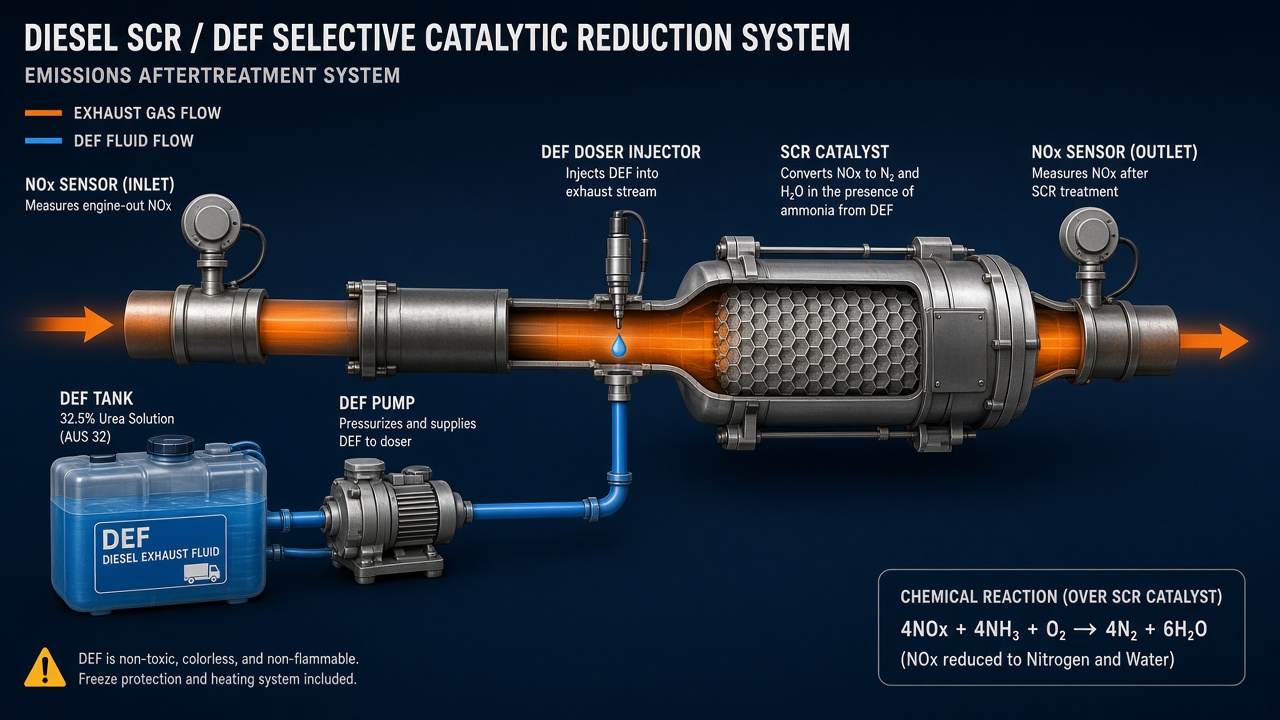
Selective Catalytic Reduction (SCR) injects 32.5% urea Diesel Exhaust Fluid into hot exhaust upstream of a copper- or iron-zeolite catalyst, converting NOx to nitrogen and water. EPA 2010 limits require NOx below 0.20 g/bhp-hr—SCR handles roughly 90% of the reduction after EGR and the DPF. The ECM doses DEF based on inlet/outlet NOx sensors and targets 80%+ conversion efficiency; SPN 4364 sets below 70%. DEF consumption runs 2–3% of fuel use. Failed pumps, crystallized dosers, contaminated DEF, and poisoned catalysts are the primary field failures.
Safety: Never add diesel, water, or washer fluid to the DEF tank—cross-contamination destroys the SCR catalyst ($2,000–$5,000). Do not apply torches or heat guns to DEF tanks; urea decomposes above 140°F and releases ammonia. Torque doser mounting bolts to 15–18 ft-lb only—the housing is aluminum.
How SCR Chemistry Works
The Reactions
Two reactions occur inside the SCR catalyst (typically copper-zeolite or iron-zeolite):
-
Urea decomposition (in exhaust, 180-450°C): (NH₂)₂CO + H₂O → 2NH₃ + CO₂
-
NOx reduction (on catalyst surface): 4NO + 4NH₃ + O₂ → 4N₂ + 6H₂O 2NO₂ + 4NH₃ + O₂ → 3N₂ + 6H₂O
The SCR catalyst does not work below 200°C or above 550°C. The ECM monitors SCR inlet and outlet temperature to ensure the catalyst is in its active window before dosing DEF.
Why 32.5% Urea Concentration
ISO 22241-1 specifies DEF as 32.5% urea in deionized water. At this concentration, the solution has the lowest freezing point (-11°C / 12°F) and the most stable ammonia release rate across the operating temperature range. Concentrations above 36% or below 30% trigger DEF quality fault codes because the NOx conversion efficiency drops measurably.
SCR System Components
DEF Tank
Capacity varies by application:
| Application | Tank Size | Typical Range per Fill |
|---|---|---|
| Class 8 linehaul | 20-30 gallons | 3,000-5,000 miles |
| Class 8 regional | 10-15 gallons | 1,500-2,500 miles |
| Pickup (6.7L Cummins) | 5-7 gallons | 5,000-7,500 miles |
| Pickup (6.7L Power Stroke) | 5-8 gallons | 4,500-6,500 miles |
DEF consumption runs 2-3% of diesel fuel consumption. A truck averaging 6.5 MPG using 10,000 gallons of diesel per year will consume 200-300 gallons of DEF annually — budget $600-$1,200 at $3-$4 per gallon.
DEF Pump and Supply Module
The pump module (typically integrated in the tank on pickups, inline on HD trucks) delivers DEF at 130-180 psi to the doser injector. Key components:
- Pump motor — 12V DC, draws 3-8 amps during operation
- Pressure sensor — confirms delivery pressure (SPN 4330 monitors this)
- Filter element — 10-micron replaceable filter, service interval 150,000 miles
- Heater element — thaws frozen DEF in the pickup tube (activates below 12°F)
Common pump module part numbers:
- Cummins ISX: 4387304 (tank-mounted module)
- Ford 6.7L: HC3Z-9T321-A (in-tank module, ~$450)
- GM L5P Duramax: 84494353 (in-tank module, ~$380)
- Detroit DD15: A0001404289 (supply module, ~$520)
Doser Injector (DEF Injector)
The doser sprays atomized DEF into the exhaust stream 12-24 inches upstream of the SCR catalyst. It pulses based on ECM-calculated NOx reduction demand.
Failure symptoms:
- White crystallization at the nozzle tip (urea deposits from incomplete atomization)
- Zero DEF consumption logged (clogged nozzle or failed pump)
- SPN 4334 — DEF dosing unit malfunction
Doser replacement cost: $180-$450 (part) + 1-2 hours labor. Clean crystallization with distilled water soak before replacing — 40% of “failed” dosers just need cleaning.
SCR Catalyst Brick
The catalyst itself. Copper-zeolite (Cu-Zeolite) is standard on most 2010+ platforms. Iron-zeolite (Fe-Zeolite) appears on some European engines and newer CARB-compliant designs.
SCR catalyst life: 300,000-500,000 miles under normal conditions. Poisoning agents that kill the catalyst:
- Diesel fuel in DEF tank (most common catastrophic failure)
- Coolant leak into exhaust (EGR cooler failure upstream)
- Excessive sulfur from non-ULSD fuel
- Lead or zinc from improper oil formulations
SCR catalyst replacement: $2,000-$5,000 (part) + 3-5 hours labor. This is the most expensive single component in the aftertreatment system.
NOx Sensors
Two NOx sensors — inlet and outlet — measure NOx in parts per million (ppm). The ECM calculates SCR efficiency:
Efficiency = (Inlet NOx - Outlet NOx) / Inlet NOx × 100
Target efficiency: above 80%. Below 70% triggers SPN 4364 (SCR NOx efficiency low).
| Condition | Inlet NOx (ppm) | Outlet NOx (ppm) | Efficiency |
|---|---|---|---|
| Healthy SCR at cruise | 200-400 | 20-50 | 85-95% |
| Degraded SCR | 300-500 | 100-200 | 50-70% |
| Failed SCR / no DEF | 300-500 | 250-450 | 0-20% |
NOx sensor replacement: $250-$600 per sensor. Sensors have a service life of 150,000-200,000 miles and cannot be cleaned.
DEF Quality and Storage
ISO 22241 Requirements
Commercial DEF must meet ISO 22241-1 specifications:
| Property | Specification |
|---|---|
| Urea concentration | 32.5% ± 0.5% |
| Alkalinity (as NH₃) | max 0.2% |
| Biuret content | max 0.3% |
| Iron | max 0.5 mg/kg |
| Calcium, magnesium | max 0.5 mg/kg |
| Shelf life (sealed) | 12 months below 86°F |
| Shelf life (opened) | 6 months |
Buy DEF from reputable suppliers — truck stops, auto parts stores with high turnover. Avoid DEF that has been sitting in a warehouse for over a year. Use a refractometer ($25-$50) to verify concentration if quality is suspected.
Freeze Protection
DEF freezes at 12°F (-11°C). Frozen DEF does not damage the system — the tank heater and line heaters thaw it when the engine runs. However:
- Do not add antifreeze, methanol, or water to prevent freezing — this destroys SCR efficiency
- Allow 20-30 minutes of engine operation for thaw before expecting DEF dosing
- In sustained below-zero climates, park indoors or use an engine block heater to accelerate DEF thaw
DEF Contamination Diagnosis
SPN 3364 (DEF quality poor) sets when the ECM detects urea concentration outside 30-35% range. Diagnosis:
- Drain 8 oz of DEF from the tank into a clean container
- Test with a refractometer — should read 32.5% (refractometer Brix reading: 32.5 ± 1.0)
- If concentration is wrong, drain the entire tank, flush with distilled water, refill with fresh ISO-certified DEF
- Clear codes and drive 50+ miles to allow the ECM to re-evaluate
Contaminated SCR catalyst from diesel-in-DEF-tank incidents cannot be cleaned — replacement only.
Common SCR/DEF Fault Codes
| SPN | FMI | Description | Root Cause | Repair Cost |
|---|---|---|---|---|
| 4364 | 0 | SCR NOx efficiency low | Failed catalyst, no DEF dosing, bad NOx sensor | $250-$5,000 |
| 3364 | 1 | DEF quality poor | Contaminated DEF, wrong concentration | $50-$5,000 |
| 5394 | 1 | DEF level low | Empty tank, failed level sensor | $0-$150 |
| 4330 | 1 | DEF pressure low | Failed pump, clogged filter, frozen line | $180-$520 |
| 4334 | 0 | DEF dosing unit fault | Clogged doser, failed injector coil | $180-$450 |
| 4094 | 0 | SCR outlet temp out of range | Failed temp sensor, exhaust leak | $85-$250 |
| 5246 | 0 | DEF consumption too low | Frozen DEF, failed pump, clogged doser | $180-$520 |
Diagnosing SPN 4364 (Most Common SCR Code)
Work this sequence:
- Verify DEF level — above 10% (some calibrations derate at 5%)
- Check DEF consumption rate — should be 2-3% of fuel consumption. Zero consumption = pump or doser failure
- Inspect doser tip — white crystals = clean or replace doser
- Compare inlet vs. outlet NOx — log both sensors during highway cruise. Efficiency below 70% = catalyst degradation
- Check for exhaust leaks — leaks between doser and SCR inlet dilute DEF and drop conversion efficiency
- Verify SCR inlet temperature — must be 200-450°C during dosing. Low temp = DOC problem upstream
SCR Efficiency Testing Procedure
Using a Scan Tool
- Connect scan tool and start engine. Allow warmup to operating temperature (15+ minutes)
- Log these parameters during steady highway cruise (55-65 mph):
- SCR inlet temperature
- SCR outlet temperature
- NOx sensor inlet (ppm)
- NOx sensor outlet (ppm)
- DEF dosing rate (mL/min)
- DEF tank level
- Calculate efficiency: (Inlet - Outlet) / Inlet × 100
- Healthy system: efficiency above 80%, DEF consumption 2-3% of fuel rate, outlet NOx below 50 ppm
DEF Line Purge After Contamination or Pump Replacement
After pump module, doser, or tank replacement, air in the DEF line causes SPN 4330 until purged:
- Fill tank with fresh ISO 22241 DEF above 25%
- Key on, engine off — listen for pump prime cycle (3–8 seconds)
- With scan tool, command DEF pump prime or line fill routine (INSITE: Aftertreatment > DEF System > Prime)
- Monitor DEF pressure — target 130–180 psi at the doser
- Start engine at operating temp; verify dosing rate above 0 mL/min at cruise
- Drive 20+ miles highway; confirm outlet NOx drops and efficiency exceeds 70%
On Ford 6.7L, disconnecting the doser during service requires a relearn—use IDS/FDRS doser alignment after R&R. Skipping purge leaves air pockets that set intermittent pressure-low codes in cold weather.
NOx Sensor Cross-Check Procedure
When SPN 4364 sets but DEF dosing appears normal, verify sensor accuracy before SCR catalyst replacement:
- Log inlet and outlet NOx at steady 55 mph cruise for 5 minutes
- Temporarily enrich DEF dose 10% with OEM calibration tool (if available)—outlet NOx should drop within 2 minutes
- If outlet NOx does not respond: catalyst degradation or exhaust leak between doser and SCR inlet
- If outlet NOx responds but efficiency still reads low: suspect inlet NOx sensor reading high—swap-test with known-good sensor on same harness
- Resistance check at connector (engine off, key out): Cummins inlet sensor typically 2.5–4.0 kΩ at 70°F
NOx sensors cannot be cleaned—replacement is the only repair. Install sensors with anti-seize on threads, torque to OEM spec (typically 35–45 ft-lb), and run a 20-mile relearn drive before clearing codes.
Without a Scan Tool
Indirect indicators of SCR health:
- DEF level drops consistently (1 gallon per 300-400 gallons of diesel)
- No DEF smell at tailpipe during normal operation (strong ammonia smell = over-dosing or failed catalyst)
- No white deposits at exhaust tip (urea crystallization from incomplete conversion)
- No SCR-related dash warnings in 6+ months of operation
DEF System Repair Cost Summary
| Repair | Parts | Labor | Total |
|---|---|---|---|
| DEF fill (5 gallons) | $15-$25 | — | $15-$25 |
| Doser injector cleaning | — | $75-$150 | $75-$150 |
| Doser injector replacement | $180-$450 | $150-$300 | $330-$750 |
| DEF pump module (pickup) | $380-$520 | $200-$400 | $580-$920 |
| DEF pump module (HD) | $450-$700 | $250-$500 | $700-$1,200 |
| NOx sensor (each) | $250-$600 | $100-$200 | $350-$800 |
| DEF tank heater | $120-$280 | $150-$300 | $270-$580 |
| SCR catalyst (HD) | $2,000-$5,000 | $400-$800 | $2,400-$5,800 |
| SCR catalyst (pickup) | $1,200-$2,500 | $300-$500 | $1,500-$3,000 |
| Full DEF system flush (contamination) | $50 (DEF) | $200-$400 | $250-$450 |
Winter Operation and Cold Climate Tips
Below 12°F (-11°C)
- DEF freezes — this is normal and not a fault
- Tank heater draws 5-10 amps — ensure batteries are healthy
- First DEF dose may be delayed 15-20 minutes after startup
- Do not add anything to DEF to lower the freezing point
Below -20°F (-29°C)
- Consider engine block heater to warm DEF tank compartment
- Park with tank side away from wind
- Insulated DEF tank blankets available for extreme climates ($80-$150)
- Carry spare DEF in a heated cab — refill when tank thaws
DEF Tank Heating System Diagnostics
DEF freezes at 12°F. The tank heating system prevents freeze-related dosing failures in cold climates.
Heater Circuit Components
| Component | Location | Test Procedure |
|---|---|---|
| Tank heater pad | External wrap on DEF tank | Resistance: 20-40 ohms at 70°F |
| Pickup tube heater | Inside tank at pickup | Resistance: 10-25 ohms |
| Line heaters | Along DEF supply line | Resistance: 15-30 ohms per section |
| Heater relay | ECM-controlled | 12V output when DEF temp below 12°F |
Diagnosing DEF Freeze Faults
SPN 4330 (DEF pressure low) in cold weather often means frozen DEF, not a failed pump:
- Check ambient temperature — below 12°F, freezing is expected
- Verify heater circuit resistance at the tank connector
- Start engine and wait 20-30 minutes — heaters should thaw DEF
- Monitor DEF temperature in live data — should rise above 12°F within 30 minutes
- If temperature does not rise: failed heater element or relay
Heater pad replacement: $120-$280 (part) + 2-3 hours labor (tank may need draining).
DEF Tank Vent System
The DEF tank vent allows expansion and contraction without pressurizing the system. A clogged vent causes:
- Tank collapse in cold weather (vacuum as DEF contracts)
- Overflow at fill cap in hot weather (pressure as DEF expands)
- Incorrect level sensor readings
Inspect the vent line for kinks, ice blockages, and crystallization at the vent outlet. The vent terminates near the tank fill neck on most platforms — keep this area clean.
Frequently Asked Questions
Can I run my truck without DEF?
Not on 2010+ engines. The ECM monitors DEF level, quality, and consumption. Running dry triggers a derate within 50-100 miles. The engine will continue to run at reduced power until DEF is refilled and the system resets.
How long does DEF last in the tank?
Sealed DEF has a 12-month shelf life. In the tank, DEF degrades slower because the closed system limits contamination. If your truck sits for 6+ months, drain and refill with fresh DEF before operating. Test with a refractometer if unsure.
Why does my truck smell like ammonia?
A faint ammonia smell during hard acceleration is normal — it is unconverted urea vaporizing in hot exhaust. A strong, constant ammonia smell indicates over-dosing (failed doser pulsing too much DEF) or a failed SCR catalyst that is no longer converting NOx.
Can I make my own DEF?
Technically, DEF is 32.5% urea and 67.5% deionized water. Practically, do not make it yourself. Impurities in tap water or agricultural urea poison the SCR catalyst permanently. Commercial DEF costs $3-$4 per gallon — not worth risking a $3,000 catalyst.
What is the difference between SCR and EGR for NOx reduction?
EGR (Exhaust Gas Recirculation) reduces NOx formation inside the cylinder by lowering combustion temperature. SCR reduces NOx after it forms, in the exhaust stream. Modern engines use both — EGR handles part of the NOx reduction, SCR handles the rest. Deleting either one puts you out of emissions compliance.
How do I reset DEF quality fault codes after flushing the tank?
Drain all contaminated DEF, flush with 2 gallons of distilled water, drain again, refill with certified DEF. Clear codes with a scan tool. Drive 50+ miles at highway speed. The ECM re-evaluates DEF quality over multiple dosing cycles. If SPN 3364 returns, the SCR catalyst may be contaminated — test NOx efficiency.
Is it normal for DEF to crystallize around the fill cap?
Light crystallization on the fill cap threads is normal — wipe it off during fill-ups. Heavy crystallization inside the fill neck or around the tank indicates a leak in the vent system or overfilling. Do not overfill — DEF expands when warm.
Sources
- ISO 22241-1 — DEF concentration, purity, and storage requirements
- Cummins Aftertreatment TSB 4971314 — SCR dosing rates and NOx efficiency targets
- Detroit Diesel BlueTec SCR Service Procedures — DEF pump pressure and heater diagnostics
- SAE J1939-71 — SPN 4364, 3364, 4330, and 4334 definitions
- EPA 40 CFR Part 1036 — 2010+ HD NOx emissions standards (0.20 g/bhp-hr)
Related Reading
- DPF System Explained — upstream particulate control and regen interaction
- Diesel Emissions Compliance Guide — tampering penalties and warranty rules
- Diesel Fuel System Diagnostics — fuel contamination paths that poison SCR
- SPN 4364 FMI 18: SCR Efficiency Low — step-by-step SPN 4364 diagnosis
- Test a NOx Sensor with a Multimeter — inlet/outlet sensor resistance checks
- Repair Cost Estimator — SCR and DEF component pricing