Diesel Emissions Compliance Guide: EPA Standards, CARB Rules & Enforcement
How We Tested and Verified
Emissions standards, penalty amounts, and regulatory timelines verified against 40 CFR Part 86 and Part 1036 (EPA HD engine standards), California Air Resources Board (CARB) Advanced Clean Fleets regulation (2024), and EPA National Compliance Initiative enforcement data. Tampering penalty figures from EPA press releases and 42 U.S.C. Section 7524. State-specific inspection requirements cross-referenced with DOT and state environmental agency publications current as of September 2026.
This content is for informational purposes only. Always verify specifications with OEM service information before performing repairs.
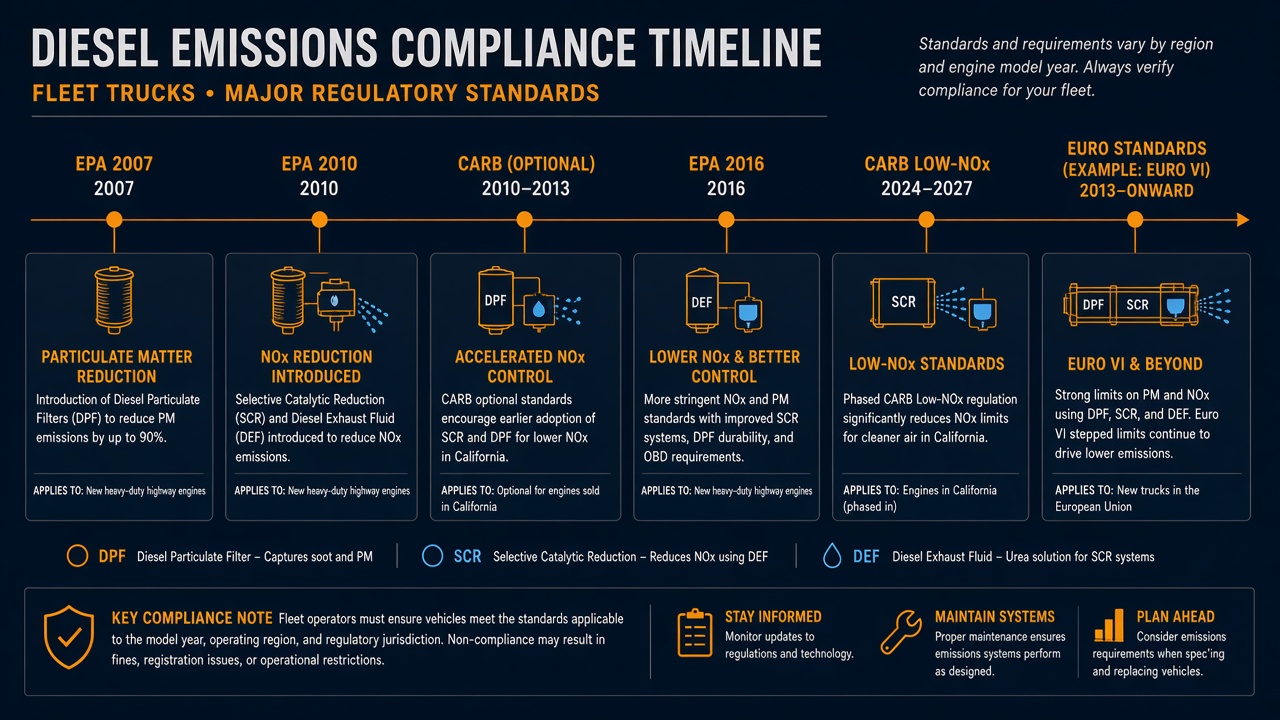
2010+ on-highway diesels must run functioning DPF and SCR systems to meet EPA limits of 0.20 g/bhp-hr NOx and 0.01 g/bhp-hr PM. Tampering—DPF delete, DEF disable, EGR block-off, or defeat tunes—violates 42 U.S.C. § 7524 with civil penalties of $4,527–$45,268 per vehicle; CARB fines reach $37,500 per day per truck. In-use NTE limits allow 0.30 g/bhp-hr NOx on the road. Documented DPF cleaning and DEF quality records cost less than any enforcement action.
Safety: Tampered trucks with deleted aftertreatment run higher EGT and soot loads, increasing fire risk during regen. Roadside inspectors can place trucks out of service for missing DPF or DEF hardware—do not operate tampered equipment on public roads.
EPA Emissions Standards Timeline
Pre-2004: The Baseline
Before federal HD emissions standards, diesel engines produced:
- NOx: 4.0+ grams per brake horsepower-hour (g/bhp-hr)
- Particulate matter (PM): 0.10+ g/bhp-hr
- Visible black smoke under acceleration was normal
EPA 2004: EGR Introduction
First federal NOx reduction mandate for heavy-duty engines:
- NOx limit: 2.0 g/bhp-hr (50% reduction)
- PM limit: 0.10 g/bhp-hr (unchanged)
- Technology: Exhaust Gas Recirculation (EGR) to lower combustion temperature
EGR reduced NOx but increased PM and engine heat load. This set the stage for the 2007 aftertreatment mandate.
EPA 2007: DPF Requirement
- NOx: 1.2 g/bhp-hr (interim)
- PM: 0.01 g/bhp-hr (90% reduction from 2004)
- Technology: Diesel Particulate Filter (DPF) required on all new HD engines
The DPF trapped soot and regenerated it through heat. This was the first aftertreatment hardware mandate.
EPA 2010: SCR and DEF
- NOx: 0.20 g/bhp-hr (90% reduction from 2004)
- PM: 0.01 g/bhp-hr (maintained)
- Technology: Selective Catalytic Reduction (SCR) with Diesel Exhaust Fluid (DEF)
Every new diesel engine sold in the US since January 1, 2010 (HD) and 2010-2013 (pickups, phased) must have a functioning DPF and SCR system. No exceptions. No grandfathering for older trucks — but trucks built before 2010 are not required to retrofit.
GHG Phase 1 (2014) and Phase 2 (2021)
Greenhouse gas emissions standards added fuel economy requirements:
- Phase 1 (2014-2018): 10-23% CO₂ reduction vs. 2010 baseline
- Phase 2 (2021-2027): Additional 5-16% CO₂ reduction
- Technology: Engine downspeeding, improved aerodynamics, automated transmissions, low-rolling-resistance tires
GHG rules do not change the aftertreatment hardware requirements — they push OEMs to improve efficiency around the existing emissions equipment.
Current Emissions Limits
Heavy-Duty Engine Standards (2010+)
| Pollutant | Limit (g/bhp-hr) | Test Cycle | Measurement |
|---|---|---|---|
| NOx | 0.20 | FTP (Federal Test Procedure) | Laboratory |
| PM | 0.01 | FTP | Laboratory |
| Non-methane HC | 0.14 | FTP | Laboratory |
| CO | 15.5 | FTP | Laboratory |
| NOx (in-use) | 0.30 | Not-to-exceed (NTE) zone | On-road |
| PM (in-use) | 0.015 | NTE zone | On-road |
The NTE (not-to-exceed) limits are what matter for in-use compliance. A truck can pass laboratory certification but fail roadside inspection if NOx exceeds 0.30 g/bhp-hr in the NTE zone during real-world operation.
Pickup and Light-Duty Diesel (Tier 3, 2014+)
| Pollutant | Limit (g/bhp-hr) | Notes |
|---|---|---|
| NOx | 0.20 | Same as HD |
| PM | 0.01 | DPF required |
| CO | 15.5 | — |
Pickup diesels (6.7L Cummins, 6.7L Power Stroke, 3.0L Duramax) use the same aftertreatment architecture as HD engines — DPF + SCR + DEF — in a smaller package.
CARB Regulations (California)
Advanced Clean Fleets (2024)
California’s Advanced Clean Fleets (ACF) regulation requires:
| Fleet Type | Requirement | Deadline |
|---|---|---|
| State and local government fleets | 50% ZEV purchases by 2024 | 2024 |
| Drayage (port trucks) | 100% ZEV by 2035 | Phased 2024-2035 |
| High-priority fleets (50+ trucks) | Report and purchase ZEV percentage | 2024+ |
| All diesel trucks | Must have 2010+ engine or equivalent | Already in effect |
If you operate in California with a pre-2010 engine, the truck cannot be registered after the current registration expires. No extension, no exemption for low mileage.
CARB Periodic Smoke Inspection Program (PSIP)
- Applies to all diesel trucks over 14,000 GVWR operating in California
- Annual opacity test: maximum 40% opacity (55% for pre-1991 engines)
- Failed test: repair and retest within 45 days
- Cost: $50-$100 per test at a CARB-certified facility
CARB Tampering Penalties
| Violation | Penalty |
|---|---|
| First offense (individual) | Up to $37,500 per device |
| Repeat offense | Up to $75,000 per device |
| Fleet operator (per truck) | Up to $37,500 per day per vehicle |
| Installer/seller of defeat devices | Up to $37,500 per device + criminal charges |
CARB actively audits repair shops. Installing, selling, or advertising delete tunes, EGR block-off plates, or DPF removal pipes in California is a criminal offense under California Health and Safety Code Section 43016.
Federal Tampering Enforcement
Clean Air Act Provisions
42 U.S.C. Section 7524 prohibits:
- Removing or rendering inoperative any emissions control device
- Manufacturing, selling, or installing defeat devices
- Operating a vehicle with tampered emissions equipment
EPA Penalty Structure (2024-2026)
| Violation Type | Civil Penalty | Criminal Penalty |
|---|---|---|
| Tampering (per vehicle) | $4,527-$45,268 | Up to $250,000 individual / $500,000 corporate |
| Sale of defeat device | $4,527 per device | Up to 2 years imprisonment |
| False certification | $45,268+ | Up to 5 years imprisonment |
| Fleet-wide tampering | $4,527 × number of vehicles | Per-vehicle criminal charges |
EPA enforcement has targeted:
- E-commerce sellers of delete tunes and hardware (eBay, Amazon listings)
- Repair shops advertising “DPF delete” services
- Fleet operators with multiple tampered vehicles
- Aftermarket parts manufacturers selling non-compliant components
How EPA Finds Violations
- State inspection program data (opacity failures trigger investigation)
- Whistleblower reports (former employees, competing shops)
- Online marketplace monitoring (delete tune sellers)
- Random roadside inspections (CMV inspections in some states)
- Warranty claim data (OEM reports unusual emissions-related failures)
What Counts as Tampering
Prohibited Modifications
| Modification | Why It Is Illegal | Detection Method |
|---|---|---|
| DPF delete (physical removal) | Removes PM control device | Visual inspection, no delta-P reading |
| DEF delete (system disable) | Disables SCR NOx reduction | Zero DEF consumption, no NOx conversion |
| EGR delete / block-off plate | Increases NOx beyond limit | No EGR flow reading, raised NOx |
| Delete tune (ECM reprogram) | Disables emissions monitoring | Aftermarket ECM calibration detected |
| Straight pipe (exhaust modification) | Removes all aftertreatment | Visual inspection |
| Fake or bypassed sensors | ECM receives false data | Sensor reading vs. physical condition mismatch |
Legal Modifications
| Modification | Status | Notes |
|---|---|---|
| OEM replacement DPF/SCR components | Legal | Must be CARB-certified or EPA-certified |
| Performance tune (emissions intact) | Legal (gray area) | Must not disable emissions monitors |
| Aftermarket exhaust (cat-back, post-DPF) | Legal | Cannot remove or bypass any emissions component |
| EGR cooler delete with EGR valve intact | Illegal | EGR flow must remain functional |
| Larger turbo (emissions intact) | Legal | Must not disable VGT or boost monitoring |
The line is simple: if the modification reduces the effectiveness of any emissions control device or disables the ECM’s ability to monitor it, it is illegal.
State Inspection Programs
States with Diesel Emissions Inspection
| State | Program | Applicable Vehicles | Frequency |
|---|---|---|---|
| California | CARB PSIP + Smog Check | GVWR >14,000 lbs | Annual |
| Colorado | Diesel Inspection Program | GVWR >14,000 lbs | Annual (Denver metro) |
| Connecticut | OBD-II emissions test | Light-duty diesel | Biennial |
| Massachusetts | OBD-II emissions test | Light-duty diesel | Annual |
| New York | Diesel emissions inspection | GVWR >8,500 lbs | Annual |
| New Jersey | OBD-II emissions test | Light-duty diesel | Biennial |
| Oregon | DEQ Diesel Program | GVWR >14,000 lbs | Annual (Portland metro) |
| Pennsylvania | Emissions inspection | Light-duty diesel | Annual |
| Texas | TCEQ programs (select counties) | Various | Varies |
States without specific diesel programs still enforce federal tampering law. A deleted truck in Texas is just as illegal as one in California — California simply has more aggressive inspection infrastructure.
Roadside Inspection (FMCSA)
During a DOT roadside inspection (Level 1-3), inspectors check:
- Visible emissions equipment present (DPF, SCR, DEF tank)
- No obvious exhaust modifications
- Check engine light not illuminated (on 2010+ engines)
- DEF tank not empty (some states)
A missing DPF or DEF tank is an out-of-service violation. The truck cannot continue until repaired.
Fleet Compliance Planning
Compliance Checklist for Fleet Managers
- Inventory all trucks — record model year, engine family, emissions equipment present
- Verify 2010+ engines — any pre-2010 truck in California must be replaced or repowered
- Audit maintenance records — DPF cleaning, DEF quality, regen completion documented
- Prohibit tampering — written policy, driver and technician acknowledgment
- Train technicians — no delete tunes, no EGR block-offs, no DPF removal
- Monitor fault codes — emissions codes addressed within 48 hours, not cleared and ignored
- Schedule annual inspections — in states with mandatory programs
- Budget for aftertreatment maintenance — DPF cleaning ($400-$800), DEF system service ($200-$500/year)
Cost of Compliance vs. Cost of Non-Compliance
| Item | Compliance Cost (Annual) | Non-Compliance Cost |
|---|---|---|
| DPF cleaning | $400-$800 | $4,527+ fine per truck |
| DEF consumption | $600-$1,200 | $4,527+ fine per truck |
| Emissions-related repairs | $500-$2,000 | $4,527+ fine + repair cost |
| Annual inspection (CA) | $50-$100 | $37,500/day (CARB) |
| Proper maintenance | $4,000-$7,000 (PM total) | Vehicle impound + repair + fine |
Non-compliance is never cheaper than maintenance. A $400 DPF cleaning prevents a $5,000 filter replacement and eliminates tampering temptation.
Documentation Requirements
Maintain these records for every truck for minimum 3 years:
- Purchase date and emissions certification label (under hood)
- All aftertreatment service records (DPF cleaning, SCR service, DEF system repairs)
- Fault code history (especially emissions-related SPNs)
- Annual inspection results (if applicable in your state)
- Driver DVIR records showing no emissions-related defects
- DEF purchase receipts (proves system is being used)
Emissions Warranty Requirements
Federal Emissions Warranty
EPA requires manufacturers to warranty emissions components:
| Component | Warranty Period | Notes |
|---|---|---|
| DPF | 5 years / 100,000 miles | Longer on some platforms |
| SCR catalyst | 5 years / 100,000 miles | — |
| DEF system | 3 years / 100,000 miles | — |
| EGR system | 5 years / 100,000 miles | — |
| ECM (emissions calibration) | 5 years / 100,000 miles | — |
| NOx sensors | 3 years / 100,000 miles | — |
Tampering voids all emissions warranty coverage. A truck with a deleted DPF that needs an engine repair will pay full price — the OEM will document the tamper and deny the claim.
OBD Monitor Readiness and Inspection Failure Modes
State OBD inspections on light-duty diesels and HD OBD programs check monitor readiness—not just whether the MIL is off. Monitors that must complete before passing inspection:
| Monitor | What It Validates | Common Incomplete Cause |
|---|---|---|
| PM filter | DPF regen completion | Short trips, aborted regens |
| SCR catalyst | DEF dosing and NOx conversion | Low DEF, frozen lines |
| EGR system | Valve flow and position | Stuck valve, cooler leak |
| NOx sensor | Inlet/outlet correlation | Failed sensor, exhaust leak |
| Misfire / fuel system | Combustion stability | Fuel quality, injector wear |
A cleared code without a completed drive cycle leaves monitors “not ready” and fails inspection. Drive cycle requirements vary by OEM—Cummins typically needs 30+ minutes highway with one successful regen; Ford 6.7L requires specific speed/load steps documented in OASIS.
For warranty claims on emissions components, OEMs require proof of maintenance: DEF purchase receipts, DPF cleaning invoices, and regen completion logs from INSITE or DiagnosticLink. Missing documentation is the most common warranty denial reason—not component failure.
Pre-Purchase Emissions Verification Checklist
Before buying a used diesel, verify compliance hardware in 15 minutes:
- DEF tank present, filled, and connected (not bypassed with a plug)
- DPF weight: real filter 80–120 lbs; hollow delete pipe 30–40 lbs
- Scan tool: no active SPN 3251, 4364, 3364, or tamper-related codes
- Live data: DEF consumption nonzero over 50 miles; DPF delta-P responds to throttle
- Visual: no straight pipes, block-off plates, or disconnected NOx sensor harnesses
Future Regulations
EPA 2027 Standards (Proposed)
- Further NOx reduction: 0.02 g/bhp-hr (90% below 2010)
- Extended useful life: emissions controls must function for 450,000-650,000 miles
- On-board emissions monitoring: real-time NOx and PM measurement
- Technology: likely combined DPF+SCR systems, possible pre-turbine SCR
CARB 2035 Zero-Emission Mandate
California requires 100% zero-emission medium and heavy-duty vehicle sales by 2035 for applicable classes. Internal combustion engines will not be sold new in California after that date. Existing diesel trucks can continue operating but face increasing registration restrictions.
Impact on Current Fleets
- 2010-2026 diesel trucks: continue operating with proper maintenance
- No federal retrofit mandate for existing trucks (as of 2026)
- California may require earlier retirement of pre-2010 engines
- Plan replacement cycles around 2030-2035 for California-operated fleets
Frequently Asked Questions
Is it legal to delete emissions on a truck I only use off-road?
No. Federal law prohibits tampering regardless of use case. “Off-road only” and “farm use” exemptions do not exist for on-highway trucks. Agricultural exemptions apply to tractors and implements — not pickup trucks or Class 8 tractors.
Can I pass inspection with a check engine light on?
No. An illuminated MIL (malfunction indicator lamp) is an automatic inspection failure in every state with an emissions program. Repair the underlying fault, complete a drive cycle, and verify the light is off before inspection.
What happens if I buy a truck that was previously deleted?
You inherit the liability. If EPA or CARB inspects the truck, you face penalties as the current operator. Before purchasing any used diesel, verify: DEF tank present and connected, DPF present (weigh it — a hollow shell weighs 30-40 lbs vs. 80-120 lbs for a real filter), no check engine light, and scan for emissions fault codes.
Are emissions deletes common in the used truck market?
More common than dealers admit. Industry estimates suggest 5-15% of used diesel pickups have some form of emissions tampering. Always scan before purchase. A $150 pre-purchase inspection saves a $4,527+ fine.
Do I need to pass emissions inspection in a state without a program?
Federal tampering law applies nationwide. While you may not have an annual inspection requirement, operating a tampered vehicle is still a federal violation. EPA can enforce in any state.
What is the penalty for a shop that installs delete equipment?
$4,527 per device installed (EPA civil), up to $250,000 criminal fine and 2 years imprisonment for willful violations. CARB penalties reach $37,500 per device in California. EPA has prosecuted shops in Texas, Montana, Idaho, and other non-CARB states.
How do I report emissions tampering?
EPA tip line: epa.gov/tips. CARB complaint line: 1-800-END-SMOG. Reports can be anonymous. EPA investigates tips and has pursued cases based on single reports.
Will my warranty cover DPF or SCR failure?
If the truck is within the emissions warranty period (typically 5 years/100,000 miles) and has not been tampered with, yes. Document the fault codes, complete all required maintenance (DEF quality, regen history), and file through the dealer. Aftermarket delete tunes void the warranty permanently.
Sources
- 40 CFR Part 86 and Part 1036 — EPA HD engine emissions standards and test procedures
- 42 U.S.C. § 7524 — Clean Air Act tampering prohibitions and penalties
- California CARB Advanced Clean Fleets Regulation (2024) — ZEV purchase requirements
- California Health and Safety Code Section 43016 — defeat device criminal provisions
- EPA National Compliance Initiative — tampering enforcement actions and penalty adjustments
- FMCSA roadside inspection criteria — visible aftertreatment and MIL requirements
Related Reading
- DPF System Explained — how DPF regen and ash loading affect compliance
- SCR and DEF Systems Guide — DEF quality and NOx sensor requirements
- Fleet Maintenance Program Template — compliance documentation and PM records
- State Diesel Emissions Testing Requirements — state-by-state inspection programs
- DPF Delete Laws 2026 — federal enforcement trends and penalties
- How to Comply with CARB Regulations — California fleet operator checklist