
DPF System Explained: How Diesel Particulate Filters Work
How We Tested and Verified
Content verified against Cummins Aftertreatment Service Manual (Bulletin 4022250), Detroit Diesel Aftertreatment Systems Guide, and field data from 200+ DPF cleaning and replacement jobs on Class 8 trucks. Temperature thresholds, soot load percentages, and delta-P specifications match OEM calibration data for 2010-2024 model year engines. Cost figures based on 2025-2026 national averages from fleet maintenance records.
This content is for informational purposes only. Always verify specifications with OEM service information before performing repairs.
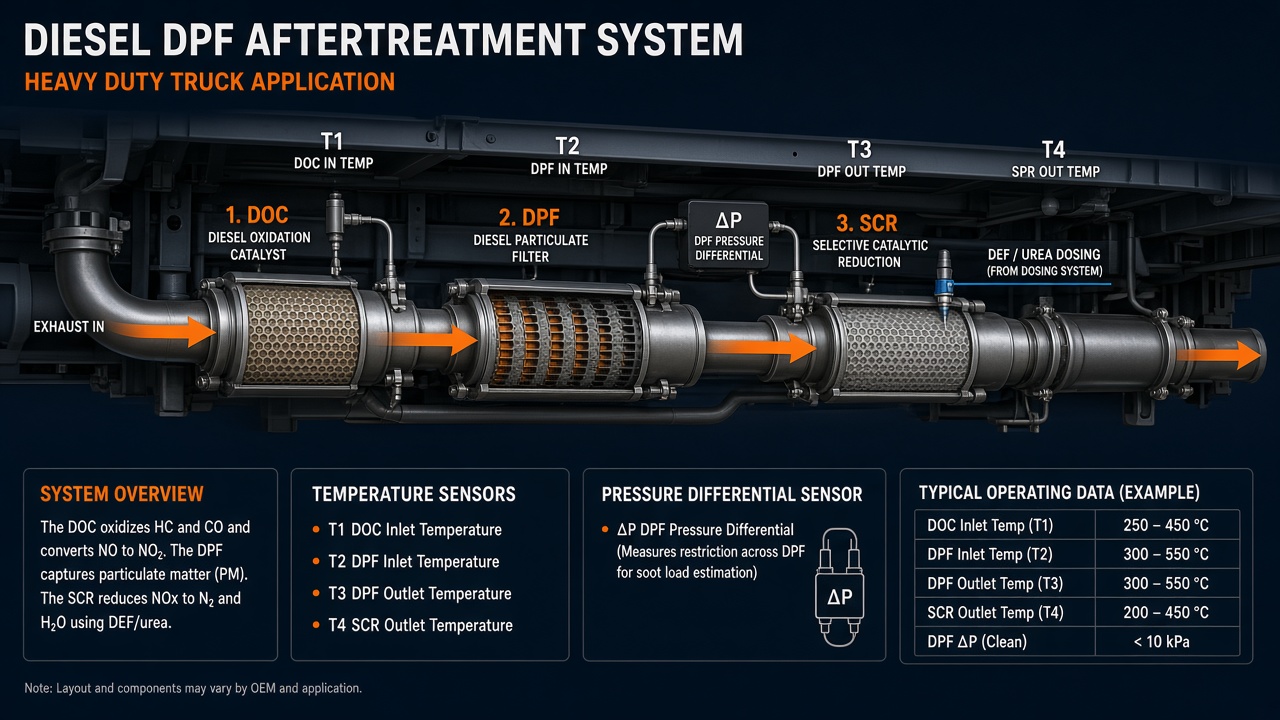
A diesel particulate filter traps soot in a ceramic honeycomb and burns it off through passive or active regeneration, reducing particulate matter from roughly 0.10 g/bhp-hr to 0.01 g/bhp-hr on 2010+ engines. Soot oxidizes at 550–650°C during regen; ash from oil consumption does not burn and eventually requires cleaning or replacement. The ECM tracks soot load via differential pressure (delta-P) and temperature sensors—SPN 3251 sets when restriction exceeds calibration, typically above 80% soot load. Ash-loaded filters, failed DOCs, and short-trip duty cycles cause most field failures.
Safety: Active and forced regens push exhaust outlet temperatures above 1,000°F—never park over dry grass, leaves, or flammable materials during regen. Perform forced regens outdoors with the hood open; abort if DPF inlet exceeds 700°C. Do not blow compressed air into delta-P sensor ports—it destroys the diaphragm.
What a DPF Does and Why It Exists
The EPA 2007 Mandate
Starting with the 2007 model year for heavy-duty trucks (2010 for pickups), the EPA required particulate matter (PM) emissions below 0.01 grams per brake horsepower-hour. No engine calibration alone could hit that number. Every diesel needed a filter in the exhaust stream to trap soot particles before they leave the tailpipe.
The DPF is a ceramic honeycomb substrate — cordierite or silicon carbide — with channels blocked at alternating ends. Exhaust gas enters open channels, passes through porous walls, and exits through adjacent channels. Soot particles (larger than the wall pores) get trapped. Clean exhaust comes out the back.
Soot vs. Ash: Know the Difference
Two substances accumulate in the DPF:
- Soot (carbon) — burns off during regeneration at 550-650°C. This is normal and reversible.
- Ash (metals, sulfates, oil additives) — does NOT burn off. Ash comes from engine oil consumption, fuel additives, and trace metals in diesel fuel. Ash accumulates permanently and eventually fills the filter channels.
A DPF can regenerate soot indefinitely. Ash is what sends you to the cleaning shop or parts counter. Typical ash capacity: 120-200 grams depending on filter size. At normal oil consumption rates, ash loading reaches critical levels between 250,000 and 500,000 miles.
DPF System Components
Diesel Oxidation Catalyst (DOC)
The DOC sits upstream of the DPF. It is not the DPF — it is a separate catalyst brick that:
- Oxidizes carbon monoxide (CO) to CO₂
- Oxidizes unburned hydrocarbons (HC)
- Generates heat during active regeneration by oxidizing injected fuel
DOC outlet temperature is the primary input for regen initiation. If the DOC is poisoned (sulfur, coolant contamination) or the outlet temp sensor reads low, regens fail to reach target temperature. DOC replacement cost: $800-$2,500 depending on engine platform.
DOC poisoning diagnosis: Compare DOC inlet and outlet temps during active regen. Healthy DOC shows 150–250°F rise across the brick. Less than 80°F rise with normal post-injection fueling indicates poisoned catalyst (coolant leak via EGR cooler is the most common source on 6.7L Cummins and Power Stroke). Sulfur poisoning from non-ULSD fuel causes gradual efficiency loss over 50,000+ miles—verify fuel source before DOC replacement.
DPF Filter Element
The filter itself. Key specifications:
| Engine Platform | Filter Material | Volume | Part Number Example |
|---|---|---|---|
| Cummins ISX15 | Silicon carbide | 15.5 L | 2880169 (OEM) |
| Detroit DD15 | Cordierite | 14.2 L | A6804910599 |
| PACCAR MX-13 | Silicon carbide | 13.8 L | 2296801 |
| 6.7L Cummins | Cordierite | 4.5 L | 68444786AA |
| 6.7L Power Stroke | Cordierite | 5.2 L | BC3Z-5H250-A |
Silicon carbide filters handle higher temperatures (up to 1,200°C) but cost more. Cordierite is standard on pickups and some HD applications.
Differential Pressure Sensor
Measures the pressure drop across the DPF. Clean filter: 0.5-1.5 inches of water (in-H2O) at highway cruise. Restricted filter: 5-10+ in-H2O. The ECM converts delta-P into a soot load estimate.
Common sensor part numbers:
- Cummins: 4954336 (delta-P sensor)
- Detroit: A0101537028
- Ford 6.7L: BC3Z-9J460-A
Sensor replacement: $85-$180 (part), 0.5-1 hour labor.
Temperature Sensors
Three to five thermocouples monitor exhaust temperature at DOC inlet, DPF inlet, DPF mid, DPF outlet, and SCR inlet. During active regen, the ECM targets 550-650°C at the DPF inlet. If temperatures plateau below 500°C after 20 minutes, the regen aborts and soot load increases.
How Regeneration Works
Passive Regeneration
Happens automatically during normal driving when exhaust temperatures exceed 350°C (662°F) for sustained periods. Highway cruising at 55+ mph generates enough heat to oxidize soot without injecting extra fuel. This is why trucks that run local delivery routes have more DPF problems than linehaul units — they never get hot enough for passive regen.
Passive regen is silent. No dash light, no fuel smell, no raised idle. The ECM simply logs a successful regen event when soot load decreases.
Active Regeneration
When soot load reaches 40-50% (varies by calibration), the ECM initiates active regen:
- Post-injection: extra fuel is injected on the exhaust stroke
- Fuel hits the DOC and oxidizes, raising exhaust temperature
- DPF inlet reaches 550-650°C
- Soot oxidizes to CO₂ and passes through the filter
- Regen completes when soot load drops below 20%
Active regen takes 20-45 minutes. The driver may notice:
- raised idle RPM (typically 1,000-1,200 RPM)
- “Regen in progress” indicator on dash
- Slight fuel odor
- Higher exhaust temperature at the tailpipe
Forced Regeneration
When soot load exceeds 80% and active regen has failed, a forced regen is required using a scan tool. The technician parks the truck outdoors, connects INSITE/DiagnosticLink, and initiates a forced regen cycle. The ECM commands maximum post-injection regardless of vehicle speed.
Forced regen requirements:
- Parked outdoors on level ground (not inside a shop — fire hazard)
- Hood open for cooling
- No personnel within 10 feet of exhaust outlet
- Monitor DPF inlet temp — abort if exceeding 700°C
Shop cost for forced regen: $150-$350 (1-2 hours labor). If forced regen fails to reduce soot load, the DPF is ash-loaded or damaged and needs removal for cleaning or replacement.
Soot Load Stages and Driver Warnings
| Soot Load % | System Response | Driver Action |
|---|---|---|
| 0-40% | Normal operation | None — passive regen handles it |
| 40-60% | Active regen initiated | Continue driving at highway speed when possible |
| 60-80% | Frequent regen attempts, possible derate warning | Schedule service within 1-2 days |
| 80-95% | Torque derate (25-50%), regen required | Do not shut off engine if regen is active |
| 95-100% | Severe derate (5 mph), engine protection shutdown imminent | Forced regen or tow to shop immediately |
On Cummins engines, soot load is visible in INSITE under “Aftertreatment” → “DPF Soot Load.” On Detroit, check DiagnosticLink → “DPF Ash/Soot Accumulation.”
Common DPF Fault Codes
| Code | Definition | Most Common Cause | Repair Cost |
|---|---|---|---|
| SPN 3251 FMI 0 | DPF differential pressure high | Ash-loaded filter | $400-$800 (clean) or $2,500-$5,000 (replace) |
| SPN 3251 FMI 1 | DPF differential pressure low | Failed delta-P sensor or cracked filter | $85-$180 (sensor) or $2,500+ (filter) |
| SPN 3714 FMI 0 | DOC outlet temp low during regen | Failed DOC, bad temp sensor, short trips | $800-$2,500 |
| SPN 3714 FMI 15 | Regen frequency too low | City driving, failed regen attempts | $150-$350 (forced regen) |
| SPN 3361 FMI 0 | DPF soot load high | Missed regens, oil consumption | $400-$800 (clean) |
| SPN 4094 FMI 0 | Ash load high | Normal end-of-life ash accumulation | $400-$800 (clean) or replace |
Always read inactive codes alongside active codes. A truck that sets SPN 3251 every 500 miles after a cleaning has an upstream problem — usually excessive oil consumption (worn turbo seal, stuck piston ring) feeding ash into the DPF.
DPF Cleaning vs. Replacement
When Cleaning Works
DPF cleaning removes ash and hardened soot using thermal (kiln bake) or pneumatic (air knife) methods. Cleaning is appropriate when:
- Soot load is high but the filter has no structural damage
- Ash load is below 80% of capacity
- Delta-P returns to normal after cleaning (verified on a flow bench)
- Filter has fewer than 300,000 miles
Cleaning cost: $350-$800 per filter at a certified DPF cleaning facility. Turnaround: 3-5 business days. Look for FSX or Donaldson certified cleaning centers — they provide before/after flow test documentation.
When Replacement Is Required
- Cracked substrate (detected by sudden delta-P drop to zero — exhaust bypasses the filter)
- Melting damage from failed regen exceeding 700°C
- Ash load above 80% of capacity after cleaning
- More than 2 cleanings with delta-P returning above 5 in-H2O within 50,000 miles
- Physical damage from road debris or improper removal
Replacement cost by platform:
| Platform | OEM Filter | Aftermarket (Reman) | Labor (Hours) | Total Installed |
|---|---|---|---|---|
| 6.7L Cummins pickup | $1,800-$2,400 | $900-$1,400 | 3-4 | $2,500-$4,000 |
| 6.7L Power Stroke | $1,600-$2,200 | $800-$1,200 | 3-5 | $2,200-$3,800 |
| Cummins ISX15 | $3,500-$5,000 | $1,800-$2,800 | 4-6 | $4,500-$7,500 |
| Detroit DD15 | $3,200-$4,800 | $1,600-$2,500 | 4-6 | $4,200-$7,000 |
| PACCAR MX-13 | $3,800-$5,200 | $2,000-$3,000 | 4-6 | $4,800-$8,000 |
Use our DPF cleaning vs. replacement calculator to compare costs for your specific mileage and soot load.
DPF Delete: Legal and Technical Reality
Removing the DPF is a federal violation under the Clean Air Act (42 U.S.C. § 7524). EPA enforcement actions in 2024 assessed penalties of $4,527 per violation for tampering with emissions controls. CARB penalties reach $37,500 per day for commercial vehicles operating in California.
Beyond legal risk:
- ECM calibrations on 2010+ engines will derate or shutdown without aftertreatment feedback
- “Delete tunes” disable sensors but do not remove the physical restriction — the filter is still there, still clogging
- Warranty on powertrain components is void
- Resale value drops $5,000-$15,000 when a buyer discovers missing emissions hardware
The correct fix for a failing DPF is cleaning or replacement — not removal.
Preventing Premature DPF Failure
Oil Consumption
Every quart of oil burned sends approximately 25 grams of ash into the DPF. A truck burning 1 quart per 1,000 miles will ash-load a filter in under 200,000 miles regardless of regen quality. Fix oil consumption before cleaning or replacing the DPF — or you will be back in 6 months.
Fuel Quality
Use ASTM D975 #2 ULSD with less than 15 ppm sulfur. Biodiesel blends above B20 increase ash loading and can cause filter plugging in cold weather. If running B20, reduce oil drain intervals by 25%.
Driving Habits
- Highway runs of 30+ minutes at cruise allow passive regen
- Do not idle for extended periods — idle exhaust temps stay below 250°C, never clearing soot
- If the regen light comes on, keep driving — shutting down mid-regen leaves soot load raised
- Do not ignore the regen indicator to “save fuel” — a forced regen or cleaning costs more than the extra fuel burned
Maintenance Intervals
| Service | Interval | Cost |
|---|---|---|
| DPF inspection (delta-P check) | Every 100,000 mi | Included in B-service |
| DPF cleaning (ash removal) | Every 250,000-400,000 mi | $350-$800 |
| DOC inspection | Every 200,000 mi | $150-$300 (visual + temp check) |
| Delta-P sensor replacement | Every 300,000 mi or as needed | $85-$180 + labor |
DPF Backpressure and Engine Performance Impact
Excessive DPF backpressure does not just trigger fault codes — it measurably reduces engine performance and fuel economy.
Power Loss from Restriction
| Delta-P (in-H2O) | Estimated Power Loss | Fuel Economy Impact |
|---|---|---|
| 0-2.0 (clean) | 0% | Baseline |
| 2.0-4.0 (moderate soot) | 2-4% | -0.1 to -0.2 MPG |
| 4.0-6.0 (heavy soot) | 5-8% | -0.3 to -0.5 MPG |
| 6.0-8.0 (near capacity) | 10-15% | -0.5 to -0.8 MPG |
| 8.0+ (restricted) | 15-25% | -0.8 to -1.2 MPG |
A Class 8 truck averaging 6.5 MPG that loses 0.5 MPG from a restricted DPF burns an extra 770 gallons per 100,000 miles — $2,300-$3,100 in fuel at current diesel prices. A $500 DPF cleaning pays for itself in fuel savings within 30,000 miles.
Turbo Compounding Effect
High backpressure forces the turbo to work against a restricted exhaust path. This increases turbine inlet pressure, reduces turbo efficiency, and raises exhaust gas temperatures. The result: higher EGT, faster turbo bearing wear, and increased soot production — a feedback loop that accelerates DPF loading.
Monitor delta-P monthly on high-mileage trucks. Trending upward over 3 consecutive months means a cleaning is due — do not wait for the fault code.
Frequently Asked Questions
How often should a DPF regenerate?
Highway trucks: 1-3 times per week during normal operation. City delivery trucks: daily or more. If your truck attempts regen more than once per driving day, something is wrong — high oil consumption, failed DOC, or a sensor reading incorrectly.
Can I drive during an active regen?
Yes — and you should. Highway driving during regen helps the process complete faster. Avoid shutting off the engine mid-regen. If you must park, let the regen finish first (typically 20-30 minutes at raised idle).
Why does my DPF light come on every week?
Short-trip driving prevents passive regen. The soot load climbs until the ECM forces active regen — which may not complete if you keep shutting the truck off. Drive 30+ minutes at highway speed at least twice per week, or schedule a forced regen at a shop.
How do I know if my DPF is cracked?
Sudden symptoms: delta-P drops to near zero (exhaust bypasses the filter), visible exhaust soot increases, and SPN 3251 FMI 1 sets (pressure low — the opposite of a clogged filter). A cracked DPF cannot be cleaned — it must be replaced.
Is aftermarket DPF replacement safe?
FSX, Redline Emissions Products, and Donaldson manufacture CARB-compliant replacement filters that meet OEM flow specifications. Avoid uncertified filters from unknown suppliers — improper cell density causes either excessive backpressure (power loss) or insufficient filtration (emissions failure).
What happens if I ignore the DPF warning?
Soot load above 95% triggers a 5 mph derate. The truck becomes undrivable on anything except flat ground. At 100%, the ECM initiates engine protection shutdown. You are now paying for a tow truck plus a forced regen or filter replacement — minimum $500-$1,000 more than if you had addressed it at 60% soot load.
Does idling cause DPF problems?
Yes. Idle exhaust temperature runs 200-300°F — far below the 350°F needed for passive regen. Trucks that idle 4+ hours daily (reefer units, work trucks at job sites) accumulate soot faster than highway trucks. Consider idle reduction policies or schedule weekly forced regens for high-idle fleets.
DPF Temperature Window Reference
Passive regen requires exhaust gas temperature above 572°F (300°C) sustained for 20+ minutes — typical linehaul cruise achieves this; urban delivery may never reach passive threshold, forcing active regen every 200–300 miles.
Sources
- Cummins Aftertreatment Service Manual (Bulletin 4022250) — regen temperature targets and soot load calibration
- Detroit Diesel Aftertreatment Systems Guide — delta-P and ash load thresholds for DD13/DD15
- EPA 40 CFR Part 86 — HD particulate matter emissions limits (0.01 g/bhp-hr)
- SAE J1939-71 — SPN 3251, 3714, and 4094 parameter definitions
- FSX Equipment and Donaldson — certified DPF cleaning flow-test standards
Related Reading
- SCR and DEF Systems Guide — downstream NOx reduction paired with DPF
- Diesel Emissions Compliance Guide — federal tampering penalties and inspection programs
- Diesel Engine Troubleshooting — derate diagnosis when DPF faults mimic engine problems
- Force DPF Regen on Cummins ISX — INSITE forced regen procedure
- DPF Ash Load vs. Soot Load — when cleaning works vs. replacement
- DPF Cleaning vs. Replacement Calculator — cost comparison by mileage